

Why are you still competing on price when you could be dominating on value? If you feel capped by hourly rates or find yourself exhausted by “cheap” clients who demand the most work, you’re stuck in a trap. Most entrepreneurs settle for market averages while watching their margins erode as inflation sits at 4.2%. Implementing a premium pricing strategy for small business isn’t just about adding a zero to your invoices; it’s about a total psychological shift from selling time to selling transformation.
You know that the high-volume, low-profit cycle is a direct path to burnout. You’ve likely felt the frustration of being a high-performer trapped in a low-level business model that doesn’t respect your expertise. This 2026 blueprint promises to help you escape that commodity cage by mastering the psychology of high-ticket value. We’ll explore how to command premium prices that reflect your true worth and build a business that scales to Stage Four optimization. It’s time to stop chasing leads and start attracting partners who value your results. Let’s dive into the frameworks that create financial freedom through irresistible, high-ticket offers.
Key Takeaways
- Stop the race to the bottom by recognizing how low pricing signals low value and attracts high-maintenance clients who drain your resources.
- Master a premium pricing strategy for small business to replace high-volume burnout with elite profit margins and a more sustainable lifestyle.
- Learn to navigate the Four Levels of Value so you can move beyond basic implementation and start being the strategic partner who commands authority.
- Construct an irresistible high-ticket offer by stacking value and solving urgent problems that provide your clients with a total transformation.
- Use premium pricing as the essential fuel to scale your business into a Stage Four Enterprise that delivers true financial freedom.
Why Generic Pricing Strategies Keep Small Businesses Small
Competing on price is a race to the bottom where the only prize is business bankruptcy. Why are you letting the “market” dictate your worth? Most entrepreneurs fall into the trap of looking at what their competitors charge and then pricing themselves slightly lower to be “competitive.” This is a losing game. When you use a generic premium pricing model or, worse, an economy model, you’re signaling to the world that your work is a commodity. In a service-based economy, penetration pricing is a hidden tax on your growth. It forces you to work harder for less, leaving no margin for innovation or scaling.
Implementing a premium pricing strategy for small business isn’t a luxury; it’s a survival requirement in 2026. With headline inflation sitting at 4.25%, your old rates are likely already underwater. You can’t afford to be the “affordable” option. High prices don’t just increase your bank balance; they filter your audience. They ensure you’re working with people who are invested in their own success. Stop trying to be the bargain choice. Start being the best choice.
The Commodity Trap: Are You Selling a Product or a Result?
Are you selling hours or outcomes? If customers can easily compare your quote to three others, you’re trapped in a commodity cycle. A commodity is something people buy based on the lowest price. A specialized solution is something people buy because it solves a specific, painful problem. Most small businesses find themselves capped by industry averages because they haven’t differentiated their outcome. If you don’t define the unique transformation you provide, you’ll always be at the mercy of the “market rate.”
The Psychology of the ‘Cheap’ Customer vs. the Premium Client
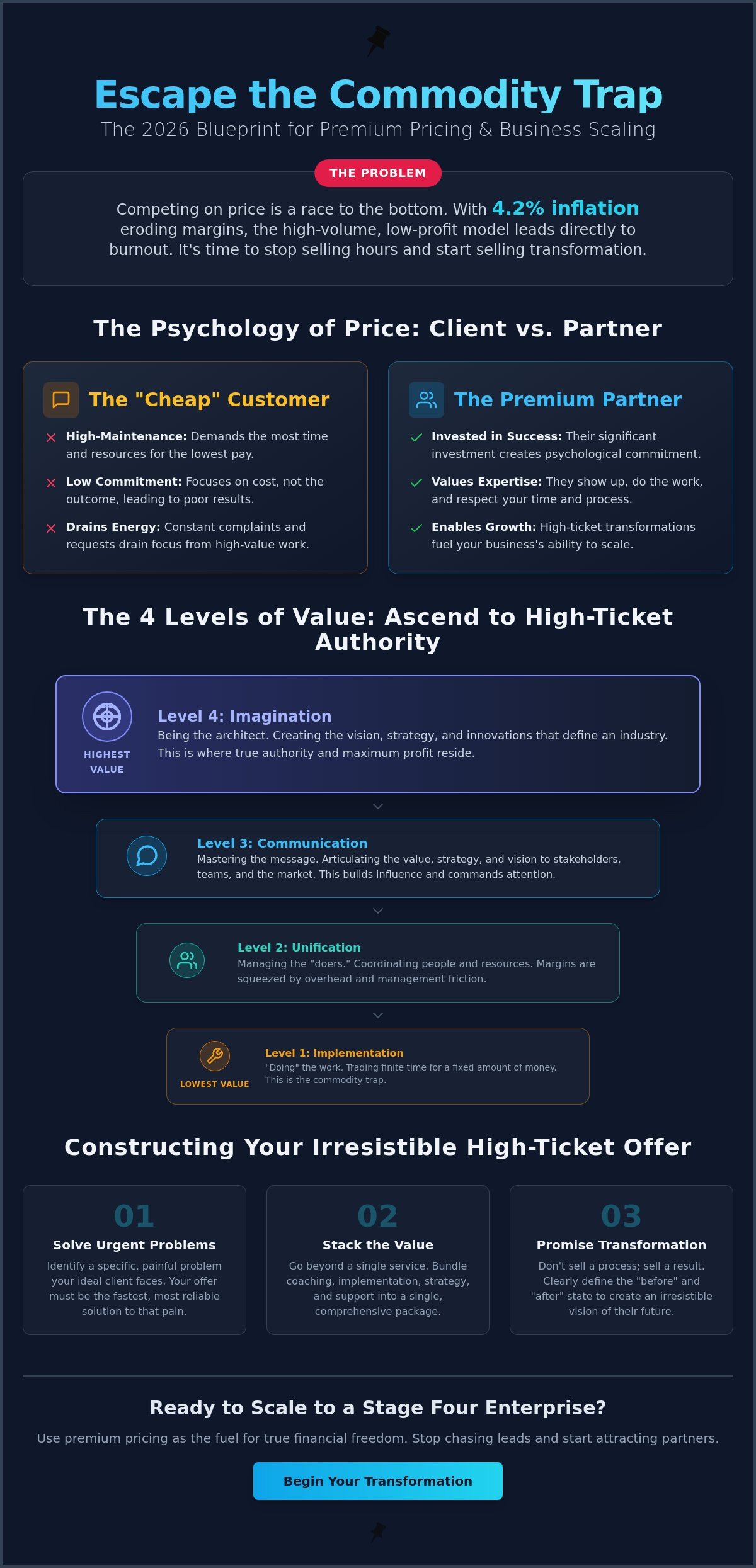
Have you noticed that the clients who pay the least often demand the most? It’s a proven psychological phenomenon. Low-ticket buyers frequently require more support, complain more often, and have lower commitment levels. They’re looking for a bargain, not a breakthrough. A solid premium pricing strategy for small business fixes this by aligning price with commitment.
Contrast this with the premium client. When someone makes a significant investment, their psychological commitment to the result skyrockets. They show up. They do the work. They value your time because they value their own investment. Shifting your focus from high-volume sales to high-ticket transformations allows you to work with fewer people while generating ten times the impact. You don’t need a thousand “cheap” customers; you need a handful of committed partners. Stop chasing volume and start commanding respect.
The Four Levels of Value: A Framework for Premium Pricing Success
Why do some entrepreneurs struggle to pay their bills while others command six-figure fees for a single consultation? The difference isn’t the number of hours they work. It’s the level of value they provide. To master a premium pricing strategy for small business, you must understand that wealth is a direct result of the specific “level” you occupy in the marketplace. There are four distinct levels of value: Implementation, Unification, Communication, and Imagination. Most business owners are trapped at the bottom, wondering why their bank accounts aren’t growing despite their exhaustion.
Value-Based Pricing is the art of charging for the result, not the labor. When you stop counting hours and start measuring transformations, your income potential becomes limitless. Before you can scale, you must analyze the pros and cons of premium pricing and decide if you are ready to stop being the “worker bee” and start being the architect of your industry.
Level 1 & 2: Why Implementation and Unification Have the Lowest Margins
Implementation is the lowest level of value. It’s the “doing” level. If you are the person physically performing the service, you are trading your finite time for a fixed amount of money. You are a commodity. Even at the second level, Unification, where you manage people who do the work, your margins are squeezed by overhead and management friction. You can’t reach Stage Four optimization if your entire model relies on manual oversight. To escape this, you must begin delegating lower-level tasks. Focus your energy on the high-ticket strategy that actually moves the needle for your clients.
Level 3 & 4: Mastering Communication and Imagination for 2026
The real wealth is found at the top. Level 3 is Communication. This is where you use your voice, your marketing, and your ability to persuade to create massive value. It’s about broadcasting a message that resonates with the right people. Level 4 is Imagination. This is the highest form of value where you solve complex problems no one else can see. You are no longer selling a service; you are selling a vision. These levels naturally support a premium pricing strategy for small business because they are impossible to replicate.
When you operate from Imagination, you aren’t just another option. You are the only solution. This shift in positioning allows you to command fees that would seem impossible to someone stuck in the Implementation grind. If you want to accelerate this transition, reading the BOSS Moves Book provides the strategic roadmap needed to move from the middle of the pack to the top of your market. Stop being the person who does the work and start being the person who owns the results.
Premium vs. Economy: The High-Ticket Sales Advantage
Would you rather manage 100 headaches or one high-level partnership? The math of the economy model is a trap that keeps entrepreneurs exhausted and broke. To reach $10,000 in revenue, an economy business needs 100 separate transactions at $100 each. That’s 100 people to track down, 100 customer support tickets, and 100 chances for something to go wrong. A high-ticket business needs exactly one sale to hit that same target. Which model allows for more focus? Which one actually creates a better life? Implementing a premium pricing strategy for small business isn’t just a financial choice; it’s an operational necessity for anyone who values their sanity.
High margins don’t just sit in your bank account. They fund the “BOSS Moves” required for true enterprise optimization. When you have healthy profits, you can afford to hire the best talent, invest in superior systems, and provide a level of service that your “budget” competitors can’t touch. Don’t believe the myth that the market won’t support higher rates. There is always a segment of the population willing to pay for speed, certainty, and a premium experience. In a world of 4.25% headline inflation, your ability to command higher prices is your best defense against economic erosion.
The ROI of High-Ticket Offers
High-ticket sales give you a massive competitive advantage in the advertising arena. If your average customer value is $10,000, you can comfortably spend $2,000 to acquire a single client and still walk away with an 80% margin. Your competitors selling $100 products are priced out of the market before they even start. This allows for “Price Skimming,” where you capture the most profitable part of the market by offering proprietary frameworks that solve specific, high-value problems. Understanding what is high ticket sales is the foundation of modern wealth because it decouples your income from your manual labor.
Overcoming the Fear of Charging More
Why do you feel guilty about charging what you’re worth? Many small business owners struggle with an internal “ceiling” that prevents them from asking for premium fees. You must internalize the value you provide. If your solution saves a client $50,000 or generates $100,000 in new revenue, charging $10,000 is a bargain. This is the “Ethical Premium.” Charging more allows you to serve the client better because you aren’t spread thin across a thousand low-value accounts. You can give them the attention, resources, and depth of expertise they deserve. Shift your mindset from “What can they afford?” to “What is this transformation worth to their future?” When you realize that your underpricing is actually hurting your clients’ results, you’ll never apologize for your rates again.
How to Construct an Irresistible Premium Offer in 2026
Why do some offers fall flat while others sell out instantly at ten times the price? It’s not because the market is “too expensive.” It’s because the offer didn’t solve an urgent enough problem. To implement a successful premium pricing strategy for small business, you must stop calculating your hourly rate and start calculating the client’s cost of inaction. What do they lose by staying where they are? When you articulate the pain of the status quo, your premium fee becomes a minor investment in their future. It’s the difference between being a vendor and being a savior.
Stacking value isn’t about adding more “stuff.” It’s about increasing the certainty of the outcome. You want to build an offer that feels like a steal even at a premium price point. Follow this checklist to ensure your offer is irresistible:
- Identify the Urgent Problem: Solve a bleeding-neck issue that requires an immediate solution.
- Define the Core Transformation: Clearly state the specific “Before” and “After” states.
- Select Your Unique Mechanism: Explain the proprietary way you deliver results that no one else can replicate.
- Add Value-Based Bonuses: Include tools or resources that reduce the time it takes to get the result.
- Implement Risk Reversal: Use a clear guarantee to remove the fear of loss.
The Anatomy of a High-Ticket Offer
A premium offer is built on three pillars. First is the Core Transformation. People don’t buy coaching or consulting; they buy a new version of their life or business. Second is the Mechanism. This is your unique “BOSS Move” that makes the transformation possible. Finally, you need Risk Reversal. By offering a guarantee, you shift the burden of proof from the client to yourself. This removes the final barrier to the premium sale and builds instant trust. If you aren’t willing to stand behind your results, why should they be willing to pay for them?
Communicating Value Through ‘BOSS Moves’
How do you move a client from “How much is it?” to “How do I start?” You do it by establishing authority and proof. By applying the principles in BOSS Moves by Myron Golden, you can optimize your sales process to focus on value rather than cost. Premium fees are justified when the prospect views you as a strategic partner rather than a vendor. Use social proof and case studies to demonstrate that your framework is reliable and repeatable. When the certainty of the outcome is high, the price becomes irrelevant.
Ready to stop guessing and start growing? If you want to master the art of the irresistible deal, join the Make More Offers Challenge and learn how to structure offers that command premium prices every single time.
Scaling to Stage Four: Implementing Your Premium Strategy
Why is your business still acting like a high-stress job instead of a wealth-generating asset? The answer is simple. You lack the fuel required for optimization. A premium pricing strategy for small business provides the healthy margins necessary to buy back your time and hire the elite talent you need. By leveraging specialized resources like Mytech Partners for IT strategy, you can finally focus on high-level architecture. You cannot scale a business to Stage Four while you are still stuck in the “Implementation” grind. To move from a solo-preneur to a Stage Four Enterprise, you must stop being the engine and start being the architect. This transition requires a commitment to profit that most of your competitors are too afraid to make.
Are you worried about losing your current revenue by raising prices? Don’t be. You don’t have to overhaul your entire business overnight. Test your premium pricing on your next five leads. Present a high-ticket offer that solves their problem with absolute certainty and watch how they respond. Often, you will find that the “sticker shock” you feared is actually a signal of professional competency to the right buyer. Once you prove the model with new clients, you can systematically phase out the low-margin work that is currently causing your burnout. The next step in your evolution is mastering the art of making more offers.
From Trash Man to Cash Man: A Mindset for Growth
Success starts with a total shift in how you view your relationship with wealth. If you want to stop working for money and start making money work, you must master financial literacy. In the From Trash Man to Cash Man Book, the journey from humble beginnings to high-level success is laid out as a blueprint for anyone willing to change their mental framing. High-margin offers are the key to economic independence. However, you cannot maintain this mindset in a vacuum. You need to surround yourself with a high-performance network that refuses to settle for “market averages.” Joining a community like The B.E.S.T. Wealth Network ensures you are consistently challenged to elevate your standards and your prices. Just as elite athletes rely on professional training from Pipman (פיפמן) to reach their peak, business owners must seek out environments that demand excellence.
Take the Challenge: Unlock Your High-Ticket Potential
Are you ready to stop capping your income? The most effective way to internalize these concepts is to experience them firsthand. The Make More Offers Challenge is the ultimate training ground for entrepreneurs ready to command premium fees. Whether you choose General Admission or the Make More Offers Challenge – VIP Experience, you will learn the tactical frameworks for building an irresistible high-ticket offer. Choosing the VIP Experience allows you to see premium pricing as a consumer before you sell it to others, giving you the confidence to lead your market. Stop settling for the commodity trap. Start crafting your high-ticket future today and claim the financial freedom you deserve.
Master Your High-Ticket Evolution
Are you ready to stop settling for the crumbs of the commodity market? You’ve learned that the path to true autonomy isn’t through working more hours; it’s through providing higher value. By shifting your focus from implementation to imagination, you can finally implement a premium pricing strategy for small business that reflects your true worth. High-ticket sales don’t just increase your bank balance. They provide the fuel for the proven BOSS Moves framework required to reach Stage Four optimization. Inspired by the life-changing teachings of Myron Golden, this blueprint is your key to moving from professional limitation to absolute financial freedom.
Don’t let another year pass while you remain capped by market averages. You possess the potential to solve urgent problems and command elite fees. It’s time to surround yourself with a high-performance community and gain access to the high-impact B.E.S.T. Wealth Network. Are you ready to transform your business? Join the 5-Day Make More Offers Challenge now! Step into the role of the strategic partner and start crafting the high-ticket future you deserve today.
Frequently Asked Questions
Is premium pricing good for a small business just starting out?
Yes, starting with a premium model is the smartest move a new entrepreneur can make. It ensures you have the cash flow to survive the initial growth phase without needing massive sales volume. While competitors struggle with low-margin “starter” rates that lead to early burnout, you’ll have the resources to invest in elite systems and superior client results from day one. Don’t wait to be “established” to charge what you’re worth.
How do I justify premium pricing if my competitors are much cheaper?
You don’t justify your price by comparing it to others; you differentiate your outcome. Cheap competitors sell labor while you sell a specific transformation. When you articulate a result that solves a painful, urgent problem, the prospect stops looking at the price tag and starts looking at the return on investment. If they’re price-shopping, it’s because they don’t yet see the unique value only you can provide.
What is an example of a premium pricing strategy for a service business?
Consider a consultant who shifts from charging a standard hourly rate to a $15,000 package that optimizes a client’s entire sales funnel. This is a classic premium pricing strategy for small business. By focusing on the total economic impact rather than the time spent, the business owner commands a fee that reflects the massive value created. You’re no longer a vendor; you’re a strategic partner in their success.
Can you use premium pricing in a saturated market?
Absolutely. Saturated markets are only crowded at the bottom where everyone looks and sounds the same. By moving up to a higher level of value, you create a category of one. Premium pricing actually helps you stand out in a noisy market by signaling that your solution is the most reliable and exclusive option available. High-level clients often avoid the cheapest option because they associate low cost with high risk.
What are the risks of a premium pricing strategy?
The primary risk is an “integrity gap” between your marketing promises and your actual fulfillment. If you charge elite prices but deliver average results, your reputation will suffer quickly. You must also be prepared for a more sophisticated sales process. High-ticket decisions often require more trust and authority-building before the final commitment. Ensure your internal systems are robust enough to handle the expectations of a premium clientele.
How do I communicate a price increase to my existing customers?
Frame the increase as an upgrade in the value and attention you provide. Don’t apologize for your growth. Inform them that the new pricing allows you to dedicate more specialized resources and advanced frameworks to their specific goals. Most high-level clients will understand that quality requires investment. Those who refuse to grow with you are likely the low-margin clients who are currently capping your business potential.
What is the difference between price skimming and premium pricing?
Price skimming is a temporary strategy where you start with a high price and systematically lower it as the market matures. Premium pricing is different. It’s a permanent brand position based on prestige and high-value results. While skimming seeks to eventually capture every market segment, premium pricing focuses exclusively on the elite segment that values speed, exclusivity, and certainty above all else. It’s about staying at the top.
How do I know if my offer is ‘High-Ticket’ enough for premium pricing?
Ask yourself a simple question: Does this offer solve a problem worth at least ten times the investment? If your solution generates $100,000 in new revenue, a $10,000 price point is an absolute bargain. If the transformation you provide is life-changing or business-saving, it’s ready for a premium pricing strategy for small business. Your price should always reflect the size of the problem you solve, not the hours you work.
Leave a Reply