

Why are you letting a calculator dictate your worth when your results are actually priceless? If you’re still adding up your hours and tacking on a markup, you aren’t running a scaling business. You’ve simply bought yourself a job with a very low ceiling. The debate of cost-plus vs value-based pricing isn’t just a technical choice for your spreadsheet. It’s the fundamental difference between scraping by with “price-shopper” clients and commanding the premium rates you deserve.
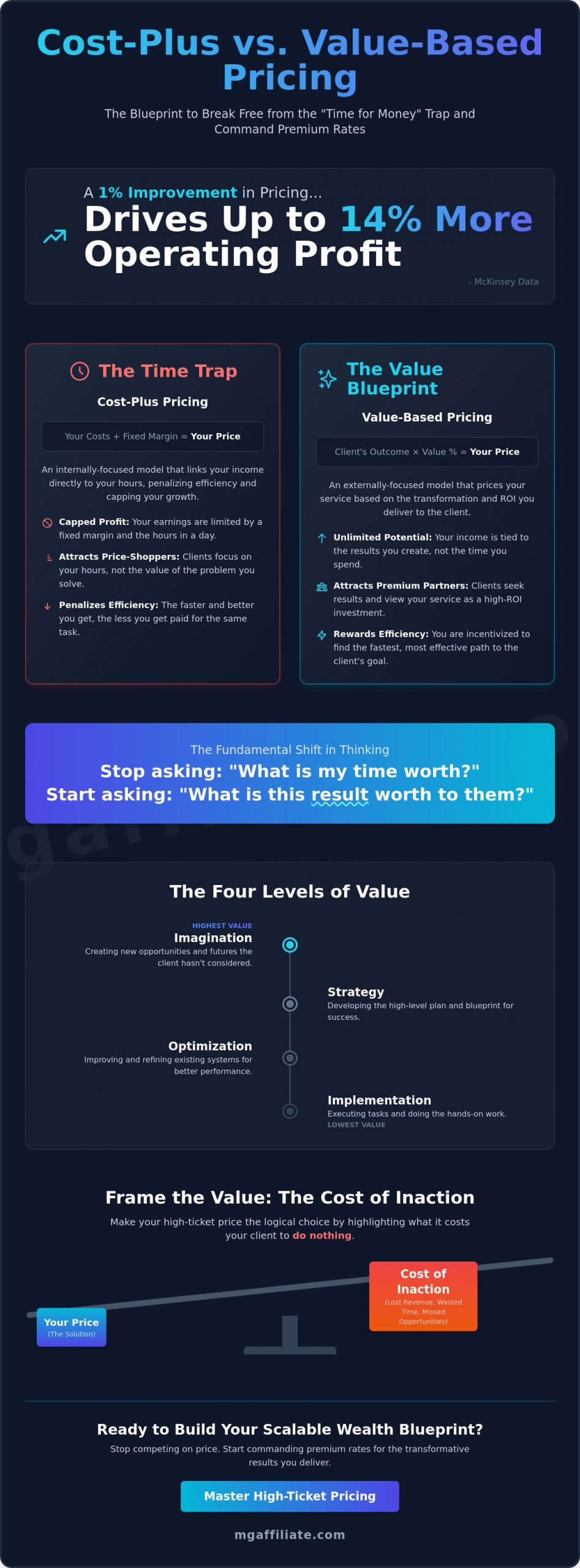
I know the frustration of putting in high effort only to see your profit margins stay razor thin. It’s exhausting to feel like your income is capped by the number of hours in a day. Data from McKinsey shows that just a 1% improvement in pricing can drive up to 14% more operating profit. This article will show you exactly why cost-plus pricing is capping your income and how to master value-based pricing to command premium rates in 2026. We’ll dive into the psychological shifts needed to attract high-ticket clients and build a scalable wealth blueprint that rewards your results instead of your time.
Key Takeaways
- Break free from the “Input + Margin” trap that ignores market demand and forces you to compete on price alone.
- Understand the fundamental shift of cost-plus vs value-based pricing to stop charging for your time and start charging for the transformation you deliver.
- Master the “Four Levels of Value” framework to elevate your offer from simple implementation to high-level imagination.
- Learn how to calculate the “Cost of Inaction” for your prospects, making your high-ticket solution the most logical choice for their growth.
- Discover the strategic blueprint to attract premium clients who prioritize results over pennies, ensuring your business is built for long-term scalability.
What is the Difference Between Cost-Plus and Value-Based Pricing?
Are you charging for your sweat or your solutions? Most entrepreneurs start their journey in what I call the “Trash Man” phase of business. They look at what they do as a series of tasks. They tally up their hours, add a little extra for profit, and hope the market says yes. This is the “Input + Margin” trap. It’s a race to the bottom that ignores what the client actually wants. If you want to move From Trash Man to Cash Man, you must understand the fundamental shift of cost-plus vs value-based pricing. One model keeps you a commodity; the other makes you a category of one.
To get a clear pricing strategy overview, we have to look at the direction of the calculation. Cost-plus pricing is internally focused. It looks backward at your receipts and your clock. Value-based pricing is externally focused. It looks forward at the client’s future. It sets rates based on the perceived worth of the transformation you provide. When you master this, you stop selling “stuff” and start selling “results.” This creates the “Value Gap,” which is the massive delta between what it costs you to deliver a solution and the fortune that solution saves or makes for your client.
The Mechanics of Cost-Plus Pricing
The math is simple but dangerous. You take your labor, add your overhead, and tack on a profit percentage. This is how high-volume commodities like grocery stores or construction crews operate. Why is this a trap for you? It penalizes your efficiency. The faster and better you get at your job, the less you get paid. Many business owners also fall victim to forgotten overhead. They fail to account for the psychological and operational costs of running a premium brand, which quickly erodes their true profit margins. According to Bain, 85% of B2B leaders believe their pricing needs improvement. Most are stuck here because they’re afraid to stop counting hours.
The Philosophy of Value-Based Pricing
This model shifts the focus from your “hours” to their “outcomes.” Why should a 2-hour solution be worth less than a 2-week struggle? If your insight saves a company $100,000 in a single afternoon, the value is in the $100,000, not the 60 minutes it took you to speak. Premium price setting relies on customer delight and ROI. You aren’t asking “What is this worth to me?” You are asking “What is this worth to them?” When you solve a “burning problem” that has been costing your prospect sleep and money, they don’t want a discount. They want a result. This is the core of making BOSS Moves in your industry.
Cost-Plus vs. Value-Based Pricing: A Side-by-Side Comparison
Are you building a legacy or just managing a spreadsheet? The choice between cost-plus vs value-based pricing determines whether you’ll be a high-performance entrepreneur or a stressed-out administrator. While many beginners prefer the safety of cost-plus because it’s easy to calculate, they quickly realize it’s a trap for their growth. You need to understand how these models differ in practice to make an informed decision for your brand. Do you want clients who respect your time or clients who scrutinize every minute? When you use cost-plus, you attract “price-shoppers.” These are the people who will complain about a small invoice while ignoring the massive problem you just solved. To get a deeper look at the mechanics, you can review this cost-plus and value-based pricing guide. It highlights how shifting your model changes your entire business trajectory.
| Feature | Cost-Plus Pricing | Value-Based Pricing |
|---|---|---|
| Scalability | Extremely Limited (Linear) | High (Exponential) |
| Client Type | Price-Shoppers & Micro-Managers | Premium Partners & Results-Seekers |
| Profit Potential | Fixed Margin (Capped) | Outcome-Linked (Unlimited) |
Consider the incentive alignment. Cost-plus pricing actually rewards you for being slow. If it takes you ten hours to fix a problem, you get paid more than if you fixed it in one. That is a broken system. Value-based pricing rewards efficiency. It encourages you to find the fastest, most effective path to the result, which is exactly what premium clients are willing to pay for. How do you handle rising operational costs? In a cost-plus world, you’re constantly chasing your tail to maintain a thin margin. When inflation hits, your profit vanishes. Value-based pricing is different. Because your price is tied to the magnitude of the problem you solve, your margins remain protected. If you’re ready to stop playing small, reading BOSS Moves will help you architect a business that values your expertise over your effort.
Scalability and the Income Ceiling
Why does cost-plus force you to work more just to earn more? It’s simple math. If your income is “Hours x Rate,” you hit a wall. Breaking the 1:1 ratio of time to money requires you to package your expertise into value-based offers that scale. The Income Ceiling is the invisible barrier where your financial growth stops because you’ve run out of hours to trade for dollars.
Market Positioning and Brand Authority
Your price is your loudest marketing message. It dictates where you sit in the market hierarchy. There is a powerful psychological link between high price and high perceived quality. In fact, “cheap” pricing often makes prospects more skeptical; they wonder why you’re so affordable if you’re actually an expert. Commanding premium rates isn’t just about the money; it’s about signaling that you are the definitive solution to their problem.
The Psychology of Value: Why Perceived Worth Trumps Cost
Why do some people gladly pay $50,000 for a solution while others haggle over a $500 invoice? It isn’t about the money in their bank account. It’s about the value in their mind. When you understand the psychology of cost-plus vs value-based pricing, you realize that price is never an absolute number. It’s a relative one based on the size of the fire you’re putting out. If your prospect’s house is on fire, they don’t want to see your receipts for the water. They want the flames gone. This is where the “Four Levels of Value” framework comes into play. Most people stay at the level of Implementation, which is just “doing stuff.” True wealth is found at the level of Imagination. Are you providing a commodity service, or are you architecting a future that didn’t exist before you arrived?
You must master the “Problem-Solution” delta to move into high-ticket territory. Ask yourself: how much is the problem actually costing them? If a business is losing $10,000 every single day due to an inefficient sales process, is a $50,000 fix expensive? No. It’s a bargain that pays for itself in five days. High-ticket offers aren’t just about the work; they’re about status and exclusivity. People pay more for the certainty of a result and the prestige of working with the best. Stop telling them what you do. Start asking them what it’s costing them to keep the problem alive. When you use rhetorical questions like, “Would you rather pay for 100 hours of my effort or one hour of the right answer?” you allow the client to sell themselves on your worth.
Quantifying the Unquantifiable
How do you put a dollar figure on “peace of mind” or “saved time”? You translate the emotional benefit into a tangible ROI. If your coaching saves a CEO ten hours a week, that is 520 hours a year. At a rate of $500 an hour, you just handed them $260,000 in found time. Use case studies to prove this transformational process isn’t a fluke. It’s a predictable outcome. For a deeper dive into crafting these premium positions, check out our guide on What is High Ticket Sales? to see how to align your brand with elite expectations.
Overcoming the “Fairness” Objection
Many clients think cost-plus is “fairer” because they can see your math. You have to shift that narrative immediately. If they say your price is too high for the time it took, you respond with confidence: “You aren’t paying for the 15 minutes it took me to fix this; you’re paying for the 20 years it took me to learn how to fix it in 15 minutes.” When a prospect claims they can get it cheaper elsewhere, agree with them. They can. But they aren’t paying for “it”—they’re paying for the certainty that the problem stays solved. Your expertise is the insurance policy against their failure.
How to Transition from Cost-Plus to Value-Based Pricing
Transitioning your business model isn’t just a change in your billing software; it’s a total transformation of your professional identity. If you’ve spent years stuck in the cost-plus vs value-based pricing debate, it’s time to stop theorizing and start executing. Moving to a value-based model requires you to stop being a technician who sells time and start being a strategist who sells transformation. Are you ready to break the income ceiling? Then you must follow a proven sequence to reframe your worth in the eyes of your prospects. This shift is the only way to ensure your business remains scalable and profitable as market demands evolve through 2026.
- Step 1: Identify the “Burning Problem.” You cannot charge premium rates for a “nice-to-have” service. You must find the one specific problem your audience is desperate to solve right now.
- Step 2: Calculate the “Cost of Inaction.” Show your prospect exactly what it costs them to keep their problem. When the pain of staying the same exceeds the price of your solution, the sale is already made.
- Step 3: Construct an Irresistible Offer. Bundle your expertise into a package that makes the price a non-issue because the value is so overwhelmingly obvious.
- Step 4: Shift Your Communication. Stop talking about “What I do” (your process) and start shouting about “What you get” (the result).
- Step 5: Implement Tiered Pricing. Offer different levels of access, such as General vs. VIP, to capture different segments of the market.
Constructing Your High-Ticket Offer
An irresistible high-ticket offer justifies a 10x price increase by focusing on the magnitude of the result. Why would someone pay you more for the same amount of work? Because they aren’t paying for the work; they’re paying for the outcome. You should never sell “coaching” or “consulting.” Instead, sell the million-dollar sales team, the restored health, or the automated business. To truly scale, you need to learn the BOSS Moves that allow you to optimize your offer for maximum profit and Stage Four growth.
The Tiered Access Strategy
Using General Admission vs. VIP tiers is the ultimate way to anchor your value. When you present a high-level VIP option, it creates a psychological reference point that makes your standard rate look like an incredible bargain. This allows you to serve clients at different stages of their journey while maximizing your revenue. Add “Value-Added” bonuses like proprietary tools or exclusive community access. These often cost you nothing to replicate but mean everything to a client looking for a shortcut to success. If you’re ready to master this transition and start commanding the rates you’re worth, it’s time to join the Make More Offers Challenge and rewire your business for wealth.
Mastering the Move to High-Ticket with the Make More Offers Challenge
Why is it that you can read every book on business strategy and still find yourself haggling over a few hundred dollars? Knowledge without execution is just a hobby. You’ve seen the data on cost-plus vs value-based pricing. You know that a 1% improvement in pricing can drive up to 14% more operating profit. Yet, most entrepreneurs fail to implement these shifts because they’re trying to fix a mechanical business problem with an old, limited mindset. You can’t build a high-ticket empire on a foundation made for a commodity job. The reason you haven’t moved yet isn’t a lack of information; it’s a lack of a proven system and the confidence to use it.
This is where the Make More Offers Challenge changes your entire trajectory. It’s a 5-day live immersion designed to rewire your brain for wealth. You aren’t just learning “pricing mechanics”; you’re learning how to think like a person who commands premium rates. Over five intensive days, you’ll move from the “how-to” of your service to the “why-now” of your offer. This challenge provides the psychological and tactical tools needed to bridge the gap between where you are and where you want to be. It’s time to stop guessing and start engineering your success.
The MMOC Wealth Blueprint
Myron Golden doesn’t just give you a theory. He gives you a blueprint. He lived the transition from “Trash Man” to “Cash Man,” and he teaches you how to replicate that evolution in your own life. This isn’t about waiting for a better economy or a lucky break. It’s about learning the specific strategies used to craft offers that sell even when the market feels uncertain. By the end of the challenge, you’ll know how to identify the “burning problems” that justify high-ticket prices. Join The Make More Offers Challenge 2026 to start your transformation and finally align your income with your true potential.
Choosing Your Level: General vs. VIP
If you want to see value-based pricing in action, look at the choice between General Admission and the VIP Experience. General Admission gets you in the door to receive the foundational training. The VIP Experience, however, gives you something far more valuable: proximity. Why is the VIP level more expensive? Because direct access to a high-ticket sales master is a shortcut that saves you years of trial and error. In the VIP sessions, you get to see the frameworks applied to real-world scenarios, helping you spot the holes in your own offers that you are currently blind to. It’s the ultimate example of paying for the result rather than the time spent.
Stop selling your time. It’s the only asset you can’t get more of. Your clients don’t want your hours; they want their problems solved. When you master the move to high-ticket offers, you stop being a servant to your schedule and start being a master of your wealth. Make the move today. Sign up, show up, and start making the kind of offers that change lives, starting with your own.
Architect Your Wealth with Value-Based Mastery
The choice is now yours. You can continue trading your finite hours for a fixed markup, or you can step into the elite circle of entrepreneurs who get paid for the massive results they deliver. We’ve explored how the debate of cost-plus vs value-based pricing is actually a choice between a capped income and unlimited scalability. You’ve learned that your worth isn’t found in your labor; it’s found in the “Value Gap” you create for your clients. By shifting your focus to the magnitude of the problem you solve, you reclaim your time and your freedom.
Success at this level doesn’t happen by accident. It requires a proven framework and the guidance of a mentor who has already mastered the system. Inspired by Myron Golden’s 30+ years of business mastery, you can access a community of high-performance entrepreneurs and a field-tested blueprint for constructing irresistible high-ticket offers. Ready to stop charging by the hour? Join the Make More Offers Challenge and master high-ticket pricing today! Your potential is waiting for you to unlock it. It’s time to make your move.
Frequently Asked Questions
Is value-based pricing ethical for small businesses?
Yes, it is the most ethical way to price because it aligns your incentives with the client’s success. When you charge based on value, you focus on delivering results rather than billing hours. This ensures the client only pays for the transformation they receive. It is about a fair exchange of value, not a calculation of your effort. You aren’t taking advantage; you’re being rewarded for the magnitude of the problem you solve.
How do I know if my customers are willing to pay for value?
You know they’re willing to pay when the cost of their problem is significantly higher than the price of your solution. If your prospect is losing money, sleep, or time, they’re looking for an outcome, not a discount. Conduct deep discovery calls to uncover the “burning problem.” If they only care about the price tag, they aren’t your target premium client and likely don’t value the result enough yet.
Can I use value-based pricing in a highly competitive market?
Absolutely, and it is often the only way to escape a race to the bottom price war. In a crowded market, most competitors look identical because they all use the same basic markup strategies. By focusing on unique value and specific, guaranteed outcomes, you differentiate your brand. You stop being a commodity and start being a specialized solution that commands higher rates because you offer certainty where others offer tasks.
What is the biggest mistake people make when switching from cost-plus?
The biggest mistake is failing to change the sales conversation from “what I do” to “what you get.” Many entrepreneurs try to justify a higher price by listing more tasks or features. This just invites the client to micromanage your hours again. You must lead with the transformation and the ROI to successfully navigate the shift of cost-plus vs value-based pricing. Sell the destination, not the plane ride.
How do I calculate value for a service that doesn’t have a direct ROI?
You calculate value by quantifying the emotional or indirect impact of your solution on the client’s life or business. If you provide peace of mind, ask the client what it’s worth to stop worrying about a specific risk. If you save them time, calculate the dollar value of those hours for a high-level executive. Every soft benefit has a hard cost of inaction that you can translate into a dollar figure.
Does value-based pricing work for physical products or just services?
It works for both, though it is most visible in specialized services and the SaaS industry. For physical products, value is driven by brand status, exclusivity, and unique utility. Think of luxury watches or specialized medical equipment. The price isn’t based on the cost of the steel or the plastic. It is based on the prestige or the life-saving result the product provides to the end user.
How often should I review my value-based pricing strategy?
Review your strategy at least every six months or whenever you achieve a significant new milestone in client results. As your expertise grows and your proof of concept becomes stronger, your perceived value naturally increases. The market also shifts. Regular audits ensure you aren’t leaving money on the table while your competitors are still stuck in the cost-plus vs value-based pricing trap of thin margins.
What happens if a competitor undercuts my value-based price?
Let them. A competitor undercutting your price is usually a sign they’re selling a commodity, not a transformation. Premium clients understand that cheap often means risky or low-quality. Stand firm in your worth and emphasize the certainty of your results. If a client leaves for a lower price, they were likely a price-shopper who would have drained your resources and complained about every minor detail anyway.
Leave a Reply