

Most entrepreneurs aren’t struggling because they lack talent; they’re struggling because they’ve built a financial ceiling over their own heads. Are you tired of watching potential customers walk away because your single price point feels like a leap of faith they aren’t ready to take? Studying tiered pricing strategy examples isn’t just a corporate exercise; it’s the fastest way to shatter your current income limits and stop leaving money on the table.
It’s frustrating to feel stuck at a certain revenue level while knowing you’re under-charging high-value clients who would pay more for better access. You deserve a business model that scales with your expertise rather than one that keeps you trading time for pennies. This article will show you how to implement high-impact tiered pricing models that eliminate income caps and turn prospects into high-ticket clients.
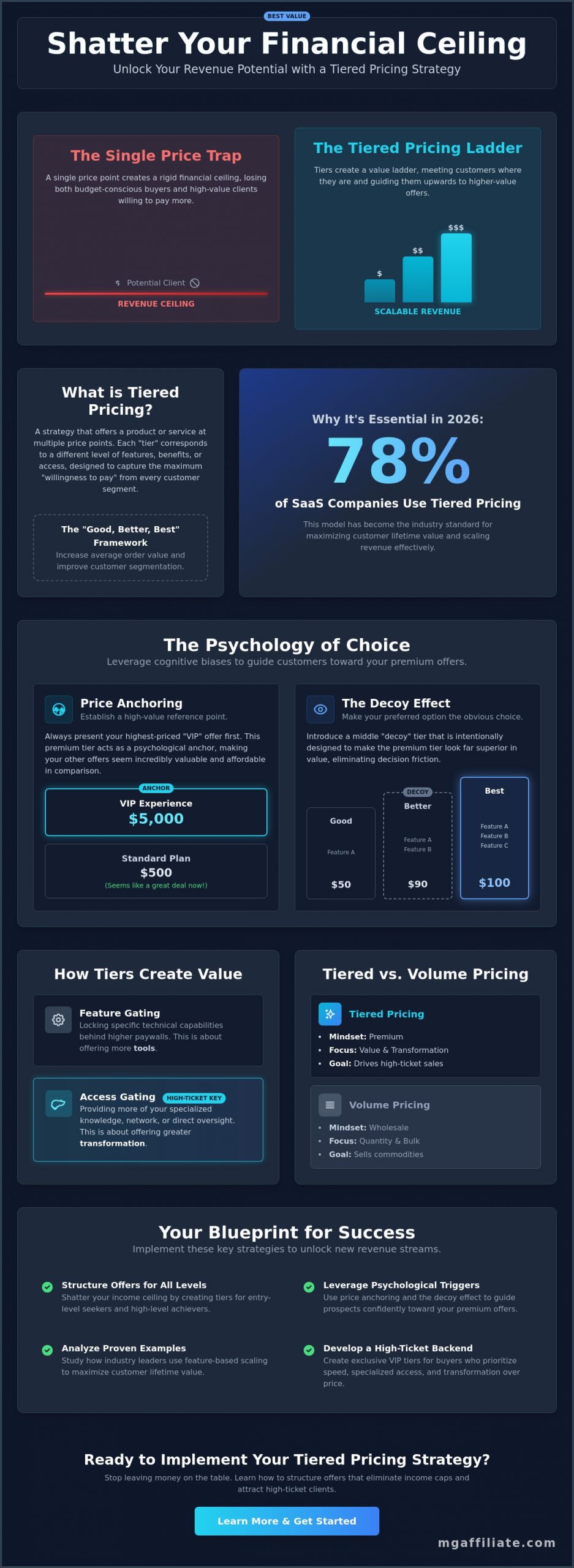
You’ll gain a clear “Good, Better, Best” framework to increase your average order value and improve customer segmentation. We’ll explore why 78% of SaaS companies now rely on these models and how you can use the same psychological triggers to command the fees you’re truly worth in 2026.
Key Takeaways
- Shatter your income ceiling by structuring offers that meet your audience exactly where they are, from entry-level seekers to high-level achievers.
- Leverage psychological triggers like price anchoring and the decoy effect to guide prospects toward your premium offers with clarity and confidence.
- Analyze proven tiered pricing strategy examples from industry leaders to understand how feature-based scaling maximizes customer lifetime value in 2026.
- Utilize the BOSS Moves framework to audit your current catalog and eliminate the gaps where potential revenue is slipping through the cracks.
- Develop a high-ticket back end that caters to VIP buyers who prioritize speed and specialized access over a lower price point.
What is a Tiered Pricing Strategy?
Are you still trying to force every prospect into a single, rigid price point? If so, you’ve built a cage around your revenue potential. A tiered pricing strategy is a sophisticated model where you offer products or services at multiple price points, each paired with specific features, benefits, or levels of access. The core objective is simple yet profound. You want to capture the maximum “willingness to pay” across your entire audience rather than settling for a middle-of-the-road average that satisfies no one.
When you rely on flat-fee pricing, you’re essentially telling your market that you don’t care about their specific needs or their capacity to invest. You lose the budget-conscious beginner who finds your entry price too high. Simultaneously, you tragically under-charge the high-value client who would gladly pay ten times more for deeper transformation and faster results. By studying high-impact tiered pricing strategy examples, you’ll see how to stop being a commodity seller and start acting like the high-ticket authority you were meant to be. This is about moving from a “take it or leave it” offer to a “how would you like to win?” conversation.
Think of it as a Two-tiered pricing system evolved for the modern entrepreneurial age. While basic systems might just split prices between two groups, a sophisticated strategy creates a clear path for customer evolution and professional autonomy.
The Mechanics of Price Tiering
Tiers function as a psychological ladder for customer ascension. You aren’t just selling a product; you’re offering a journey. In 2026, consumers don’t just want a tool. They demand a personalized value path. Feature gating involves locking specific technical capabilities behind higher paywalls. Access gating, however, is where the real wealth is built. This involves providing more of your specialized knowledge, your network, or your direct oversight to those ready for the highest level of success. It turns your business into a catalyst for life-changing results.
Tiered vs. Volume Pricing: Clearing the Confusion
Don’t confuse value with bulk. Volume pricing is a “wholesale” mindset where customers pay less per unit as they buy more. It’s the territory of commodities and warehouse clubs. Instead, tiered pricing is a “premium” mindset. It focuses on different levels of transformation. Which model drives high-ticket sales? The answer is tiered pricing every single time. It allows you to segment your audience based on the intensity of the problem they need solved. Successful tiered pricing strategy examples show that when you offer a path to excellence, your most ambitious clients will always choose the highest tier to secure their own advancement.
The Psychology of Tiers: Anchoring and the Decoy Effect
Why do prospects hesitate? It isn’t usually the price itself. It’s the lack of context. Without a comparison, every price feels like an arbitrary number. Sophisticated tiered pricing strategy examples reveal that the human brain doesn’t evaluate value in a vacuum. Instead, it relies on comparison. By utilizing specific psychological pricing strategies, you can dictate the terms of that comparison before your prospect even has a chance to doubt you.
The decoy effect is your most potent weapon against analysis paralysis. When you provide a “middle” option that is intentionally designed to make the premium choice look superior, you eliminate the friction of decision-making. You’re no longer asking them to judge your worth. You’re asking them to choose their level of commitment. This Good-Better-Best framework provides psychological safety, making the path to success feel structured and attainable rather than overwhelming.
The Power of the Premium Anchor
Lead with your highest-priced offer. Always. When you present your elite “VIP Experience” first, you establish an immediate standard of excellence. This top tier serves as a psychological anchor. It defines the ceiling of what is possible and signals your authority as a results-driven mentor. By establishing a premium standard at the top, you transform your entry-level offers into irresistible bargains that prospects feel foolish to ignore. This isn’t just a marketing trick. It’s a way to honor the exclusivity of your highest-level knowledge while ensuring no one is left behind. If you want to see how this works in practice, you might consider how the Make More Offers Challenge – VIP Experience creates a clear distinction from general admission.
Eliminating the “No” with Choice
Choice is the antidote to rejection. When you offer only one price, the prospect’s internal dialogue is “Yes or No.” When you offer three tiers, that dialogue shifts to “Which one is right for me?” This transition is vital for anyone looking to understand what is high ticket sales. It puts the customer in the driver’s seat. They feel in control of their own professional evolution. They aren’t being “sold” a package; they are choosing a transformation. This sense of autonomy is exactly what high-performance clients crave. They don’t want more stuff. They want the specific key that unlocks their latent potential. Effective tiered pricing strategy examples prove that by providing these choices, you build a rapport of trust and exclusivity that a single-price model can never match.
Common Tiered Pricing Examples Across Industries
How do the world’s most profitable companies maintain their dominance? They never offer just one way to pay. Whether you’re looking at software giants or elite coaching programs, the most successful tiered pricing strategy examples share a common thread. They align their price with the depth of the result the customer wants to achieve. In the SaaS world, companies like HubSpot utilize seat-based tiering to allow businesses to start small and scale. As of April 2026, their Marketing Hub Professional starts at approximately $890 per month, while their Enterprise tier jumps to $3,600. This isn’t just about more “stuff”; it’s about providing the infrastructure for massive corporate growth.
Streaming services have also mastered this art. Netflix and Spotify implemented price increases in early 2026 to better segment their users. Netflix now offers an ad-supported tier at $8.99, a standard ad-free version at $19.99, and a 4K Premium experience for $26.99. Each level targets a specific psychological profile, from the budget-conscious viewer to the home-cinema enthusiast who demands the highest quality. If you’re still selling a single “one size fits all” service, you’re essentially ignoring these proven paths to profitability.
The 3-Tier “Sweet Spot” Structure
Why do most successful businesses settle on three options? It’s the psychological “sweet spot” that prevents decision fatigue.
- Tier 1: The Entry Level. This is your “General Admission.” It’s designed for those who want to test your expertise without a massive initial investment.
- Tier 2: The Standard. This is your “Most Popular” option. It serves the majority of your audience and provides the core features they need to see real progress.
- Tier 3: The Premium. This is for the elite. It targets the 5% of your audience who want the fastest results, the highest access, and the most proximity to your specialized knowledge.
Case Study: The Make More Offers Challenge
One of the most powerful tiered pricing strategy examples in the coaching industry is the Make More Offers Challenge. By offering a General Admission tier for $97, the program builds a massive base of motivated entrepreneurs. It’s an accessible entry point that delivers high-value training over five days. However, the real revenue driver is the VIP Experience.
The VIP tier doesn’t just give you more videos. It gives you proximity. It offers accelerated coaching and direct access that General Admission attendees don’t receive. This tiered approach generates significantly more revenue than a single-price ticket ever could because it identifies the high-ticket clients hiding within the larger crowd. It proves that when you give people the opportunity to pay for faster results, your most ambitious prospects will always raise their hands.
How to Implement Tiered Pricing in Your Business
Implementation is where your vision meets the pavement. You’ve seen the tiered pricing strategy examples that drive massive revenue, but how do you build yours? It starts with a fundamental shift in perspective. You aren’t selling a list of features. You are selling a transformation. If you don’t understand the specific “win” your client is chasing at each level, your pricing will always feel like a guess. Stop guessing and start strategizing. You need a system that recognizes the different stages of your customer’s journey and rewards their ambition.
Follow these five steps to build a pricing architecture that scales:
- Step 1: Identify the Transformation. What is the core result for each segment? A beginner needs a foundation; an elite player needs optimization.
- Step 2: Audit Your Offerings. Look at your current products. Which ones are assets that drive growth, and which are liabilities draining your time?
- Step 3: Determine the Value Gap. The jump from one tier to the next must be undeniable. Successful models often feature price gaps of 50% to 100% between tiers to ensure the perceived value increase is clear and compelling.
- Step 4: Design the Anchor. Create your most expensive offer first. This defines your brand authority and makes every other tier you sell look like an incredible gift.
- Step 5: Test and Refine. Don’t marry your first draft. Use conversion data to see where people are getting stuck and adjust your feature gates accordingly.
Aligning Tiers with the Four Stages of Business
Your pricing must reflect the journey of your client. In the boss moves myron golden methodology, businesses move through specific stages of evolution. Are you still stuck in Stage 1, focused solely on implementation? Tiered pricing allows you to guide your clients toward Stage 4: Optimization. By structuring your tiers to solve problems at each stage, you create a natural ascension path. You aren’t just selling a service; you’re providing the roadmap for their professional evolution. Ready to master this framework? Grab your copy of the BOSS Moves book and start optimizing your revenue today.
Avoiding Common Pricing Pitfalls
Why do some tiered models fail? Usually, it’s because of the “Too Many Tiers” trap. If you offer more than four options, you’ll trigger analysis paralysis. Your prospect will get confused, and a confused mind always says “no.” Keep it simple. Ensure that the value jump is worth the price jump every single time. If the difference between Tier 1 and Tier 2 isn’t immediately obvious, your customers will default to the cheapest option. Clarity is the key to high-ticket conversions. When you look at successful tiered pricing strategy examples, you’ll notice they use transparent, punchy language that makes the choice effortless.
Mastering the High-Ticket Tier with Myron Golden
Why is your business still operating on thin margins? It’s likely because you’ve focused all your effort on the “front end” while neglecting the high-ticket “back end” where true wealth is generated. To be truly profitable, your business needs a premium tier that reflects the highest level of transformation you can provide. While the tiered pricing strategy examples we’ve explored help stabilize your cash flow, your high-ticket offer is what creates economic independence and professional competency. It’s the difference between surviving and dominating your market.
What does a VIP buyer actually want? It isn’t more “stuff.” They don’t want another 40-hour video course or a thicker manual. They want speed, proximity, and the elimination of obstacles. They are paying for the “key” to unlock their own latent potential. By structuring your tiers correctly, you are essentially training your audience to value your expertise. You’re moving them from a transaction-based relationship to a transformation-based partnership. When they see the results at the entry level, they naturally begin to wonder: “If this is what I get for a small investment, what would happen if I invested at the highest level?”
The “Make More Offers” Philosophy
Do you have a sales problem? Most likely, you don’t. You have an offer problem. The “Make More Offers” philosophy teaches that your income is a direct reflection of the number and quality of offers you put into the marketplace. Tiering is the engine that allows you to make more offers to the same person without sounding repetitive. It gives you the flexibility to meet a prospect at their current level of professional evolution while always keeping the door open for higher-level mentorship. This is how you scale a service-based business without burning out. You stop trading time for money and start trading value for wealth.
Ready to Scale Your Offers?
Every day you wait to “fix” your pricing is another day you’re losing thousands in potential revenue. The gap between where you are and where you want to be is often just a single, well-structured high-ticket offer. You don’t have to figure this out in isolation. The B.E.S.T. Wealth Network provides the community and strategic partnership needed to support your growth as you transition into a high-performance mentor. It’s time to stop under-charging and start commanding the fees your expertise deserves. Join the Make More Offers Challenge and structure your tiers for success! This is your invitation to step into a state of success and autonomy that most only dream of. Don’t let your current financial limitations dictate your future potential. Take the step toward life-changing results today.
Shatter Your Revenue Ceiling Today
You now have the blueprints to transform your business from a flat-fee commodity into a high-performance wealth engine. By implementing the tiered pricing strategy examples we’ve discussed, you’re doing more than just changing numbers on a page. You’re creating a psychological pathway that guides your clients toward their own professional evolution. You’ve learned how to lead with a premium anchor and use the decoy effect to eliminate decision fatigue. Now, it’s time to stop studying and start executing.
Are you ready to stop leaving money on the table? Myron Golden’s 30 plus years of business strategy have already helped thousands of entrepreneurs scale to 5, 6, and 7-figure offers using these proven behavioral economics frameworks. The only thing standing between you and economic independence is the quality of the offers you’re making to the world. Don’t let another day pass while you’re stuck at your current income level. Master your pricing and make more offers, join the Challenge today! Your future self will thank you for having the courage to demand what you’re truly worth. You have the potential; now you have the key.
Frequently Asked Questions
What is the most effective number of tiers for a pricing strategy?
Three tiers represent the psychological sweet spot for most businesses. Why? Because it provides enough choice to segment your audience without triggering analysis paralysis. When you offer more than four options, you risk overwhelming your prospects and losing the sale entirely. Stick to a clear Good-Better-Best framework to keep the path to success straightforward. This structure allows you to anchor your value at the top while still offering an accessible entry point at the bottom.
How do I know if my price gap between tiers is too large?
You’ll know your price gap is too large if your conversion rate for the higher tier is non-existent despite high traffic. A healthy gap is typically between 50% and 100% of the previous tier’s price. If the jump feels like a leap of faith rather than a logical step toward a bigger transformation, you need to either lower the price or significantly increase the perceived value. Your clients must see the upgrade as an essential investment in their own advancement.
Can tiered pricing work for a one-man consulting business?
Tiered pricing is the only way a solo consultant can break the “time for money” trap. By creating tiers based on access and speed rather than hours worked, you can serve budget-conscious clients through digital resources while reserving your direct mentorship for high-ticket partners. It’s the foundation of professional autonomy and financial independence. It allows you to scale your impact without scaling your workload, turning your specialized knowledge into a reliable wealth-building engine.
What is the difference between tiered pricing and price discrimination?
Tiered pricing offers different value levels to everyone, while price discrimination involves charging different customers different prices for the identical product. In a tiered model, the customer self-selects their level of investment based on the transformation they desire. It’s a transparent system that builds trust by aligning cost with specific outcomes and features. This approach empowers the buyer to choose the path that best fits their current stage of professional competency and growth.
Should I always offer a free tier (Freemium)?
You shouldn’t always offer a free tier. While freemium models can work for mass-market software, they often attract low-commitment users who drain your resources. If you’re building a high-ticket brand, an entry-level paid tier is far more effective. It qualifies your leads immediately and ensures you’re only mentoring people who are truly invested in their professional evolution. Focus your energy on those who are willing to put skin in the game for their own results.
How do I move a customer from a lower tier to a premium high-ticket tier?
Move customers upward by delivering an undeniable win at the lower level first. Once a client experiences the reliability of your entry-level strategies, they’ll naturally crave more proximity and faster results. Use your lower tiers as a proving ground that prepares their mindset for the elite transformation found in your high-ticket offers. Successful ascension is about leading your clients through a logical progression from identifying a need to taking a specific action.
What happens if no one buys my highest-priced tier?
If no one buys your highest tier, it’s still performing a vital role as a price anchor. Its presence makes your mid-tier offers look like an incredible bargain. However, if your goal is to sell that top tier, you must audit your offer to ensure you’re selling a high-level transformation rather than just more “stuff.” High-ticket buyers aren’t looking for more work; they are looking for the key that unlocks their latent potential and provides exclusive access.
Is tiered pricing better than a flat monthly subscription?
Tiered pricing is significantly more effective than a flat subscription because it shatters your income ceiling. Statistics from early 2026 show that SaaS platforms implementing tiered pricing strategy examples see 25% to 40% higher revenue per customer than those with flat-rate models. A flat fee ignores the reality that your most ambitious clients are ready to pay more for exclusive access and accelerated growth. Don’t limit your profitability by forcing everyone into a single box.
Leave a Reply