

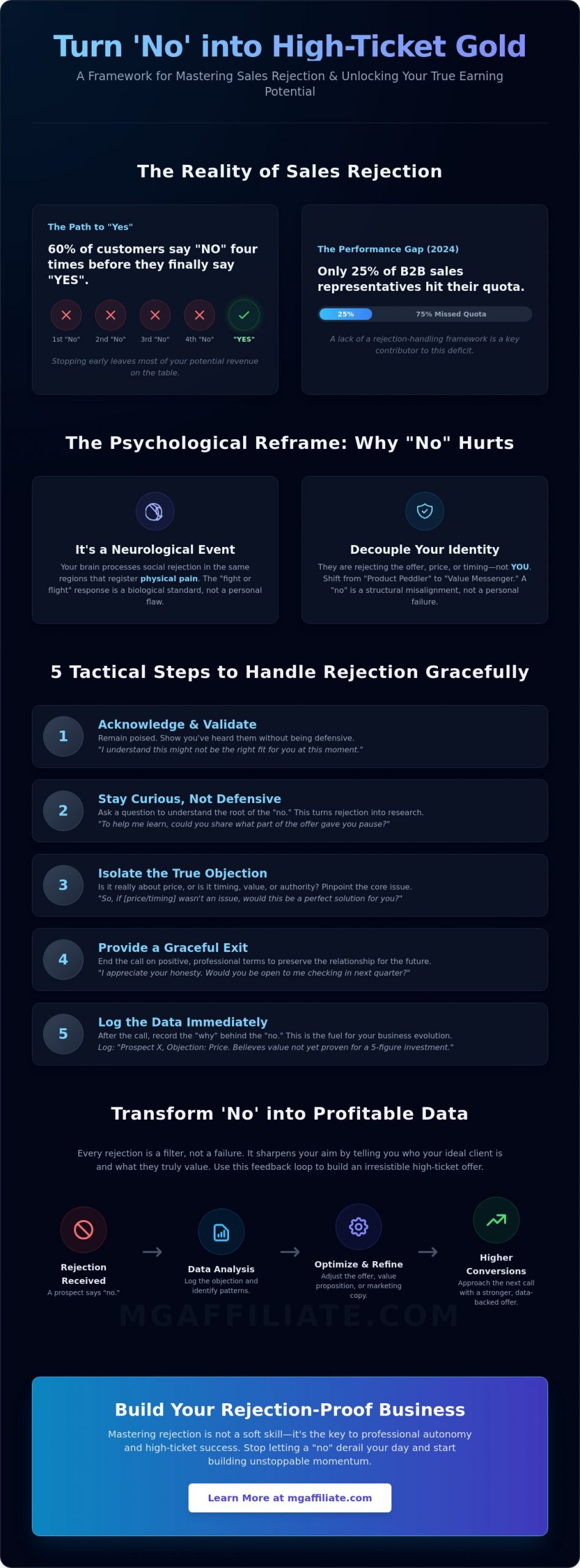
Did you know that 60% of customers say “no” four times before they finally say “yes”? If you are stopping after the first rejection, you are leaving the majority of your potential wealth on the table. Learning how to handle sales rejection gracefully is not just a soft skill; it is the fundamental key to professional autonomy and high-ticket success. Why do most reps let a single “no” derail their entire day? It is because they lack a repeatable framework to process the friction and move forward with confidence.
You likely feel that familiar sting of doubt when a prospect hangs up. You start to question your offer, your price, and your own value. It is an exhausting cycle that contributed to only 25% of B2B representatives hitting their quota in 2024. We are going to break that cycle today. You will learn how to transform your psychological approach and adopt a tactical mindset that treats every rejection as a data point rather than a defeat. This article provides the psychological and tactical frameworks you need to turn every “no” into a stepping stone for your next high-ticket “yes.”
Key Takeaways
- Reframe rejection as a neurological event rather than a personal failure to stop emotional exhaustion immediately.
- Master how to handle sales rejection gracefully by adopting the “Cash Man” approach to decouple your identity from the outcome.
- Execute a precise five-step tactical framework that maintains professional poise and preserves high-value relationships during difficult calls.
- Leverage every “No” as a profitable data point to optimize your premium offers and refine your marketing copy for higher conversions.
- Build the psychological muscle needed for high-ticket closing by mastering the art of the “Offer Squat” through consistent practice.
The Psychology of Sales Rejection: Why It Hurts and How to Reframe It
Why does a “no” on a high-ticket sales call feel like a physical blow to the chest? Is it because you lack discipline? No. It is because your brain is biologically programmed to perceive social exclusion as a threat to your survival. When a prospect rejects your offer, your brain processes that event in the same regions that register physical pain. Understanding the psychological consequences of rejection helps you realize that your emotional reaction is a biological standard, not a personal flaw. To master how to handle sales rejection gracefully, you must first accept that rejection is a neurological event, not a judgment of your character.
Your success in 2026 depends on your Rejection Quotient. This is the specific amount of friction and refusal you can process while maintaining your peak performance state. Most entrepreneurs fail because their Rejection Quotient is too low. They hit a wall of “no’s” and retreat. High-performers do the opposite. They understand that wealth is directly proportional to the amount of rejection they can handle without losing their enthusiasm. You aren’t avoiding pain; you are collecting data for your business evolution.
The Neurological ‘No’: Why Your Brain Overreacts
When you hear a rejection, your amygdala triggers a “fight or flight” response. This was useful for ancestors facing predators, but it is a liability during a Zoom call. In the isolated digital environments of 2026, this response is often amplified because you lack the physical mirror neurons that soften social interactions. Your cortisol levels spike, clouding your judgment and making your next call feel impossible. Stop the cycle immediately with a 10-second reset breath. Inhale for four seconds, hold for two, and exhale for four. This simple mechanical action signals your nervous system to exit survival mode and return to a state of strategic clarity.
Learning to override these primal responses is a hallmark of elite performance training; many organizations consult with top-tier motivational experts from Speakers.com to help their teams maintain clarity and resilience in high-stakes sales environments.
Reframing Rejection as a Requirement for Growth
Are you operating from a scarcity mindset? If you view every “no” as a lost opportunity, you are trapped in a cycle of emotional exhaustion. Shift to an abundance mindset where every rejection acts as a filter. Not every prospect is qualified for a premium, high-ticket solution. By “failing forward,” you use these interactions to sharpen your offer and identify exactly who your ideal client is. Graceful rejection is the ability to remain emotionally neutral while staying strategically engaged. It means you don’t take the “no” home with you. You leave it on the call, extract the lesson, and move to the next “yes” with unshakeable confidence.
Developing this level of mental resilience is essential for both your professional and personal life; to explore practical, story-driven strategies for applying psychological insights to your daily routine, read more.
Decoupling Your Identity: The ‘Cash Man’ Approach to Sales
Why do you let a stranger’s “no” dictate your self-worth? It’s a common trap for entrepreneurs who haven’t yet mastered the psychological divide between their personhood and their profession. You’ve fused your identity with your offer. To learn how to handle sales rejection gracefully, you must separate the messenger from the message. You are a high-performance creator. Your offer is merely a solution. If the solution doesn’t fit the prospect’s current needs, it’s a structural misalignment, not a personal failure. Stop viewing yourself as a “Product Peddler” who begs for validation. Start seeing yourself as a “Value Messenger” who carries the key to a prospect’s breakthrough.
Adopting a BOSS Moves Myron Golden mindset changes the stakes of every interaction. When you operate from this level of business optimization, a single call is no longer a life-or-death event for your ego. It is simply a test of the offer’s current structure. If they say no, they aren’t rejecting you. They are rejecting the price, the timing, or the perceived value of the specific package you presented. By using established Techniques To Help Business Owners Handle Sales Rejection, you can analyze these structural gaps without bruising your spirit. This detachment allows you to pivot and refine your strategy for the next high-ticket opportunity.
Moving from Stage One to Stage Four Mindset
Business growth happens in stages. Stage One is about survival, where every “no” feels like a threat to your existence. Stage Four is about systems, scale, and legacy. High-level entrepreneurs in Stage Four understand that rejection is a necessary filtering mechanism. Because high-ticket offers are exclusive, they inherently attract more “no’s.” You are looking for the elite few who recognize the premium value you provide. If you want to scale, you must accept that a higher volume of rejection is the toll you pay to reach the most significant “yes’s” of your career. If you want to accelerate this transition, studying the principles in the BOSS Moves book is a critical next step.
The Power of Emotional Detachment
Persuasion doesn’t come from desperation. It comes from “Outcome Independence.” If you need the sale to feel successful, the prospect will smell that neediness and retreat. True authority is maintained when you are perfectly fine whether they buy or not. Use the mantra: “Some will, some won’t, so what? Someone’s waiting.” This isn’t just a catchy phrase; it’s a strategic stance. When you remain emotionally neutral, you retain your position as the expert. Even if the prospect says they aren’t interested, your lack of an emotional reaction proves that your value isn’t dependent on their opinion. That is how to handle sales rejection gracefully while keeping your professional power intact.
5 Tactical Steps to Handle Rejection Gracefully in Real-Time
Execution is where the high-ticket mindset meets reality. You’ve reframed the “no” neurologically. You’ve decoupled your identity from the offer. Now, what do you actually say when the prospect declines? Knowing how to handle sales rejection gracefully is about maintaining control of the narrative even when the deal isn’t closing today. Follow these five tactical steps to ensure every refusal becomes a strategic asset.
- Step 1: Pause and Acknowledge. Do not rush to defend your price. Silence is a power move. Take a breath and let the prospect’s statement hang in the air for two seconds. This prevents you from sounding defensive.
- Step 2: Express Gratitude. Thank them for their honesty. A simple “I appreciate you being direct with me” preserves the relationship and keeps the door open for future high-ticket opportunities.
- Step 3: Ask the ‘Golden’ Question. Transition from seller to investigator. This is where you gather the intelligence needed to optimize your next offer structure.
- Step 4: Leave the Door Open. Position yourself as a long-term resource. You aren’t a one-time vendor. You are a strategic partner who is available when the timing eventually aligns.
- Step 5: Document and Detach. Record the specific reason for the rejection in your CRM. Then, move to the next lead immediately. Speed is the antidote to emotional lingering.
The ‘Golden’ Question: Digging for the Real Reason
The first reason a prospect gives is rarely the real reason. Use this script to uncover the truth: “I appreciate your honesty. Just so I can improve my process, was it the timing, the price, or the fit that didn’t quite land for you?” Listen closely. If they mention price, it’s often a value perception issue. If they mention timing, it’s a priority issue. You can then use the “Feel, Felt, Found” technique to pivot. Say, “I understand how you feel. Many of my most successful clients felt the same way initially. What they found was that the investment actually saved them more time than they expected.” This maintains your authority while addressing their concern head-on.
Professional Parting: How to End the Call with Authority
Never end a call sounding disappointed. Desperation is the fastest way to kill your professional reputation. Instead, use the Referral Pivot. Ask, “Since this isn’t the right fit for you right now, who do you know who is currently looking to scale their profitability?” Data shows that a referral leads to a meeting 80% of the time, compared to just 2% for cold calls. By asking for a lead, you demonstrate that you are still in demand and operating from a place of abundance. Finally, set a future check-in date. A simple “I’ll touch base in six months to see how your goals have shifted” keeps you on their radar without being a nuisance. This is how to handle sales rejection gracefully while building a pipeline that eventually yields a “yes.”
Transforming ‘No’ into Data for High-Ticket Offer Optimization
Stop viewing rejection as a wall. View it as a mirror. If you want to know how to handle sales rejection gracefully, you must treat every “no” as a diagnostic tool. Frequent pushback on price isn’t a signal to lower your rates. It’s a signal that you haven’t mastered the fundamental architecture of what is high ticket sales value perception. You are failing to bridge the gap between the prospect’s current pain and your premium solution’s potential. Every rejection is a whisper from the market telling you exactly where your offer architecture is weak.
Start a Rejection Log today. Commit to tracking the next 100 calls without emotional attachment. Are people dropping off because of the price, the timeline, or a specific feature? When you see a pattern, you have found the “leak” in your offer. Use this “rejection research” to rewrite your marketing copy and refine your offer stack. This is how you build an “Irresistible Offer” that anticipates objections before they are even spoken. You don’t guess what the market wants. You let the market tell you through its refusals.
Identifying Patterns in Your Sales Process
Where is the friction? If the rejection happens at the beginning of the call, your hook is weak and fails to establish authority. If it happens at the very end, your close lacks conviction or clarity. You must learn to distinguish between “I can’t afford it” and “I don’t see the value.” The first is a resource problem. The second is a communication problem. Adjust your offer stack by adding specific bonuses or risk-reversal guarantees that directly neutralize the most common reasons for refusal. This turns your sales process into a self-correcting machine.
Refining Your Ideal Client Profile (ICP)
Sometimes, a “no” has nothing to do with your skill or your offer. You are simply talking to the wrong person. Use your rejection data to tighten your lead qualification criteria. If 80% of your rejections come from a specific industry or income bracket, stop spending money to reach them. A “no” from a low-quality lead is actually a “yes” for your time management. It frees you to focus on high-probability prospects who already possess the mindset to invest in premium solutions. Refusing to chase the wrong leads is a primary step in how to handle sales rejection gracefully.
To master the art of the pitch and eliminate these patterns, you need the right strategy. Learn how to position yourself as the only logical choice with the BOSS Moves Book.
Mastering the Art of the Offer with the Make More Offers Challenge
How do you bridge the gap between understanding the psychology of a “No” and actually collecting a high-ticket “Yes”? You need a controlled, high-intensity environment where theory is replaced by execution. The Make More Offers Challenge serves as the definitive training ground for your professional evolution. Knowing how to handle sales rejection gracefully is the foundation of a resilient business, but the ultimate goal is to evolve your strategy until your offers are so precisely tuned that the rejection becomes a rare data point rather than a daily obstacle. This challenge is designed to help you make that transition in real-time.
To succeed in the 2026 sales landscape, you must implement “Offer Squats.” This proprietary framework requires you to repeat the motion of making a high-ticket ask until the neurological sting of refusal evaporates. Just as physical muscles grow through resistance, your sales capacity grows through the friction of the marketplace. When you participate in this live training, you learn how to handle sales rejection gracefully by watching a master navigate the nuances of the close and by engaging with a community of high-performers. Hearing others process rejection helps normalize the experience, stripping the “No” of its power and allowing you to focus entirely on the value you provide.
The 5-Day Wealth Blueprint for Sales Mastery
This is not a passive seminar. It is a 5-day immersion into the mechanics of wealth creation and the psychology of the “ask.” Each day, you are pushed to refine your offer structure and increase your speed of implementation. Why is speed important? Because the faster you move from one offer to the next, the less time you have to dwell on the previous rejection. If you opt for the VIP Experience, you gain the added advantage of specialized coaching sessions designed to shatter your specific personal sales plateaus. This level of proximity to high-performance mentorship is the “key” that unlocks your latent potential for profitability.
Take the Next Step Toward Financial Freedom
Your journey from a limited professional mindset to high-level success requires a radical shift in how you view your own value. Whether you are starting from a humble position or looking to scale an existing enterprise, the principles found in the “From Trash Man to Cash Man Book” prove that your current circumstances do not dictate your future results. Don’t let the fear of a “No” rob you of the “Yes” that will change your life. Master your business destiny by joining the next Make More Offers Challenge. It is time to stop fearing the market and start leading it. Join the challenge today and transform every rejection into a stepping stone for your next premium breakthrough.
Unlock Your High-Ticket Future Today
You now possess the psychological and tactical blueprints to dominate the 2026 marketplace. By reframing rejection as a neurological event and decoupling your personal worth from your professional offer, you have already surpassed the majority of your competition. Remember that your wealth is a direct reflection of your Rejection Quotient. Mastering how to handle sales rejection gracefully is the fundamental requirement for achieving true economic independence. Will you let a temporary “no” stop your permanent progress? Or will you use that data to refine your offer architecture and scale your profitability?
It is time to move from abstract concepts to high-ticket mastery. We have already helped over 100,000 entrepreneurs transform their financial reality using the proprietary “Four Levels of Value” framework. You don’t have to navigate this evolution alone. Through direct mentorship from Myron Golden, you can stop guessing and start closing with unshakeable confidence. Ready to turn your ‘No’s into a high-ticket empire? Join the Make More Offers Challenge today! Your next life-changing “yes” is waiting on the other side of your next ask. Take the leap and claim the success you were built for.
Frequently Asked Questions
How do I stop taking sales rejection personally?
You stop taking it personally by realizing that a “no” is a rejection of the current offer structure, not your human value. High-performers decouple their identity from the outcome. This is the core of how to handle sales rejection gracefully. You are a value messenger. If the prospect isn’t ready for the value, it’s a data point for your business, not a character judgment.
What is the best response when a prospect says ‘No’?
The best response is a strategic pause followed by gratitude. Thank the prospect for their honesty to preserve the relationship. Then, ask the “Golden Question” to uncover the real reason for the misalignment. This keeps you in a position of authority. It turns a dead end into a research opportunity for your next high-ticket offer optimization.
Does everyone face rejection in high-ticket sales?
Every elite salesperson faces rejection. High-ticket sales inherently involve more refusal because the barrier to entry is higher. Since 80% of sales require 5 to 12 follow-up attempts, hearing “no” is simply a standard part of the filtering process. You aren’t failing. You are filtering for the premium clients who truly recognize your value.
How many rejections should I expect before a ‘Yes’?
You should expect at least four rejections per prospect. Current data indicates that 60% of customers say “no” four times before they finally agree to a deal. If you give up after the first or second refusal, you are statistically guaranteed to miss the majority of your revenue. Persistence is the hallmark of the high-ticket mindset.
Can I handle sales rejection if I am an introvert?
Introverts are often better equipped to learn how to handle sales rejection gracefully because they rely on systems rather than just charisma. By using a repeatable framework to process “no’s,” you can manage your energy and focus on the analytical side of the sales process. Your ability to listen for the “objection behind the objection” is a superpower.
What should I do immediately after a painful sales rejection?
Clear your cortisol immediately with a 10-second reset breath. Inhale for four seconds, hold for two, and exhale for four. Once your nervous system is back in a state of clarity, record the rejection in your log and call your next prospect. Speed of implementation is the only way to prevent emotional lingering and maintain your momentum.
How do I know if the rejection is about me or my product?
If the prospect questions the price or the timeline, the rejection is about the product or offer structure. If they stop engaging entirely, you likely failed to establish authority or trust early in the call. Use your Rejection Log to identify if the friction is happening at the hook or the close to determine exactly what needs optimization.
Is there a way to reduce the number of rejections I get?
Tighten your qualification criteria to ensure you are only speaking to your Ideal Client Profile. If you are talking to the wrong person, no amount of skill will save the deal. Use your rejection research to create an Irresistible Offer that addresses common pain points before the prospect even brings them up. Better targeting leads to higher closing rates.
Leave a Reply