

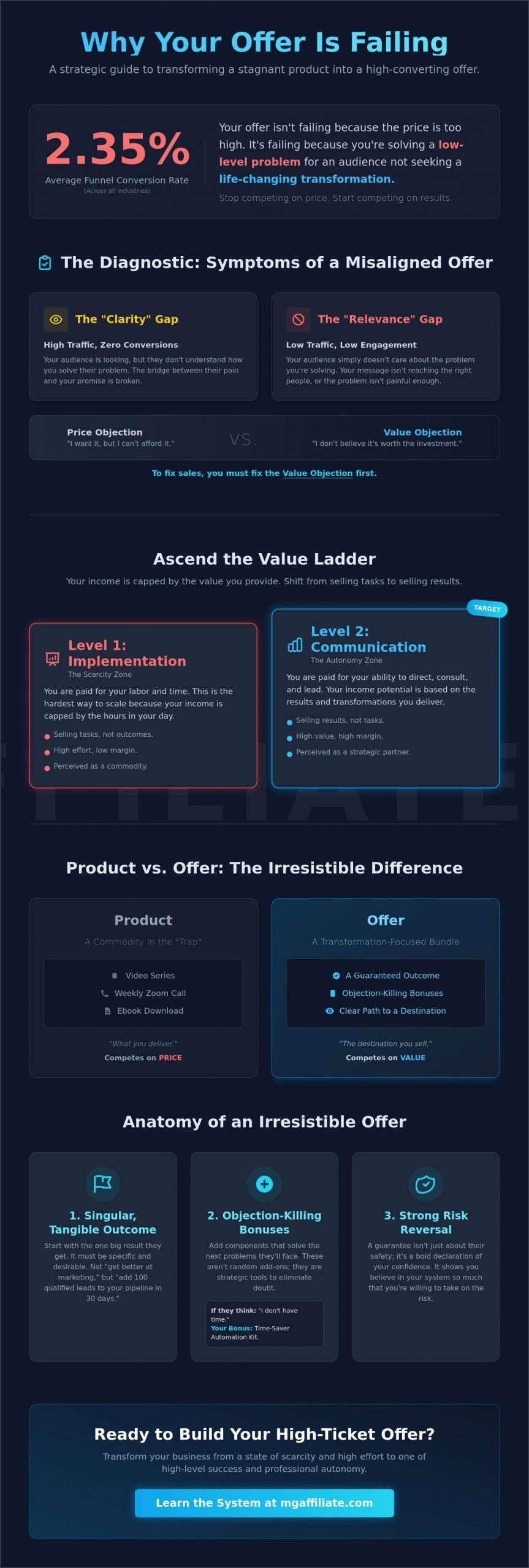
Your offer isn’t failing because your price is too high; it’s failing because you’re solving a low-level problem for people who aren’t looking for a life-changing transformation. It’s frustrating to pour high effort into a campaign only to face zero sales and financial stagnation. With average funnel conversion rates across all industries hovering around 2.35%, you cannot afford to blend into the noise. If you want to know exactly what to do when your offer isn’t selling, you must stop competing on price and start competing on results.
You already possess the latent potential for professional evolution, but you need the right key to unlock it. This guide reveals the exact strategic shifts and mindset resets needed to transform a stagnant product into an irresistible, high-converting offer. We’ll walk through a high-ticket diagnostic to identify your gaps and provide a repeatable system for making BOSS moves. It’s time to claim your autonomy, raise your prices with confidence, and build the wealth you’ve worked so hard to achieve.
Key Takeaways
- Learn exactly what to do when your offer isn’t selling by diagnosing whether you’re solving a minor nuisance or a life-altering problem for your clients.
- Escape the commodity trap by shifting from selling basic coaching services to creating transformation-focused bundles that make saying no feel like a mistake.
- Master psychographic profiling to ensure you’re speaking to an audience that has both the deep desire for a solution and the financial capacity to invest in it.
- Discover how to use automated qualifying systems to filter leads, ensuring you only present your high-ticket offers to the most committed prospects.
- Adopt the BOSS Moves mindset to transition your business from a state of scarcity and high effort to one of high-level success and professional autonomy.
The Diagnostic: Why Your Offer is Meeting with Silence
Why is your Stripe account silent? Why is the market ignoring your expertise? It isn’t because you lack talent. It’s because your value proposition is invisible or, worse, irrelevant. When you’re stuck wondering what to do when your offer isn’t selling, the answer rarely lies in your Facebook ad settings. It lies in the magnitude of the problem you solve. Are you solving a minor nuisance or a life-altering crisis? People pay for transformation, not information. If your offer feels like a “nice-to-have” instead of a “must-have,” you’ve already lost the battle for their attention.
Silence is usually a messaging problem, not a product problem. This “Crickets” phenomenon happens when your audience can’t see themselves in the solution you’ve built. You might have a world-class product, but if the bridge between their pain and your promise is broken, they’ll never cross it. Stop blaming the algorithm. Start auditing your core premise. Is it a broken sales funnel or a broken core idea? A funnel can be optimized, but a weak premise must be reinvented from the ground up.
The 4 Levels of Value Assessment
Where do you sit on the value scale? Most entrepreneurs start at the “Implementation” level, where they’re paid for their labor. This is the hardest way to scale because your income is capped by your hours. To achieve true financial autonomy, you must move toward the “Communication” level. This is where you’re paid for your ability to direct, consult, and lead. Moving to this level changes your income potential instantly because you’re selling results, not tasks. Your current offer likely occupies the “Implementation” level, which is why you’re exhausted and underpaid.
Symptoms of a Misaligned Offer
How do you know if the premise is broken? Look at the data. High traffic but zero conversions points to a “Clarity” gap; they’re looking, but they don’t understand how you help. Low traffic and low engagement signals a “Relevance” gap; they simply don’t care about the problem you’re solving. You must also distinguish between a price objection and a value objection. A price objection means they want it but can’t afford it. A value objection means they don’t think it’s worth the investment, regardless of the cost. If you want to know what to do when your offer isn’t selling, start by fixing the value, not lowering the price.
Offer vs. Product: The Irresistible Difference
Stop confusing your product with your offer. A product is a commodity; it’s the “what” you deliver, like a series of videos or a weekly Zoom call. An offer is a psychological construct. It’s the entire transformation-focused bundle that makes saying “no” feel like a total mistake. When you’re stuck wondering what to do when your offer isn’t selling, you must realize that you aren’t selling a “course.” You’re selling a destination. If your audience perceives your solution as just another commodity, they will compare you based on price rather than value. This is the “Commodity Trap,” and it’s where your profitability goes to die.
The market doesn’t want another “coaching program.” They want their problems to vanish. To move from a logical “maybe” to an emotional “yes,” you must stack the value. Stacking isn’t about adding “more stuff” that creates more work for the buyer. It’s about adding components that solve the next three problems your buyer will face once they achieve their initial goal. When you analyze the strategies for selling new products, it becomes clear that the most successful entries into a market are those that remove the most friction. You aren’t just selling a tool; you’re selling the certainty that the tool will work in their specific world.
Anatomy of an Irresistible Offer
An irresistible offer starts with a singular, tangible outcome. What is the one big result they get? Once that’s established, you add bonuses that specifically kill objections. If they’re thinking, “I don’t have time,” your bonus should be a “Time-Saver Automation Kit.” If they’re thinking, “I don’t know how to find leads,” your bonus is a “Lead Generation Blueprint.” Finally, include a strong risk reversal. A guarantee isn’t about their safety; it’s a bold declaration of your own confidence in the system you’ve built.
Transforming a Product into a High-Ticket Offer
You can turn a $47 ebook into a $5,000 transformation program by changing the structure, not just the price tag. Understanding what is high ticket sales requires you to stop selling information and start selling implementation and speed. Use the “Stacking” technique to increase your perceived value by 10x without actually increasing your workload. By bundling your core product with proprietary frameworks and high-level community access, you shift the focus from the cost of the program to the cost of staying where they are. If you want to stop the silence and start the sales, you need to master the art of the Make More Offers Challenge and stop playing small with your pricing.
Targeting the Right Ears: Audience and Messaging Fixes
You can have the most transformative offer on the planet, but if you’re whispering it to people who can’t afford the solution, you’ll stay broke. This is the “Who” problem. Many entrepreneurs waste months trying to convince skeptics to buy when they should be presenting their value to those who already have a burning desire for it. If you want to know what to do when your offer isn’t selling, look at your audience’s bank account and their ambition level. Are you talking to people who just have the problem, or people who have the money to solve it? High-ticket success requires a shift from being a “helper” to being a strategic partner for the affluent.
Mastering the art of identifying your target audience goes far beyond basic demographics like age or location. You must dive into psychographic profiling. What are their deepest fears? What are their unstated desires? When you operate at the “Communication” level of value, you must speak the language of the person your client wants to become. Position yourself as the only logical solution by projecting expert authority. You aren’t just another option. You are the specific key they’ve been searching for to unlock their latent potential.
The ‘Affluent Buyer’ Psychology
Premium buyers don’t buy “more information.” They find information for free on YouTube. They invest in you because they want speed, ease, and certainty. If your messaging focuses on “100 hours of video content,” you’re actually repelling Stage Three and Stage Four business owners who value their time above all else. They’re asking themselves one major question at night: “Will I ever be able to scale this business without it completely consuming my personal life and health?” If your offer promises to return their time while increasing their revenue, you’ve won.
Fixing Your Sales Copy
Your copy should follow the “Hook-Story-Offer” framework. The hook grabs their attention, the story builds the bridge of trust, and the offer presents the solution. Eliminate passive, weak language. Stop “trying to help” and start “commanding results.” Use authoritative, metaphorical verbs that frame your offer as a vehicle for professional evolution. If your messaging feels flat, see how BOSS Moves by Myron Golden helps you optimize your messaging to attract high-level clients. When you refine your copy, you stop wondering what to do when your offer isn’t selling and start managing the influx of qualified leads who are ready to pay what you’re worth.
The Mechanics of Momentum: Scaling Your Reach
Do you think more traffic will save your business? Think again. If your conversion rate is stagnant, dumping more traffic into your funnel is like pouring water into a bucket full of holes. It doesn’t solve the problem; it just helps you fail faster and at a higher cost. When you are stuck wondering what to do when your offer isn’t selling, you must first ensure your offer is optimized for conversion before you touch the “scale” button. Traffic is a magnifying glass. It makes a great offer a goldmine and a bad offer a money pit.
To build real momentum, you must implement a “Click and Sell” approach. This involves using intelligent automation to qualify your leads before they ever see your premium price point. In 2026, 63% of marketers are already using AI in their campaigns to streamline these touchpoints. You should use these tools to filter out the “window shoppers” and focus your energy on the “buyers.” High-ticket success isn’t about talking to more people. It’s about talking to the right people more often. Leverage social proof relentlessly. Nothing validates a premium price point faster than a documented transformation from someone who was exactly where your prospect is now.
Automating the High-Ticket Journey
The roadmap for 2026 requires a seamless pipeline from your lead magnet to your high-ticket offer. Use webinars and multi-day challenges to build deep trust at scale. These formats allow you to demonstrate your expertise and address objections in real-time. This is part of the “Value Staircase.” Each step the prospect takes must provide enough value to justify the next, more significant investment. By the time they reach your high-ticket offer, the sale should feel like a natural progression rather than a high-pressure pitch. You can automate these conversion sequences to ensure your business grows while you sleep.
Making More Offers Every Single Day
Your business lives or dies by your invitation frequency. Follow the “Offer a Day” rule. If you aren’t inviting someone to work with you every single day, you don’t have a business; you have a hobby. Many entrepreneurs fear being “salesy,” but a consultative approach removes that friction. You aren’t “selling”; you’re offering a solution to a person in pain. If you have the key to their cage, it’s your duty to offer it. If you want to master this rhythm and stop wondering what to do when your offer isn’t selling, you must join the Make More Offers Challenge. Commit to the process, increase your frequency, and watch your momentum explode.
Re-Engineering Your Business for High-Ticket Success
If you are still wondering what to do when your offer isn’t selling, the problem might not be your funnel; it might be your philosophy. True professional evolution requires a fundamental shift from a scarcity mindset to one of total abundance. This is the “Trash Man to Cash Man” transition. It’s the realization that your current financial limitations are a result of your current mental framing. You don’t get paid for your time. You get paid for the value you bring to the marketplace. Until you bridge this wealth literacy gap, you will continue to trade hours for pennies while Stage Four businesses dominate your industry.
Stage One businesses struggle with offers because they are stuck in the “Implementation” trap. They sell labor, which is the hardest thing to scale. Stage Four businesses dominate because they sell transformation and results. They understand that premium clients aren’t looking for a bargain; they are looking for a breakthrough. Are you ready to stop playing small? Your next offer should be your most expensive one yet. This isn’t about greed. It’s about having the resources to provide the level of service and certainty that high-ticket clients demand. It’s time to re-engineer your entire model to support your autonomy and success.
The BOSS Moves Strategy
Moving from “selling” to “serving” at a higher level means designing offers that don’t even exist in the market yet. This is the “Imagination” level of value. Use the MMOC blueprint to restructure your business around your proprietary intellectual property. Instead of copying what your competitors are doing, create a new category where you are the only logical choice. When you operate from this position of strength, you stop chasing leads and start attracting them. You can find the strategic keys to this transformation in the BOSS Moves Book, which serves as a roadmap for business optimization.
Your 48-Hour Action Plan
Success requires speed and decisive action. Follow this plan to transform your results immediately:
- Step 1: Audit your current offer. Use the “Irresistible” checklist to ensure you are solving a life-altering problem, not just a nuisance.
- Step 2: Raise your price. Adjust your pricing to reflect the true transformation value you provide. If your price doesn’t scare you a little, it’s likely too low.
- Step 3: Commit to the 5-day intensive. Stop trying to figure it out alone. Join the Make More Offers Challenge to master the rhythm of high-ticket sales and professional evolution.
The marketplace is waiting for your unique expertise. Don’t let a broken premise or a scarcity mindset keep you from the wealth you deserve. Take the leap, implement these BOSS moves, and watch your business transform into a high-performance machine. If you want to know exactly what to do when your offer isn’t selling, the answer is simple: make a better offer to better people at a better price.
Claim Your Professional Autonomy Now
Transformation isn’t a lucky break; it’s a strategic choice. You’ve discovered that silence in your business is a diagnostic tool, not a permanent failure. By shifting from a commodity-based product to an irresistible offer, you move from the implementation trap to the communication level of value. Stop trying to convince the wrong people. Start positioning yourself as the only logical solution for premium buyers who crave speed and certainty. You finally understand what to do when your offer isn’t selling. You must audit your premise, refine your message, and increase your offer frequency relentlessly.
Don’t let this specialized knowledge sit idle while your potential remains latent. Over 100,000 entrepreneurs have already used the proprietary BOSS Moves framework to achieve significant personal advancement. With direct mentorship from Myron Golden, you can bridge the wealth literacy gap and start commanding the prices you’re truly worth. It’s time to stop playing small and start serving at the highest level possible.
Your professional evolution is only one offer away. Take the leap and claim the success you’ve worked so hard to build.
Frequently Asked Questions
Why is my offer not selling even though I have great traffic?
High traffic without sales indicates a fundamental conversion gap between your promise and the audience’s specific desires. Traffic acts as a magnifying glass; it simply proves that your current message is not resonating with the people seeing it. If you want to know what to do when your offer isn’t selling despite high visibility, you must audit your value proposition. You are likely selling a commodity rather than a transformation.
How do I know if my price is too high for my audience?
Price is rarely the barrier; the lack of perceived value is the real culprit. When prospects claim they cannot afford your solution, they usually mean they don’t believe the result justifies the investment. If you are solving a life-altering problem for an affluent audience, your price is simply a reflection of the speed and certainty you provide. Don’t lower the price; increase the magnitude of the problem you solve.
What is the difference between a product and an offer?
A product is a physical or digital item like a book or a video course, while an offer is the entire psychological transformation you present to the buyer. Your product is just one component of the “Value Stack.” An irresistible offer includes the core result, bonuses that eliminate objections, and a strong risk reversal. It is the difference between selling a hammer and selling a completed, beautiful home.
How can I fix my messaging if I’m not a professional copywriter?
Focus on the “Hook-Story-Offer” framework rather than trying to use complex marketing jargon. Start with a punchy declaration that identifies a specific pain point, share a relatable narrative of transformation, and present your solution as the only logical path forward. Use authoritative, metaphorical verbs that command progress. You don’t need to be a writer; you need to be a strategic communicator who understands your client’s “midnight worries.”
Should I lower my price if I haven’t made a sale in 30 days?
Lowering your price is a race to the bottom that attracts low-quality clients and devalues your expertise. Instead of discounting, you should enhance your offer by adding components that solve the buyer’s next three problems. If you haven’t made a sale, it’s a sign that your messaging or targeting is misaligned. Re-engineering your business for high-ticket success requires holding your ground on price while dramatically increasing the perceived value.
What are the 4 levels of value in business?
The four levels are Implementation, Unification, Communication, and Imagination. Most struggling entrepreneurs are stuck in Implementation, where they trade their labor for dollars. To achieve true financial autonomy, you must ascend to the Communication and Imagination levels. This is where you are paid for your ability to direct others and design unique solutions that do not yet exist in the marketplace. This shift is the key to professional evolution.
How do I create a high-ticket offer from a low-ticket product?
Transform a low-ticket item by bundling it with implementation support, exclusive community access, and proprietary frameworks that guarantee a specific result. Move the focus away from the “information” and toward the “implementation.” High-ticket clients pay for speed and the reduction of friction. By adding layers of certainty and personal advancement to your core product, you can justify a premium investment that reflects the true value of the transformation.
What is the Make More Offers Challenge and can it help me?
The Make More Offers Challenge is a 5-day intensive designed to help you master the rhythm of high-ticket sales and build a repeatable system for wealth creation. It provides the exact strategic roadmap for what to do when your offer isn’t selling by teaching you how to restructure your business model for maximum impact. If you are ready to stop hearing crickets and start commanding premium prices, this challenge is the catalyst you need.
Leave a Reply