

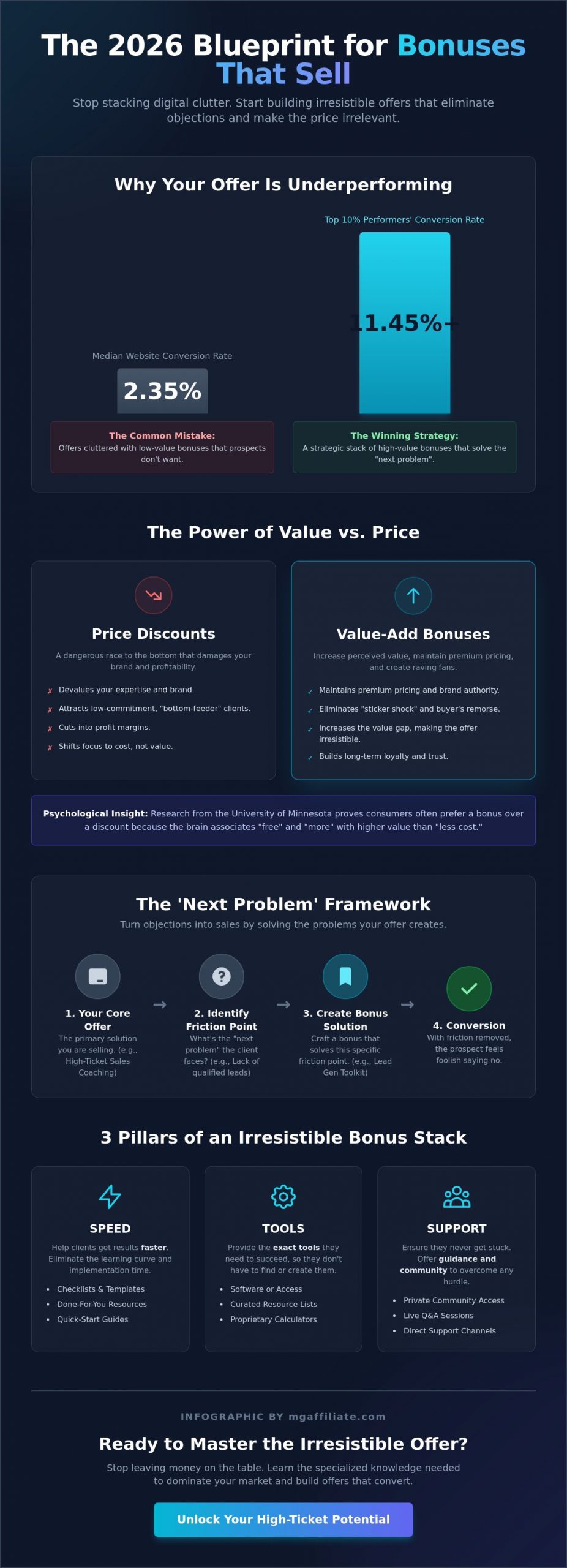
Your offer isn’t failing because it’s too expensive; it’s failing because your bonuses are nothing more than digital clutter that your prospects don’t actually want. Why settle for a median website conversion rate of 2.35% when the top 10% of performers are hitting 11.45% or higher? The secret isn’t lowering your price. It’s creating bonuses that sell by mastering the art of the psychological stack. You’ve likely felt the frustration of high lead costs paired with low closing rates, watching potential wealth slip through your fingers because your offer lacked the “must-have” factor.
You know that a truly powerful offer should make your prospect feel foolish for saying no. We agree that your expertise deserves a premium, yet you’re still hearing “I need to think about it” far too often. This guide promises to hand you the 2026 blueprint for crafting high-value bonuses that solve the “next problem” and eliminate objections instantly. We will explore how to build a value stack that dwarfs your investment cost and secures long-term loyalty through strategic, intentional rewards that act as the key to unlocking your client’s full potential.
Key Takeaways
- Master the “Next Problem” framework to identify friction points and eliminate buyer objections before they even surface.
- Learn the tactical steps for creating bonuses that sell by auditing your core offer and building a specialized stack focused on speed, tools, and support.
- Discover the psychological power of value anchoring and determine whether a massive bundle or a targeted unbundled stack will drive higher conversions for your business.
- Understand why offer structure is the primary reason businesses fail to scale and how the Make More Offers Challenge provides the specialized knowledge needed to dominate your market.
What is a Sales Bonus and Why Does It Drive Conversions?
Stop thinking of a sales bonus as a “nice-to-have” extra. In the high-stakes world of 2026 commerce, a bonus is a strategic tactical asset designed to amplify the perceived value of your core offer until the price becomes irrelevant. Most entrepreneurs fail because they stack their offers with “clutter bonuses” that actually decrease value by overwhelming the buyer. Creating bonuses that sell requires a shift in perspective. You aren’t just giving away “free stuff”; you’re providing the specific keys your prospect needs to unlock the results they’re paying for.
Why does the bonus often carry more weight than the main product? It’s the “Tipping Point” concept. Your prospect is constantly weighing the risk of investment against the reward of transformation. A well-crafted bonus acts as the final weight on the scale that forces a decision. Research from the University of Minnesota proves that consumers often prefer a bonus item over a discount because the human brain associates “free” and “more” with higher value than “less cost.” This is the foundation of a truly irresistible offer. When your bonus stack is perceived as being worth more than the investment itself, saying “yes” becomes the only logical conclusion.
Moving Beyond ‘Free Gifts’ to Strategic Incentives
The era of the generic PDF and the “free 15-minute consultation” is dead. In 2026, these are seen as obligations, not incentives. To dominate your market, your bonuses must be intentional. They should function as a sophisticated sales promotion that addresses the immediate psychological needs of your buyer. High-performance bonuses create urgency and exclusivity by offering specialized knowledge or tools that aren’t available anywhere else. If your bonus doesn’t make the prospect feel like they’re getting an unfair advantage, it’s just noise. You must move from being a vendor to being a strategic partner who anticipates every hurdle your client will face.
Why Bonuses Outperform Price Discounts
Do you want to be known for being cheap, or for being the best? Discounting is a dangerous race to the bottom that devalues your professional brand and attracts “bottom-feeder” clients who lack commitment. By creating bonuses that sell, you maintain your premium pricing while simultaneously increasing the value gap. This approach allows you to provide a “Level 4” value experience. Instead of cutting your profit margins, you’re building a wealth-generating machine that rewards action. Bonuses allow you to overcome the “sticker shock” by shifting the conversation from what the product costs to what the total package is worth. This is how you eliminate buyer’s remorse before the transaction even happens.
The ‘Next Problem’ Framework: Creating Bonuses That Solve Objections
Every solution you sell is a gateway to a new challenge. If you don’t address that challenge, you aren’t selling a result; you’re selling a brand new headache. Creating bonuses that sell is the process of identifying these subsequent hurdles and neutralizing them before they become excuses for inaction. Your prospect’s brain is a survival machine. It’s constantly scanning for reasons to say “no” to protect itself from perceived risk. When you present a core offer, the prospect immediately begins calculating the work required to implement it. If the perceived work outweighs the perceived reward, the sale dies.
The ‘Next Problem’ framework turns this psychological defense mechanism into your greatest sales tool. By mapping out the “Friction Points” that occur after the purchase, you can create a “Stack” of bonuses that act as a sequence of solutions. This leads the buyer toward total mastery rather than leaves them stranded at the first obstacle. You aren’t just adding value; you’re removing the friction that stops them from saying yes. This is how you move from a 2.35% median conversion rate toward the elite 11.45% achieved by the top 10% of performers.
Identifying the Friction Points of Your Core Offer
To build an irresistible stack, you must look past the initial sale. What happens five minutes after they buy? If you sell a comprehensive workout plan, the immediate “next problem” is meal prep and nutrition. If you don’t solve that, the workout plan is useless. Similarly, if you’re offering high ticket sales coaching, the purchaser’s immediate friction point is a lack of high-quality leads to practice on. A bonus acts as a strategic bridge that carries your client from the initial purchase to their ultimate transformation. It ensures they never feel stuck or overwhelmed by the very solution they just bought.
Turning Implementation Hurdles into Bonus Solutions
Implementation is where most dreams go to die. Your bonuses should be designed to maximize speed and ease. “Done-For-You” templates, swipe files, and checklists are the ultimate high-conversion assets because they eliminate the “blank page” syndrome. Frame your bonus as the “missing piece” of the success puzzle. If the core offer is the engine, the bonus is the fuel and the GPS. When you present your offer this way, the prospect realizes that they don’t just want your product; they need the entire ecosystem you’ve built. If you want to master this offer structure, the Make More Offers Challenge provides the exact blueprints for building these high-value stacks.
Bundling vs. Unbundling: Choosing the Right Strategy for 2026
Should you overwhelm your prospect with a mountain of value or reveal your brilliance one piece at a time? This is the fundamental choice between bundling and unbundling. While the “everything but the kitchen sink” approach can work, it often leads to decision paralysis. Your prospect sees twenty bonuses and thinks, “I’ll never have time to go through all of this.” Creating bonuses that sell requires a surgical understanding of how your audience perceives volume versus value. Are you providing a solution, or are you just providing more work? The right strategy depends entirely on the psychological state of your buyer at the moment of the offer.
Value Anchoring is the secret weapon of high-ticket sales. By presenting your bonuses as a sequence of high-value assets, you establish a mental price point that dwarfs the actual investment. If your core offer is $5,000, but your unbundled bonus stack is valued at $15,000, the prospect’s brain anchors to the higher number. Suddenly, the $5,000 isn’t a cost; it’s a $10,000 discount. This technique creates multiple “wins” throughout your presentation. Each time you reveal a new bonus, you’re not just adding a feature; you’re solving a specific objection and giving the prospect a hit of dopamine as they realize their success is becoming more certain.
The Art of Bundling for Maximum Perceived Value
Bundling is most effective when your target audience needs a complete ecosystem to succeed. Think of a SaaS platform or a comprehensive certification program. In these cases, the “massive bundle” provides a sense of security. However, you must avoid “Value Overload.” If the bundle feels like a cluttered attic, the value disappears. Structure your bundle so that every piece feels like a vital organ of the main body. Ensure the price feels like a tiny fraction of the total worth by clearly stating the individual value of every component before revealing the package price.
The Unbundling Method: Creating Value from Thin Air
Unbundling is the most efficient way to increase your offer’s appeal without creating more work for yourself. Take a single chapter from your book or one module from your course and turn it into a standalone “Mastery Blueprint.” Naming is the key to this transition. A generic “Bonus Module” has zero weight, but a “Proprietary Lead Generation Framework” is an asset. This is the secret to scaling an enterprise with speed. By unbundling your existing intellectual property, you can create a high-value stack that feels personalized and exhaustive. Creating bonuses that sell through unbundling allows you to present a narrative of total support, ensuring the prospect feels you have anticipated and solved every potential hurdle on their journey to wealth.
Step-by-Step Guide to Crafting a Bonus Stack That Converts
You’ve identified the “next problem.” Now, you must engineer the solution. Creating bonuses that sell isn’t about throwing random ideas at a wall; it’s a precise architecture of value. Start by auditing your core offer. Why would a prospect hesitate? If your offer requires significant effort, your bonus must provide ease. If your offer takes time to manifest results, your bonus must provide speed. Successful stacks in 2026 rely on three pillars: Speed, Tools, and Support. Speed collapses the time-to-result; Tools do the heavy lifting; Support ensures they never feel abandoned in the process.
Assign a real-world value to every asset in your stack. Don’t guess. Use your previous consulting rates or historical sales data to anchor these prices. When you write your bonus descriptions, sell the transformation, not the features. Nobody wants a “10-page PDF.” They want the “Client Acquisition Engine” that generates leads while they sleep. Finally, integrate these into your pitch using the “Stack” technique. Reveal each bonus one by one, building a cumulative mountain of value that makes the final price reveal feel like a gift rather than a cost.
Naming Your Bonuses for Maximum Impact
A name is a promise. Avoid boring, administrative terms like “Workbook” or “Cheat Sheet.” These sound like homework. Instead, use power words that imply momentum and exclusivity. Think “Accelerator,” “Vault,” “Blueprint,” or “Engine.” Your bonus name should tell the prospect exactly what result they will achieve the moment they open the file. If the name doesn’t spark an immediate “I need that” reaction, it’s not working hard enough for your bottom line.
Establishing Real vs. Perceived Value
How do you justify a high price tag on a digital asset? You anchor it to the cost of the problem it solves. If your bonus saves a client forty hours of work, value it based on what those forty hours are worth to a high-performer. This creates a “Price vs. Worth” distinction. When the prospect sees that a single bonus is worth more than the entire investment of the core offer, the sale is essentially closed. You aren’t just selling a product; you’re offering a massive arbitrage opportunity.
Automation and Delivery in 2026
In a world where traffic from AI search platforms converts 22% higher than traditional search, your delivery must be seamless. Use AI-driven personalization to deliver bonuses based on customer behavior. If a buyer struggles with a specific module, trigger a “Support” bonus automatically. This instant gratification reduces refund rates and dramatically increases customer lifetime value. High-performance entrepreneurs use these systems to scale without increasing their personal workload. To master the mechanics of these high-conversion systems, explore Click and Sell Almost Anything and start creating bonuses that sell today.
Master the Art of the Irresistible Offer with Myron Golden
Why are you still working so hard for such a small return? It’s a question every struggling entrepreneur must face. The reality is that your income isn’t capped by your work ethic or your industry’s potential. It’s capped by your offer structure. If you’re still selling a commodity, you’re competing on price. If you’re creating bonuses that sell, you’re competing on value. Myron Golden has spent decades proving that the ability to create, convey, and convert offers is the most profitable skill on the planet. By shifting from a “selling” mindset to an “offering” mindset, you stop begging for attention and start commanding it.
The frameworks taught by Myron Golden aren’t just marketing tips; they’re the keys to psychological optimization and economic independence. When you master the art of the stack, you aren’t just adding items to a list. You’re building a fortress of value that makes your core product look like the bargain of the century. This is how average entrepreneurs transform into high-ticket closers who dominate their niche. You have the latent potential to achieve high-level success. You simply need the right system to unlock it.
Why Your Offer Structure is Capping Your Income
A commodity is a product that people look for the lowest price on. An irresistible offer is a transformation that people will pay a premium to achieve. Which one are you currently presenting? The right bonus stack allows you to charge 10 times more than your competitors because you aren’t selling the same thing they are. You’re selling the speed, the tools, and the support required to reach the finish line first. This is the essence of making BOSS Moves. To reach the next level of business growth, you must optimize your offer until the value is so high that the price becomes a non-issue for your ideal client.
Join the Make More Offers Challenge
Are you ready to stop guessing and start growing? The Make More Offers Challenge is a 5-day live intensive training ground designed to overhaul your business from the ground up. Over five days, you’ll learn the exact frameworks for creating bonuses that sell and structuring offers that eliminate objections instantly. You can choose your level of immersion. General Admission provides the foundational training you need to start scaling, while the VIP Experience offers a more intimate look at the strategies required for high-level market dominance. The choice is yours, but the clock is ticking on your current results. Ready to create offers that sell? Join the Make More Offers Challenge today.
Ignite Your Professional Evolution Through Irresistible Offers
Your journey from a commodity vendor to a high-ticket authority depends on one critical pivot. You must shift from selling products to offering total transformations. We’ve explored how the “Next Problem” framework neutralizes objections before they are even spoken. You now understand how strategic unbundling creates a value stack that makes your price feel like a gift. Mastering the skill of creating bonuses that sell is the most direct path to increasing your conversion rates and eliminating buyer’s remorse. Stop letting potential wealth slip through the cracks of a weak offer structure.
Success is not an accident. It’s a result of implementing proven, proprietary frameworks. Thousands of successful high-ticket entrepreneurs have already used these exact wealth-building systems to achieve economic independence. This process focuses on immediate implementation and tangible results. Are you ready to stop guessing and start winning? Scale your business with the Make More Offers Challenge and join a network of elite performers. Your potential is waiting. Your action must be immediate. Step into your future today.
Frequently Asked Questions
How many bonuses should I include in my offer?
Aim for three to five high-impact bonuses to create an effective value stack. Including too many items leads to decision paralysis, while too few may fail to provide the psychological leverage needed to close a high-ticket sale. Focus on the three pillars of speed, tools, and support to ensure every addition serves a specific strategic purpose.
What makes a bonus ‘irresistible’ to a high-ticket buyer?
A bonus becomes irresistible when it collapses the time-to-result for the buyer. High-ticket prospects value their time more than their money. If your bonus provides a “Done-For-You” tool or a “Speed Accelerator” that removes a difficult implementation hurdle, it shifts from being a “free gift” to an essential asset they can’t afford to ignore.
Can I use bonuses for physical products as well as digital ones?
Yes, physical products thrive when paired with digital “accelerator” bonuses. If you sell a tangible tool, include a digital “Mastery Vault” or a “Setup Blueprint” that ensures the customer gets immediate value. This hybrid approach is a core component of creating bonuses that sell because it provides instant gratification while the physical product is in transit.
How do I value a bonus if I’ve never sold it separately?
Anchor the value to the financial cost of the problem the bonus solves. If your bonus saves a client ten hours of professional labor, value it based on the market rate for those hours. This creates a logical, defensible price point that establishes real-world worth in the prospect’s mind during your sales presentation.
Will adding too many bonuses make my main product look weak?
Only if the bonuses are irrelevant clutter. When each bonus is a strategic solution to a “next problem,” it actually strengthens your core offer. It proves you have a comprehensive system for success. Strategic bonuses show you’ve anticipated every obstacle, which builds trust and positions you as a high-performance mentor.
What is the best way to present bonuses during a sales pitch?
Use the “Stack” technique to reveal them one by one. Don’t dump them all at once. Present your core offer first, then introduce each bonus as a specific solution to a potential objection. This builds a cumulative mountain of value, making the final investment price feel like a massive arbitrage opportunity for the buyer.
Should I offer bonuses that are only available for a limited time?
Yes, because urgency is a primary driver of human action. Offering a “Fast Action Bonus” for those who commit within a specific timeframe, such as the first 24 hours, forces a decision. It rewards the decisive high-performers who are ready to experience significant personal evolution and professional advancement immediately.
How do I create bonuses quickly without sacrificing quality?
The most efficient method for creating bonuses that sell is unbundling your existing intellectual property. Take a single high-value chapter from your book or a specific module from a previous training and repackage it as a standalone “Mastery Engine.” This allows you to provide specialized knowledge without the need to generate entirely new content from scratch.
Leave a Reply