

Your high-ticket offer isn’t failing because the price is too high; it’s failing because your value is too thin. Why are you still letting prospects treat your expertise like a commodity? When you study successful offer stack examples, you’ll see they don’t just list features. They solve every logical objection before the prospect even has a chance to speak. You know the frustration of watching a lead walk away because they think you’re “just another service,” and it’s time to end that cycle for good.
You probably feel like your conversion rates are stuck in the mud while your competition keeps raising their prices. It’s frustrating to know you have the “key” to their success but can’t get them to see it. I promise to give you a clear blueprint for an irresistible offer that protects your profit margins and makes your sales presentations feel effortless. We’re going to dive into specific frameworks designed to turn skeptical prospects into committed buyers. Let’s look at the strategic sequence of solutions that will transform your business into a wealth-building machine.
Key Takeaways
- Eliminate the “Price-Value Gap” by shifting your focus from cost reduction to radical value expansion.
- Model your strategy after proven offer stack examples designed for 2026, including high-ticket consultant and SaaS frameworks.
- Neutralize every logical objection by mapping your bonuses to the specific hurdles that stop prospects from buying.
- Secure your path to financial independence by joining the Make More Offers Challenge to master the art of the irresistible stack.
The Psychology of the Offer Stack: Why Value Beats Price
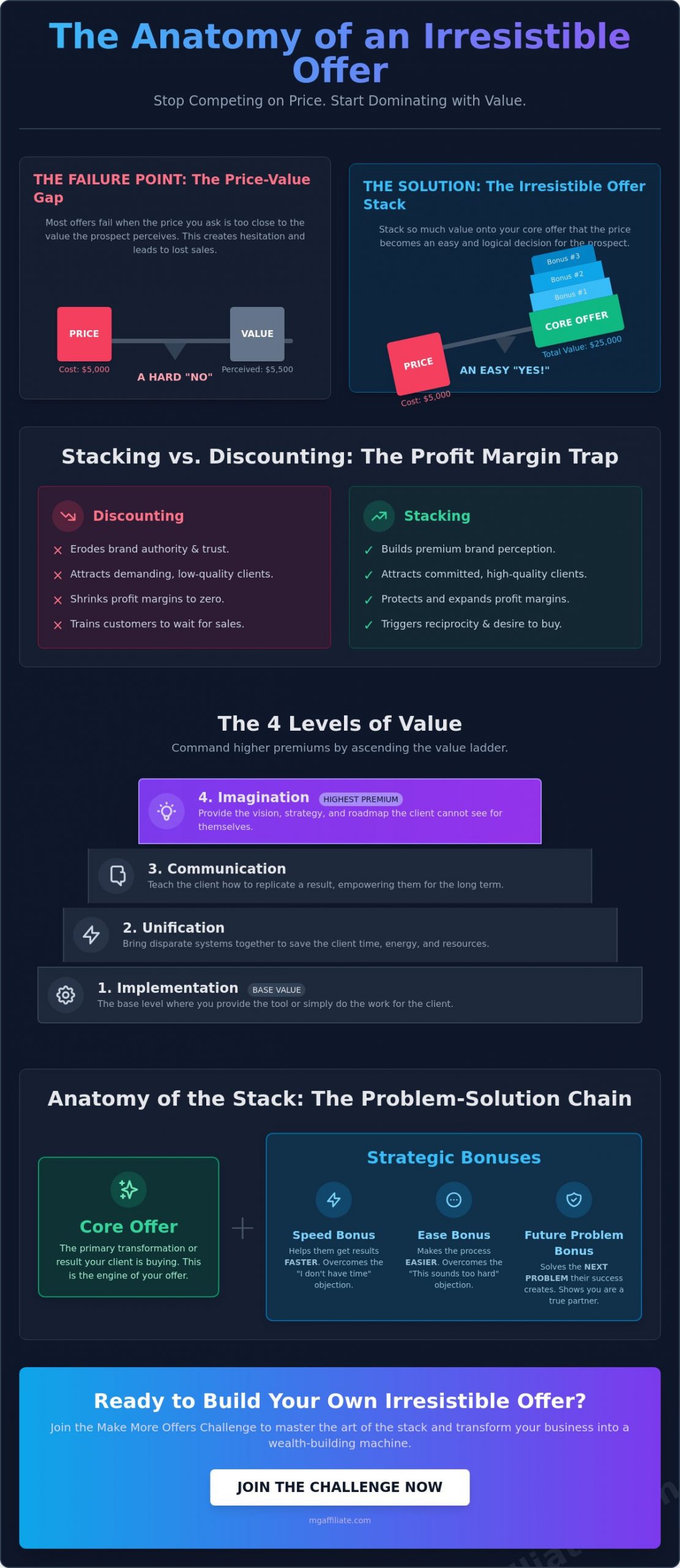
Price is rarely the reason a prospect walks away. Most entrepreneurs lose sales because they haven’t widened the gap between what they charge and what the customer actually gets. An offer stack is the total sum of value a customer receives compared to the price they pay. While the concept shares roots with traditional product bundling, a high-ticket stack is far more strategic. It’s a psychological bridge that moves a buyer from “this is expensive” to “I can’t afford not to do this.”
When you look at successful offer stack examples, you’ll notice they don’t focus on price reduction. They focus on value expansion. Most businesses fail because they try to close the “Price-Value Gap” by lowering their fees. This is a fatal mistake. Instead of shrinking your price, you must inflate your value. This shift transforms you from a product seller into an offer seller. A product is just a commodity. An offer is a comprehensive solution that makes the decision to buy a logical necessity.
The 4 Levels of Value in Stacking
To build a high-ticket stack, you have to understand where your value lives. Implementation is the base level where you provide the tool or do the work. Unification involves bringing disparate systems together to save the client time. Communication is the third level where you teach the client how to replicate a result. Finally, there is Imagination. Moving up these levels is the secret to commanding higher premiums. Imagination level offers command the highest premiums because they provide the vision and strategy that the client cannot see for themselves.
Stacking vs. Discounting: The Profit Margin Trap
Stop discounting your services. It’s a trap that erodes your brand authority and attracts nightmare clients who demand the most while paying the least. When you discount, you tell the world your original price was a lie. Stacking does the opposite. It preserves your profit margins while making the customer feel like they’ve won a massive victory. This triggers the psychological law of reciprocity. By adding high-value bonuses that solve specific problems, you create a sense of obligation in the prospect. They feel compelled to say yes because you’ve already given them so much value before the transaction even begins. This is how you use offer stack examples to build a business that thrives on high margins and happy clients.
Anatomy of an Irresistible High-Ticket Offer Stack
Building a high-ticket offer is like constructing a high-performance engine. Every component must work in harmony to drive the prospect toward a single conclusion: saying yes. Your Core Offer is the engine itself. It’s the primary vehicle for the transformation or result your client is chasing. However, in a competitive market, the engine isn’t enough. You need the turbocharger, the navigation system, and the safety features. These are your bonuses. By studying successful offer stack examples, you can see how leaders in your industry layer value to make the price feel insignificant compared to the outcome.
The first layer is the Speed Bonus. High-ticket buyers are often time-poor and result-hungry. They will pay a premium to reach the finish line faster. If your core service takes six months, your Speed Bonus should show them how to see results in six weeks. Next is the Ease Bonus. This removes the “friction” of the process. It’s the difference between giving someone a gym membership and giving them a personal chef. You’re making the process less painful. Finally, you must include the Future Problem Bonus. This anticipates the new challenge your core solution will create. If you’re ready to master this architecture, the Make More Offers Challenge provides the strategic key to unlocking this level of business growth.
The “Problem-Solution” Chain
Every solution you provide creates a new, higher-level problem. This is a fundamental law of business. If you sell a weight loss program, the new problem is “what do I cook every night?” If you don’t solve that secondary problem, it becomes a reason for the prospect to hesitate. You use bonuses to break this chain of friction. For example, a meal plan bonus perfectly solves the cooking dilemma created by the diet. By addressing these hurdles before they even arise, you prove that you are a strategic partner who is deeply committed to their success. This level of foresight is what separates a generic course from a high-ticket experience.
Quantifying Perceived Value
You must assign a concrete, real-world value to every element in your stack. This isn’t about pulling numbers out of thin air; it’s about transparency and logic. Research into consumer’s perceived brand value shows that buyers are more likely to commit when they understand the utilitarian and social benefits of what they’re buying. If a template saves a client twenty hours of work, and their time is worth $100 an hour, that template has a documented value of $2,000. Use honest comparisons to other market solutions to anchor your value. When the prospect sees the total value is ten times the price, the investment becomes a logical necessity.
To finalize the stack, you must inject scarcity or urgency. Why do they need to move today? Whether it’s a limited number of spots in the VIP Experience or a time-sensitive bonus, you must give them a reason to act. Without a deadline, a “maybe” eventually becomes a “no.” High-performance mentors don’t leave the close to chance. They use offer stack examples to create a sense of momentum that carries the prospect all the way to the finish line.
5 Powerful Offer Stack Examples to Model in 2026
Are you still selling “stuff” or are you selling outcomes? Most entrepreneurs fail because they bury their prospects in digital clutter. They add more videos and more PDFs, thinking quantity equals quality. It doesn’t. These offer stack examples demonstrate how to layer high-impact solutions that command high-ticket prices without overwhelming your buyer. You must move from being a vendor to becoming a strategic partner. This shift is the key to escaping the commodity trap and building a business that scales with authority.
- The High-Ticket Consultant Stack. This combines a Core Strategic Audit with custom implementation templates and a weekly Q&A. It turns your advice into a tangible system that the client can actually use.
- The SaaS/Software Stack. Move beyond monthly subscriptions. Bundle annual access with a high-level implementation call and access to an exclusive mastermind. This secures long-term retention and higher upfront cash flow.
- The Coaching Program Stack. Your transformation curriculum is the base. Add a private community for peer support and a 1-on-1 kickoff session to ensure immediate momentum.
- The Agency/Done-For-You Stack. Don’t just execute tasks. Pair your execution with a custom strategy roadmap and a real-time reporting dashboard. This proves your value through data.
- The “Challenge” Stack. Look at the Make More Offers Challenge as a primary model. It combines high-intensity daily training with VIP Q&A sessions and action-oriented workbooks to drive immediate results.
This strategic layering aligns with the foundational principle of a value proposition. You must define exactly how you meet the unique needs of your customer segment while establishing a clear price-to-value advantage. When you do this, the price becomes a secondary thought. Let’s break down how this looks in specific niches so you can start building your own irresistible offer stack examples today.
The Coaching & Mentorship Stack Breakdown
Your core is a 12-week transformation program. Stop there, and you’re just another course creator. Add a private Slack community for 24/7 support. This solves the “loneliness” problem of self-paced learning. Finally, include a library of “plug-and-play” templates. These give the client immediate speed. They don’t have to build from scratch; they just have to execute. You’ve removed the thinking and replaced it with doing.
The Service Provider “Value-Add” Stack
If you’re a web designer, your core is a full website redesign. What happens after the site launches? They need hosting, security, and updates. Add six months of managed SEO hosting as a bonus. This solves a future problem before it starts. Throw in a custom brand style guide and logo variations to ensure their new site looks professional across every platform. You’ve moved from a one-time project to a long-term solution.
The Digital Product “Mastery” Stack
A comprehensive video course is the foundation. To make it high-ticket, you need human connection. Add monthly live “hot seat” coaching sessions where you solve real problems in real time. Want to increase perceived authority? Include an interview series with industry titans. This transfers their credibility to your offer and proves you are a high-level player. You aren’t just selling information; you’re selling access and status.
How to Structure Your Stack to Overcome High-Ticket Objections
Why do prospects hesitate? It isn’t the dollar amount. It’s the lack of certainty. You must use your offer stack to systematically dismantle every reason they have to say no. When you study high-performing offer stack examples, you’ll see they don’t leave objections to chance. They anticipate them. They map every bonus to a specific psychological barrier. If the prospect thinks, “I don’t have time,” your stack must include time-saving templates or automated systems. You aren’t just adding features. You’re removing roadblocks. This creates a clear path toward a logical yes.
High-ticket sales are won or lost on three primary objections: time, value, and ability. If you don’t address these in your presentation, you’re leaving your profit margins to luck. A strategic mentor knows that every bonus in the stack should act as a specialized tool to neutralize a specific fear. By the time you get to the price, the prospect should feel that the value is so overwhelming that the cost is a secondary concern. This is how you turn a skeptical lead into a high-ticket buyer who is excited to start the journey with you.
The “Is it worth it?” Objection
This objection is actually a value deficit. The prospect doesn’t see how your solution creates a 10x return on their investment. To solve this, you must stack social proof and case studies as active assets within your offer. Show them the “Cost of Inaction.” What does it cost them to stay exactly where they are for another year? Compare that heavy price to your investment. For a deeper look at setting these levels, check out the 2026 guide to premium offers. By framing the purchase as a logical necessity for professional evolution, you move the conversation from “expense” to “investment.”
The “Can I do it?” Objection
This is the most common reason for a “no” in the high-ticket world. The prospect believes in your system, but they don’t believe in themselves. They fear they lack the technical skill or the discipline to execute. You neutralize this by adding “Done-with-you” or “Done-for-you” elements to your stack. Use the strategies found in BOSS Moves to simplify complex business growth into manageable, daily actions. Implementation bonuses remove the fear of failure by providing the exact blueprints and support needed for success. When you provide the tools and the framework, the “how” is no longer a mystery.
Certainty is the ultimate currency in 2026. If you can’t provide it, you can’t close high-ticket deals. Your stack must prove that the result is inevitable. The final piece of this puzzle is risk reversal. A strong guarantee isn’t a safety net for a bad product; it’s a statement of absolute confidence in your methodology. It shifts the burden of risk from the buyer to the seller. Are you ready to build a stack that commands respect and high margins? Start your journey by joining the Make More Offers Challenge today and master the art of the irresistible close.
Mastering the Stack: Join the Make More Offers Challenge
Mastery isn’t a suggestion. It’s a requirement for anyone seeking true economic independence in 2026. Why is learning to stack the #1 skill for financial freedom? Because when you control the offer, you control the income. You stop being a victim of market fluctuations and start being the architect of your own wealth. The 5-Day Make More Offers Challenge (MMOC) is the laboratory where this mastery is forged. It isn’t a passive seminar. It’s a high-intensity deployment designed to rewrite your financial DNA. While we’ve discussed several offer stack examples throughout this guide, observing them is different from building them in the heat of battle.
The MMOC framework has already transformed thousands of businesses by shifting their focus from selling “stuff” to selling outcomes. This isn’t about incremental growth. It’s about a total professional evolution. You can choose your level of immersion. General Admission provides the foundational blueprints to stop your profit leaks. The VIP Experience, however, is where the real magic happens. It offers an extra layer of proximity and advanced strategy that allows you to see the “Imagination” level of value in action. This is the difference between learning a system and mastering a craft.
The MMOC Experience: Stacking in Real-Time
The challenge follows a rigorous day-by-day breakdown that forces you to confront your business’s weaknesses. You start by identifying your core value and end with a stack that makes a “no” feel like a logical mistake for your prospect. You won’t be doing this alone. You’ll work alongside a community of high-performers, receiving live feedback and the kind of specialized knowledge that only comes from a mentor who has already mastered the system. This real-time optimization is the “key” to unlocking the latent potential your business already possesses. Read the full MMOC 2026 breakdown to see exactly how each day moves you closer to your goal of high-ticket dominance.
Your Next Step to High-Ticket Mastery
Offer literacy is more than a marketing tactic. It’s a tool for wealth redistribution. When you learn to communicate value at this level, you gain the power to move capital from where it’s stagnant to where it can create real growth. You’ve seen the offer stack examples. You understand the psychology. Now, you must take action. Stop selling products. Products are commodities that get compared on price. Start selling transformations that have no equal. Every day you wait is a day you’re leaving your potential on the table. Register for the next challenge today. Secure your spot in the VIP Experience. Build the legacy your hard work deserves.
Claim Your Seat at the High-Ticket Table
You’ve seen how the right offer stack examples can transform a struggling service into a high-ticket powerhouse. You now understand that value isn’t about adding more stuff; it’s about solving the specific psychological hurdles that stop your prospects from committing. By mapping your bonuses to objections and shifting your focus from products to transformations, you unlock a level of profitability most business owners only dream of. The gap between where you are and where you want to be is simply the quality of the offer you’re making.
It’s time to stop theorizing and start executing. You have the potential for massive growth, but you need the right framework to access it. Our proprietary BOSS Moves framework has already empowered over 100,000 entrepreneurs to master their markets and reclaim their time. Don’t let another lead slip through your fingers because your value proposition was thin. Register for the Make More Offers Challenge and build your stack live! You’ll receive live coaching from Myron Golden to ensure your next presentation is undeniable.
Your professional evolution is waiting for you. Take the leap and become the authoritative leader your clients are looking for today. Success isn’t an accident. It’s a choice you make right now.
Frequently Asked Questions
What is an offer stack?
An offer stack is the strategic grouping of a core solution and several high-value bonuses that collectively solve a prospect’s problem. It moves the conversation away from a single product or service and toward a complete transformation. By layering these elements, you increase the perceived value until the price becomes a secondary concern for the buyer.
How many bonuses should be in an offer stack?
You should aim for three to five high-impact bonuses in your presentation. If you include too few, you won’t widen the value gap enough to justify a high-ticket price. If you include too many, you risk creating digital clutter that overwhelms the prospect and slows down the decision-making process.
Does offer stacking work for service-based businesses?
Yes, offer stacking is essential for service providers who want to escape the commodity trap. Instead of just selling a website or a tax return, you stack strategy sessions, maintenance plans, or proprietary templates. This makes your service unique and prevents prospects from comparing your price to lower-quality competitors.
What is the difference between a value stack and an offer stack?
A value stack is typically a list of features and prices shown at the end of a pitch to summarize the deal. An offer stack is the entire architecture of the solution designed to solve specific objections and future problems. While they are related, the offer stack is the strategic framework that makes the sale inevitable.
Can an offer stack be too big and overwhelm the customer?
Yes, an offer stack becomes overwhelming when the bonuses aren’t curated to solve specific hurdles. Every piece of your stack must serve a purpose. If a bonus doesn’t save time, increase ease, or solve a future problem, it is just noise. Focus on high-impact offer stack examples that prioritize quality over sheer volume.
How do I determine the value of my bonuses?
You determine value by calculating the real-world cost of the result or the time saved for the client. If a template saves a professional ten hours of work, value it based on their hourly rate. Always be honest and logical with these numbers. Fabricating “fake” values will instantly destroy the trust and rapport you’ve built with your audience.
What is the most important part of a high-ticket offer stack?
Certainty is the most critical element of any high-ticket offer. Your prospect must believe that the result is inevitable and that you’ve removed every logical reason for failure. When you use offer stack examples to prove that your system is reliable and risk-free, the price becomes an investment rather than a cost.
How do I use an offer stack in a sales webinar or presentation?
Introduce each component of your stack individually to build a sense of momentum and mounting value. Explain the specific problem each bonus solves before adding it to the total. This “stacking” effect creates an overwhelming feeling of generosity and logic before you ever reveal the final investment required to join.
Leave a Reply