

A startup doesn’t have to run on time borrowed from your marriage. Balancing a startup with marriage responsibilities starts with treating your relationship as a shared priority: involve your spouse in important decisions, protect regular time together, and agree on boundaries for work talk. Begin with 10 minutes each day to connect, then build a routine you can both sustain.
It’s understandable when work spills into home life. Self-employment schedules can make balancing work and personal life difficult, according to the U.S. Bureau of Labor Statistics. But your business plan doesn’t have to be the only plan you make together. Clear communication and steady routines can help you meet startup demands as partners, rather than leave one spouse feeling shut out.
This article explains how to invite your spouse’s perspective without handing over every business decision, make meaningful time for each other, and share updates without letting work dominate every conversation. You’ll also find practical planning habits for aligning goals, handling busy periods, and staying connected as your startup grows.
Key Takeaways
- Invite your spouse to offer perspective on decisions that affect shared priorities, while keeping business ownership and decision-making roles clear.
- Put time together on the calendar and treat it as a commitment, not something to fit in only when work slows down.
- Share business updates with context and a clear purpose, then agree on boundaries that keep work from taking over personal conversations.
- Use planning habits to align personal and business goals, revisit commitments together, and adjust when circumstances change.
1. Asking a spouse for business perspective
A spouse can offer a valuable perspective without taking control of the startup. The author recalls his wife asking whether he ever stopped working about 10 years earlier. That question prompted him to consider how business demands affected their shared life. Ask your spouse focused questions about priorities, time, and risks. For example, “What part of this plan concerns you most?” invites a specific response, not a vague endorsement.
Start by separating the decision from the discussion. Explain the choice you face, the options you’re considering, and what each could mean for your household. Then listen without immediately defending the plan. The author has been married for over 22 years, and Steve and Mary Alessi said they had been married for 34 years. Those details don’t establish a formula for every couple; they underline that a spouse’s perspective belongs in an ongoing conversation, not a single business meeting.
How can a spouse support an entrepreneur without becoming an unpaid employee? Agree on the support you’re asking for, such as reviewing a proposal or talking through a decision, and set clear limits. If your spouse takes on recurring business tasks, discuss the workload and expectations separately rather than treating their help as automatic. Clear roles protect the relationship and help both of you understand what’s expected.
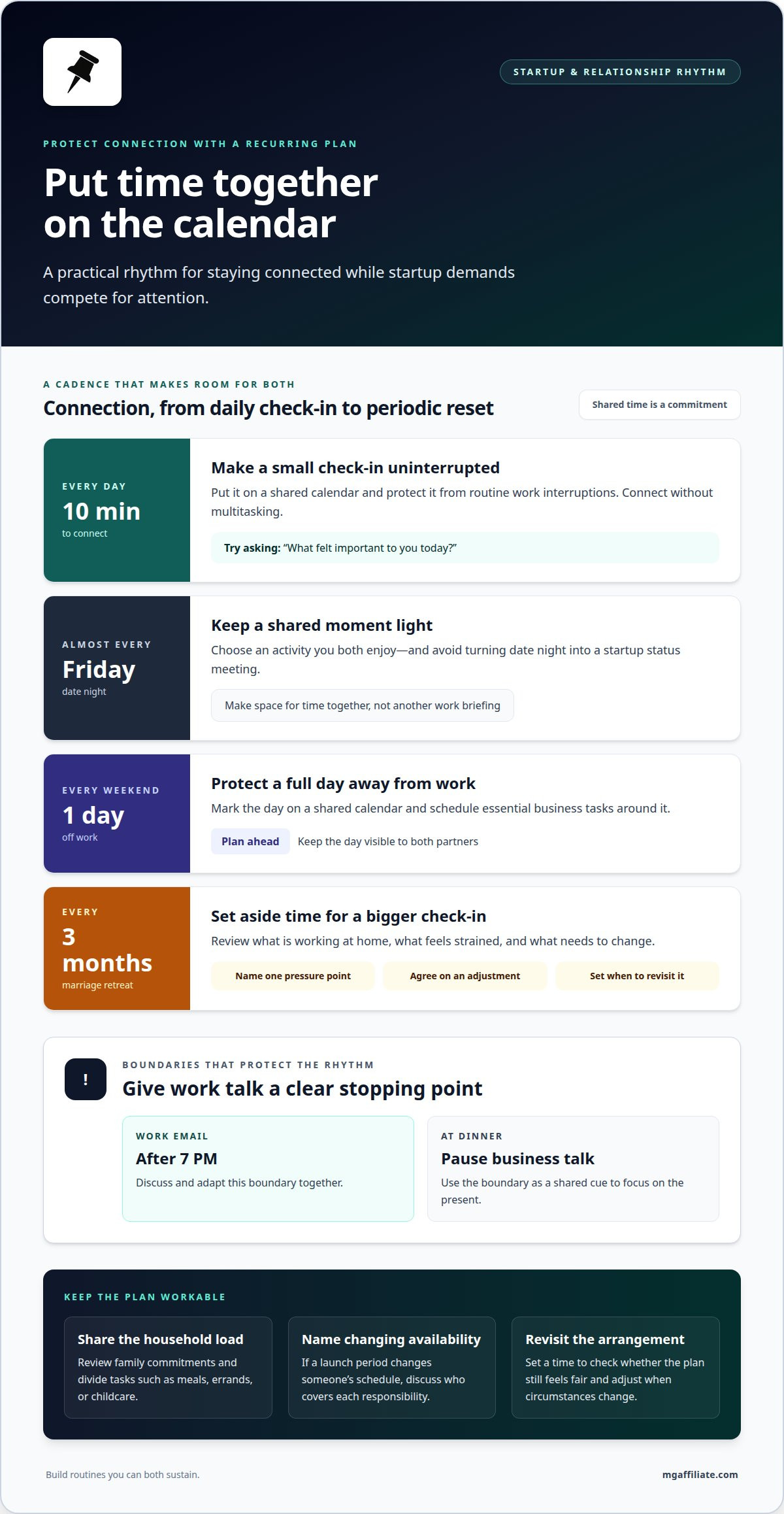
For couples working together, assign ownership before work begins. For example, one spouse might lead customer conversations while the other handles household planning, if both freely agree. Set a check-in to review whether the arrangement still feels fair. The author recommends ending work-email use after 7 PM, a boundary couples can discuss and adapt together.
How should couples handle disagreements about startup risk and time commitments? Name the specific concern, such as unpredictable hours or financial exposure, then weigh it against the business plan and household priorities. Decide what information or boundary would make the next step manageable. Self-employment schedules can make balancing work and personal life difficult, according to the U.S. Bureau of Labor Statistics, so discuss the schedule directly instead of dismissing the concern.
2. Scheduling recurring time together
Reserve 10 minutes each day to connect without multitasking. Put the time on a shared calendar, then protect it from routine work interruptions. Ask one specific question, such as, “What felt important to you today?” Listen fully before discussing tomorrow’s plans. A short daily check-in gives each spouse a predictable opening to share, rather than waiting for a quiet moment that may never arrive.
Build longer conversations into the calendar, too. The author and his wife hold marriage retreats every 3 months. Use that recurring time to review what’s working at home, what feels strained, and what needs a change. Keep the discussion practical: identify one pressure point, agree on an adjustment, and decide when to revisit it. A retreat doesn’t need an elaborate agenda. A planned conversation away from ordinary household routines can help both partners focus.
Protect lighter moments as deliberately as planning sessions. The author and his wife have weekly date nights almost every Friday. Choose an activity you both enjoy, and avoid turning it into a startup status meeting. The author also recommends taking one full day off work every weekend. Mark that day on a shared calendar and schedule essential business tasks around it.
Leading together at home means treating household responsibilities as shared work, not invisible support. Choose a weekly planning moment to review family commitments and divide tasks, such as meal preparation, errands, or childcare. If a launch period changes someone’s availability, name the change and agree on who covers each responsibility. Then set a date to revisit the arrangement. For couples mapping business goals alongside home priorities, the Make More Offers Challenge is another resource to consider as part of the wider startup plan.
3. Sharing business updates without overwhelming a spouse
Be clear about why you’re sharing startup news. Say whether you want advice, practical help, or simply a listening ear. For example, “I need to talk through a delayed launch, not solve it tonight” sets expectations. Share the essential context, explain what changed, and identify any decision that affects your household. This keeps updates useful without turning every conversation into an open-ended business briefing.
How should spouses communicate about startup stress, schedules, and changing priorities? Describe the pressure and its practical effect, then explain what might need to change at home. For example, if a customer deadline shifts your work hours, tell your spouse what needs adjusting and discuss the impact on your household. The author recommends ending work discussions at dinner. Use that boundary as a shared cue to pause business talk and focus on the present.
Sharing leadership also means agreeing on who has authority over which decisions. If both spouses work in the startup, define responsibilities by decisions rather than vague titles. One partner might lead product choices while the other manages customer communication, if that division suits their skills and both agree. Identify decisions that need both perspectives, such as a major schedule change affecting family commitments. Clear ownership reduces duplicated effort and helps keep business disagreements from becoming personal disputes.
When the business situation changes, use a concise update: what happened, what it affects, and what response you need. For instance, if a launch is delayed, explain whether plans at home need to change too. Invite questions, but don’t assume every update calls for immediate problem-solving. If stress is high, ask whether it’s a good time to talk. If not, agree on a better time rather than letting concerns about work schedules or shifting priorities build up.
4. Applying business planning practices to marriage
Borrow a startup planning habit: put shared priorities into a written marriage plan. Name what each partner wants to protect, such as family time, financial stability, or career growth. Turn those priorities into agreements about work hours, household duties, and decisions that need joint discussion. Keep the plan visible and revisit it when a launch, customer demand, or caregiving need changes. This makes balancing a startup with marriage responsibilities an ongoing practice, not a one-time conversation.
Long or unpredictable startup hours can squeeze out conversation, rest, and shared routines. That pressure may increase stress and cause tension if one spouse feels consistently sidelined. Plan your capacity at home: identify urgent work, decide what can wait, and set a stopping point. If an urgent task disrupts a planned commitment, discuss the impact and agree on a replacement plan together.
How can couples set shared financial limits and manage startup-related financial risk? Write down which household funds are protected, which business expenses need mutual agreement, and what changes would trigger a spending pause. Review the startup’s cash needs alongside essential household commitments before making a new financial decision. For couples balancing a startup with marriage responsibilities, setting financial boundaries early can help keep business decisions aligned with shared priorities.
Watch for recurring signs that startup demands are harming the marriage: repeated arguments about work hours, resentment over household duties, or withdrawal from conversations. If those patterns persist or feel difficult to resolve together, couples can seek counseling before conflict becomes their only way to communicate. Treat support as a practical step, not a verdict on the relationship. If your startup plan also needs stronger offers, explore the Make More Offers Challenge as a business-focused next step.
MG Affiliate: BOSS Moves Book
MG Affiliate’s BOSS Moves Book is a business resource for entrepreneurs who want to build with intention. After setting shared expectations at home, turn to the book as you consider your next business decisions. Apply its ideas to your planning, then discuss any changes that could affect your spouse, household schedule, or shared priorities.
A book can support your planning, but it can’t make relationship decisions for you. Keep discussing how startup demands affect your household, and make important choices together. To add a business resource to your entrepreneurial growth, explore the BOSS Moves Book.
Visit mgaffiliate.com to learn more about the BOSS Moves Book.
Build Your Next Season With Shared Intention
Make the plans you’ve discussed part of how you lead, rather than another task competing with your marriage. Choose one business priority and one shared relationship priority, then use both to guide your decisions. This keeps balancing a startup with marriage responsibilities connected to the life you’re building together, rather than treating it as a problem to solve once.
For continued business learning, MG Affiliate offers the BOSS Moves Book and the Make More Offers Challenge, with General Admission and VIP Experience options. Consider these resources as you decide what support fits your next entrepreneurial step. They’re business-focused offerings, not substitutes for the conversations and choices you make together as spouses.
Contact MG Affiliate to discuss your goals, and keep building a future that makes room for both your ambition and your partnership.
Frequently Asked Questions
How can entrepreneurs balance startup demands with marriage and family life?
Decide which responsibilities need your personal attention, then identify what you can delegate, delay, or simplify. For example, during a product launch, an entrepreneur might postpone optional networking and use a meal service instead of cooking. Discuss these trade-offs with your family before changing plans. This makes balancing business and family life a series of deliberate choices, rather than a string of last-minute compromises.
What boundaries help protect quality time for a spouse while running a startup?
Set boundaries around work locations and devices, as well as work hours. For example, keep laptops out of the bedroom and silence non-urgent business notifications during planned time together. Agree on a simple exception for genuinely time-sensitive issues, so every interruption has a clear reason. These limits help keep work out of shared spaces and give both spouses practical ways to protect personal time.
How can couples divide household and childcare responsibilities during startup growth?
Give each recurring task one accountable owner, including less visible work such as school forms, appointment scheduling, and replacing household supplies. If one spouse handles school communication, the other might own meal planning or arranging childcare. Review the division when a launch or family need changes what each person can manage. Clear ownership avoids the “I thought you had it” problem and makes an uneven workload easier to spot.
What weekly routines help founders and spouses maintain connection and intimacy?
Set aside a brief weekly reset for practical coordination and personal connection. Review upcoming family commitments first, then have each spouse name one thing they appreciated and one need for the coming week. Choose a gesture of affection that feels welcome to both, such as a longer goodbye or an uninterrupted conversation before sleep. Keep the routine flexible so intimacy stays mutual, not another performance target.
Leave a Reply