

To learn how to structure a high ticket offer, start with the transformation you deliver, then match the price and support to the work required. The audience, outcome, and service depth should make sense together.
It’s easy to assume a premium offer needs more calls, modules, or content. But adding more isn’t the same as creating more value. A focused intensive may suit someone addressing a specific challenge, while ongoing mentorship gives clients room to apply ideas and build over time.
This guide explains what high-ticket offers are and how to shape one around a clear audience and meaningful outcome. You’ll learn how to weigh pricing against service depth, choose between mentorship and an intensive, and consider the benefits and demands of this business model before building your offer.
Key Takeaways
- Start with a specific audience and transformation, then shape the offer around the support needed to make progress toward it.
- Set pricing in proportion to the value and service depth, not simply the number of calls, hours, or materials included.
- Choose mentorship for sustained guidance and an intensive for focused work on a defined challenge.
- Weigh the growth potential and delivery demands of a premium model, then explore BOSS Moves Book for a next step in developing your business mindset.
Pricing in relation to the value and depth of service
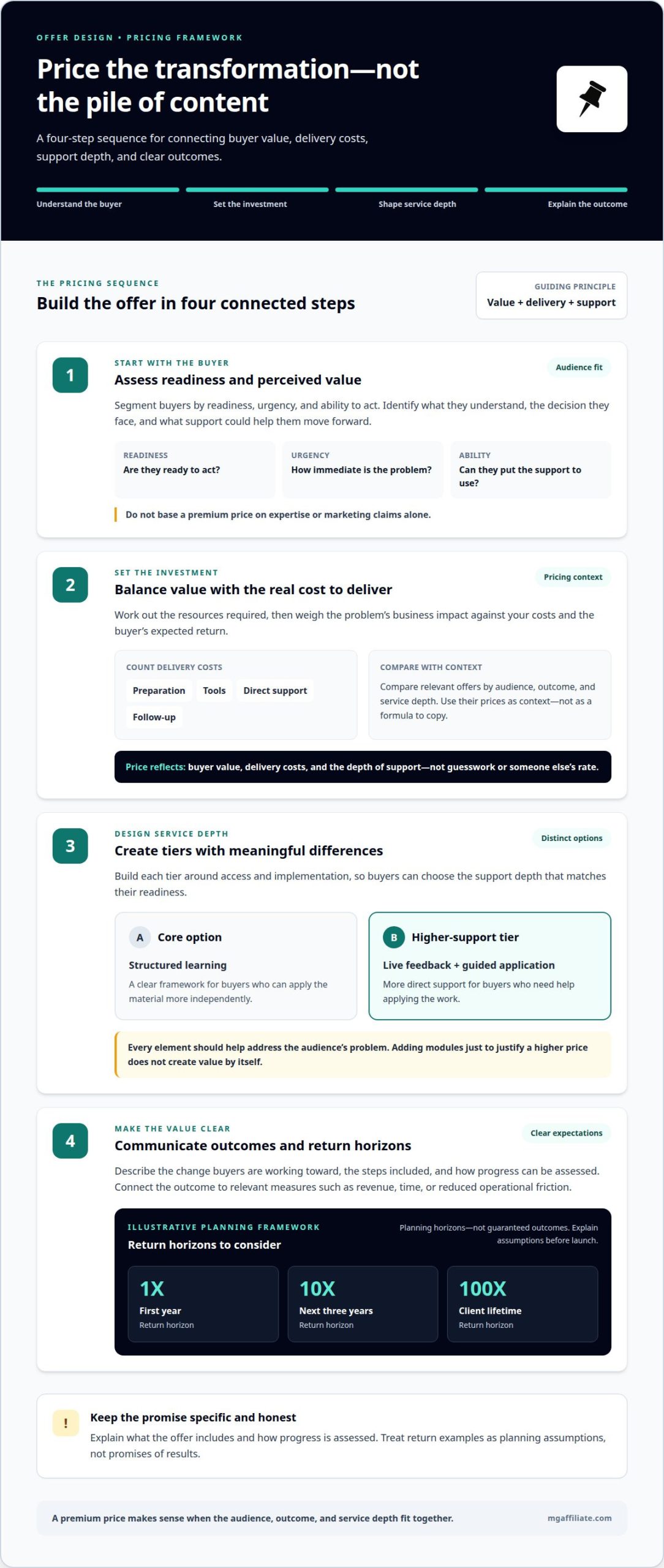
A practical answer to how to structure a high ticket offer starts with buyer value, delivery costs, and support. Use these steps to connect perceived value with a clear investment.
-
Assess Buyer Readiness and Perceived Value
Segment your audience by readiness, urgency, and ability to act. A buyer facing an immediate business problem may value focused guidance differently from someone still exploring options. If you’re deciding how to structure a high ticket offer, identify what buyers understand, the decision they face, and the support that can help them move forward. Don’t base a premium price on expertise or marketing claims alone.
-
Set Pricing Around Value and Costs
Calculate delivery costs, including preparation, tools, direct support, and follow-up. Compare relevant offers by audience, outcome, and service depth, using their prices as context rather than a formula. Weigh the problem’s business impact against your costs and the buyer’s expected return. Set a price that reflects these factors instead of guessing or copying another offer.
-
Create Tiers for Different Service Depths
Build tiers around meaningful differences in access and implementation. For example, a core option could offer structured learning, while a higher-support tier adds live feedback and guided application. Make each option distinct so buyers can choose the depth that suits their readiness. Don’t add modules just to justify a higher price; every element should help address the audience’s problem.
-
Communicate Outcomes and Return on Investment
Describe the change buyers are working toward, the steps included, and how progress can be assessed. For example, connect a business decision to revenue, time, or reduced operational friction. A pricing framework can consider a 1X return in the first year, 10X over the next three years, and 100X over a client’s lifetime. Present these as planning horizons, not guaranteed outcomes, and explain the assumptions before launch.
Choosing long-term mentorship or short-term intensives
Choose a format that fits buyer readiness and the work required. A premium offer should give qualified entrepreneurs a clear path from initial interest to a confident decision.
- Define the buyer and decision authority. Identify the client who feels the problem, has a reason to address it now, and can approve the investment. For a business purchase, include the person who controls the budget in the conversation. A lead form can capture the prospect’s goal, current challenge, and role in the decision before a discovery call.
- Match the product to the transformation. Choose a course when buyers need a repeatable strategy they can apply independently. Choose mentorship when progress depends on feedback, accountability, or adapting decisions as circumstances change. An intensive suits a defined challenge that benefits from concentrated work. A VIP Day or Intensive can be delivered as a one- or two-day deep dive.
- Set duration by the work, not by convention. Most masterminds, personal mentorship programs, and courses run for 4 to 8 weeks. Use that as a reference, then map the client’s milestones, practice time, and feedback needs. If the transformation requires sustained implementation, allow time to apply the strategy and address obstacles. If the goal is narrow, avoid stretching delivery into a longer program without a clear purpose.
- Qualify, nurture, and close with clarity. A high-ticket sales process typically moves from a lead form to nurturing, then a sales or discovery call. Use each stage to understand the prospect’s problem, readiness, desired outcome, and budget authority. On the call, connect the offer’s format and support to their stated needs, explain the next step, and invite a decision without pressure. A short intensive may fit a need for focused execution; ongoing strategic guidance may point toward mentorship.
To sharpen your offer-building strategy, explore an offer-building challenge as a practical next step.
What are high ticket offers?
Define the offer by the change it supports, the stakes involved, and the access included. Price can signal premium positioning, but it cannot explain value on its own.
-
Define the Transformation and Stakes
Identify the costly or consequential problem your audience wants to solve. Treat that as an illustration, not a promise of success.
-
Specify the Before-and-After Transformation
Write one clear before-and-after statement, such as moving a consulting practice toward $50,000 in monthly recurring revenue. Then identify the support that helps the buyer make progress, such as expert feedback, guided implementation, or access to a structured process. Keep the outcome specific to the audience; avoid claiming that every client will reach the same result.
- Compare the offer with other formats. Low-ticket products, such as a basic digital package, typically provide self-directed material. A membership offers ongoing access, while custom services tailor the work to one buyer’s needs. A high-ticket offer combines a valuable transformation with deeper support or specialized delivery.
- Use price examples as context, not a universal rate. The right positioning depends on the audience, stakes, expertise, and service depth, not an industry label alone.
- Make terms and claims clear for U.S. buyers. State deliverables, payment schedules, cancellation terms, and refund policies before purchase. Compliance depends on the offer and jurisdiction, so make accurate claims and avoid implying guaranteed results. Payment plans can divide an agreed investment into scheduled installments; explain the amounts and timing plainly.
Benefits and challenges of high-ticket business models
A premium model can increase revenue per sale, but it also raises delivery and selling demands. Weigh both before choosing a price point.
- Compare sales volume with delivery capacity. For $100K in ninety days, a $500 offer requires 200 clients, while a $10,000 offer requires 10. Fewer sales may mean fewer customer relationships to manage, but each buyer expects substantial value. Map the support each sale requires before deciding whether your expertise and schedule can sustain the model.
- Build a repeatable delivery framework. High-ticket coaching can rely heavily on your individual expertise. That can be difficult if every client needs a different process or constant access. Document the core steps, decision points, and support boundaries. For example, a strategy program can use a shared framework while tailoring feedback to each client’s stated business problem.
- Qualify buyers before presenting the price. A person willing to invest must also have a relevant need and realistic expectations. Use a discovery conversation to understand their goals, decision authority, and ability to implement. If a prospect wants guaranteed results or needs a different solution, don’t force the sale. Strong qualification protects trust and keeps your offer aligned with the buyer.
- Validate demand before scaling delivery. Test the offer through a waitlist, presales, discovery calls, or a small pilot. These steps reveal whether the audience understands the outcome and accepts the price. Use feedback to refine the promise, format, and support before expanding marketing. A premium offer should earn its place through a clear customer need, not a higher price alone.
Ready to strengthen your offer strategy? Explore practical offer-building guidance.
MG Affiliate: BOSS Moves Book
BOSS Moves Book from MG Affiliate is a natural next step if you’re ready to turn offer ideas into deliberate business action. Once you’ve defined your audience, transformation, and service depth, use the book to develop your entrepreneurial mindset and approach.
As you read, note who your current offer serves, the problem it addresses, and the support you can deliver consistently. Use those decisions to guide your next move, whether you’re refining your positioning or preparing to present the offer to potential buyers. Focus on practical progress, not complexity for its own sake.
If you’re ready to continue developing your business, contact MG Affiliate.
Turn your offer idea into a clear next move
Your next step is to put your offer into practice. Choose one audience, one problem, and one transformation to focus on, then use them to guide your messaging and delivery. As you consider how to structure a high ticket offer, keep asking whether each part supports the value you intend to deliver.
To keep developing your business mindset, consider exploring proven implementation guides and frameworks. For offer-focused learning, MG Affiliate provides dedicated resources and intensive training programs to help you scale. Choose the next step that best fits your goals, and make room to apply what you learn.
Ready to explore your next step? Contact MG Affiliate to discuss your offer. Keep moving forward with a clear purpose and a commitment to deliver value.
Frequently Asked Questions
How can I validate demand before fully building the offer?
Test whether qualified prospects will take a meaningful next step before creating every asset. Share a concise offer description with potential buyers, then invite them to join a waitlist, discuss the idea, or commit through a pilot. Track their questions and objections. Compliments alone are weak evidence; repeated interest paired with action gives you a stronger signal of fit and clarity.
How do I pick the “right” problem to solve with my offer?
Choose a problem your intended buyers recognize and already try to address. For example, a consultant might focus on stalled sales handoffs if prospects repeatedly describe missed follow-ups and unclear ownership. Make sure you understand the causes, can explain a useful approach, and can deliver the work responsibly. Don’t choose a problem solely because it sounds dramatic or attracts attention.
How do you identify the ideal customer and validate demand for a high-ticket offer?
Describe the ideal customer through observable traits: their role, current situation, buying trigger, and ability to approve a purchase. Compare that profile with people who have previously sought similar help. In conversations, ask what they have tried, what remains unresolved, and how they would decide to act. Look for consistent patterns across qualified prospects rather than relying on one enthusiastic response.
What should be included in a high-ticket offer, such as deliverables, bonuses, support, and guarantees?
Include only components that help the buyer use the core solution. State the deliverables, sequence, access method, and support boundaries, such as what feedback covers and where it happens. Add a bonus only if it removes a relevant obstacle. Include a guarantee only when you can define its terms, honor the commitment, and avoid implying outcomes outside your control.
What are common mistakes and risks when creating and selling a high-ticket offer?
Common mistakes include promising outcomes you can’t control, adding deliverables without a clear purpose, and leaving support expectations vague. For example, unlimited access can create a workload that undermines delivery for every buyer. Another risk is selling to prospects who lack the need or capacity to use the offer. Set clear boundaries and qualify fit before accepting a commitment.
What payment plans, financing options, and refund policies work for high-ticket offers?
Payment plans can split the agreed investment into scheduled installments, with amounts and timing explained plainly. State cancellation terms and refund policies before purchase.
Leave a Reply