

An AI business plan generator can turn your business details into a first draft, but it can’t validate whether the assumptions fit your industry. The practical answer to how to write a business plan with AI assistance is to give the tool specific, relevant inputs, then review its financial projections, mission, vision, and other sections before relying on the plan.
AI can make a blank page easier to tackle, but a polished draft doesn’t prove that its estimates or template suit your business. Your industry shapes what information belongs in the plan and which assumptions need closer attention.
This guide explains what AI business plan generators do, why templates and estimates differ across industries, and how to assess AI writing tools through practical testing. You’ll learn to use AI as a drafting partner while keeping your judgment in charge of the decisions that matter.
Key Takeaways
- Use AI to organize a business-plan draft, then examine its projections and market research against your real operating assumptions.
- Adapt the plan’s template to your industry, focusing on the costs, customers, and operating details that shape your business.
- Treat market-interest and conversion estimates as assumptions to assess, not automatic proof of demand.
- Test AI writing tools with your own business context and judge whether their drafts are clear, relevant, and easy to improve.
What is an AI business plan generator?
An AI business plan generator uses your business details to draft sections such as operations, financial forecasts, and market analysis. According to the Federal Reserve Board, lenders require business plans, financial projections, and loan packages. For an SBA-backed application, align these materials with its stated requirements.
AI Financial Projections and Statements
A generator can organize sales, expenses, cash flow, and forecast assumptions into financial statements. Treat each figure as an input to examine, not a result the software has proven. Check how changes in sales volume or operating costs affect the forecast.
Generated Market Research
Market research features can turn a business description and target-customer details into summaries of customer needs, competitors, and demand. The generator may also suggest positioning or marketing strategies based on your prompt. Review each claim against customer conversations and market observations. Separate evidence you can support from generated language, so assumptions don’t appear to be established facts.
Use a business plan generator to create a first draft, compare possible business models, or organize information before preparing a loan package. For instance, a restaurant owner can prompt it to outline menu sales, staffing, and operating expenses. The more clearly you describe your business, customers, and the plan’s intended use, the more relevant the draft can be.
To learn how to write a business plan with AI assistance, review the draft section by section. Confirm that the mission and vision reflect your actual goals, the financial statements use consistent assumptions, and market claims have support. Correct errors before presenting the plan. Then format it for its reader, with clear headings, concise explanations, and forecasts tied to the business strategy.
Industry-specific templates and customization
AI business plan tools range from free access with usage limits to paid plans with different features. Costs depend on access level, generation limits, and document options, so compare what each plan lets you create and export.
A useful template reflects how the business earns revenue and delivers its work. A food business may need sections for inventory, menu sales, and kitchen operations, while a consulting firm may focus on services, client acquisition, and project delivery. Generic templates can miss these differences unless you tailor the prompts and headings.
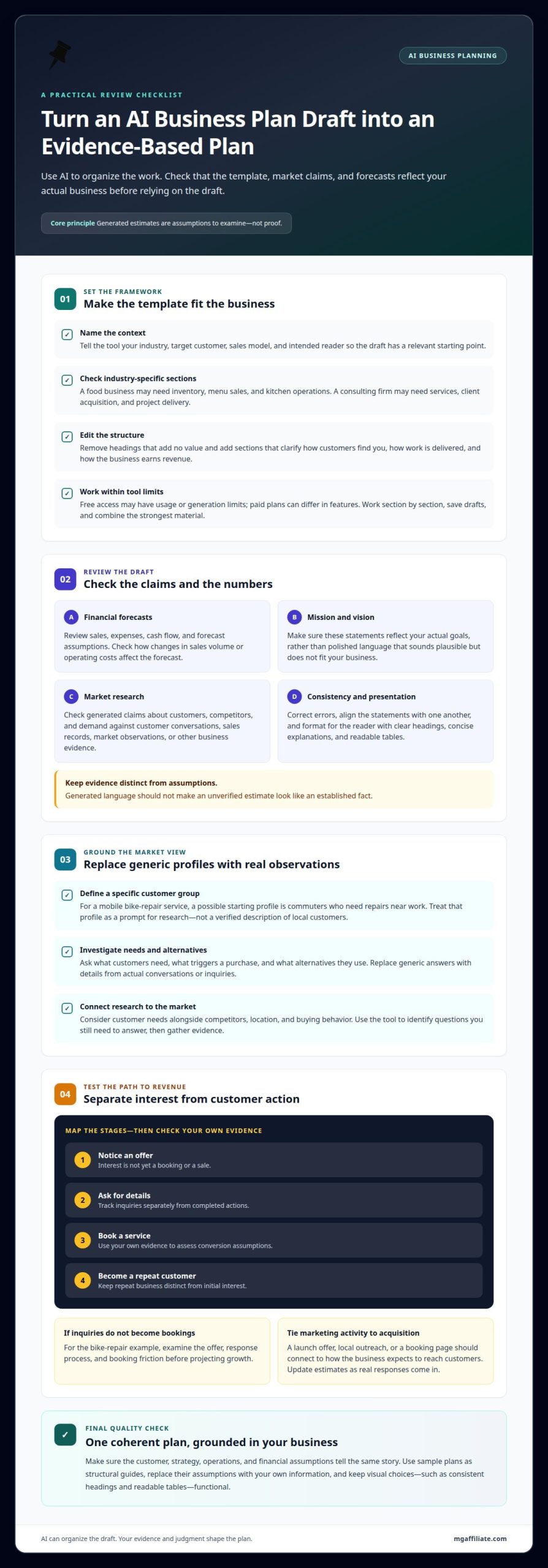
Customize the structure before asking AI writing tools to develop the document. Name your industry, target customer, sales model, and intended reader. Then review each section: does the strategy explain how customers find you, and do the operating details match the work? Remove headings that add no value and add sections that clarify your business model.
Simplified templates help founders organize core ideas without drafting a comprehensive document all at once. A free word allowance or generation limit can affect how much content you create in one session. Work section by section, save each draft, and combine the strongest material into one plan. This also makes revisions easier when your assumptions change.
Templates, branding, and visual design affect how readers navigate the finished plan. Use consistent headings, readable tables, and a restrained color palette. For example, a landscaping business could group services, seasonal operations, and customer segments under clear labels. Keep visual choices functional: a logo or accent color should support recognition, not distract from the strategy.
Use examples as structural guides, not facts to copy. Compare a sample retail plan with your own product mix, sales channels, and operating model. Replace its assumptions with your information, then check that every section supports the same strategy. A customized template gives AI a clearer framework and gives you a document you can present with confidence.
Market interest and conversion estimates
An AI-powered plan can organize market research, define a target market, and draft a route to customers. It can also suggest conversion assumptions, but a polished estimate isn’t evidence of demand. Use the draft to identify questions, then ground your answers in customer interviews, sales records, or other business evidence.
Start with a specific customer group. For a mobile bike-repair service, the target market might be commuters who need repairs near work. Ask the tool to describe their likely needs, buying triggers, and alternatives. Treat its response as a sample profile, not a verified description of local customers. Replace generic claims with details from actual conversations or inquiries.
Next, map interest to action. Separate people who notice an offer from those who ask for details, book a service, or become repeat customers. A generator can help structure these stages and draft a forecast, but your conversion estimate should be based on your own evidence. If the repair service gets inquiries but few bookings, examine the offer, response process, and booking friction before projecting growth.
Market research should connect customer needs with competitors, location, and buying behavior. Prompt the tool to list what information you still need, such as common repair requests or where customers seek service. Then gather evidence and revise the plan. Keep sourced facts distinct from assumptions so readers can see which claims are supported and which still need testing.
Turn those findings into marketing and go-to-market steps. For the bike service, the plan could describe a launch offer, local outreach, and a booking page, then explain how each activity supports customer acquisition. Make the pitch deck and business plan tell the same story: who you serve, why the offer matters, and how interest becomes revenue. Update estimates as real customer responses come in.
Testing AI business plan writers
A useful test measures whether a tool can turn your actual venture details into a coherent plan. An author spent around 15 hours testing AI-powered business plan writers, a reminder that comparison takes more than reading the opening paragraph. Run the same business description through each tool, then compare structure, relevance, clarity, and how much editing the output needs.
Give every tool the same purpose. For example, ask for a plan to guide internal decisions, explain a funding request, or present a venture to investors. Include your industry, customer, offer, and operating model. Then check whether the draft addresses those details or falls back on generic entrepreneur advice. A strong result connects the business’s purpose to its strategy instead of merely filling template headings.
Test the financial sections separately. Provide consistent assumptions and see whether sales, expenses, and cash-flow explanations stay aligned throughout the document. Look for arithmetic errors, conflicting claims, and forecasts without a clear basis. Then test revisions: ask the tool to clarify a specific section without changing your stated assumptions. Its response shows whether you can refine the plan without rebuilding it.
Finally, judge the plan as its intended reader would. An investor may need a concise explanation of the opportunity and use of funding, while an entrepreneur planning operations may need more detail about execution. Check whether the tool can adapt its language and emphasis to that audience. Keep a simple record comparing strengths, errors, and editing effort. Choose the writer that produces the most useful starting document, not the one that sounds most confident.
Put your next business move into action with entrepreneurial growth resources.
MG Affiliate: BOSS Moves Book
MG Affiliate offers the BOSS Moves Book as a next step for readers ready to turn business planning into deliberate action. After using AI to shape your plan, identify the decisions that need your attention, such as refining your offer, reaching customers, or setting priorities. A business plan gives direction; consistent action moves the venture forward.
Use the book as an educational resource alongside your own planning and research. It doesn’t replace industry-specific financial review or evidence from your customers. Instead, it can support you as you work through the choices involved in building your business. MG Affiliate also offers From Trash Man to Cash Man Book, The B.E.S.T. Wealth Network, and Click and Sell Almost Anything.
Contact MG Affiliate to learn more about the BOSS Moves Book.
Turn your next business move into action
A business plan becomes more valuable when it guides real decisions, not just a polished presentation. As you decide how to write a business plan with AI assistance, treat the document as a working tool: revisit priorities, update your choices as you learn, and keep your next step clear.
For continued entrepreneurial learning, MG Affiliate offers valuable business resources, strategic guides, and expert development tools. Choose the path that best fits how you want to keep developing your business knowledge and taking action.
Ready to explore your options? Contact MG Affiliate to discuss your options. Keep building with purpose, one informed move at a time.
Frequently Asked Questions
What are the different types of business plans?
Business plans vary by purpose: a traditional plan explains the venture in depth, while a lean plan captures its core model and priorities. A startup plan focuses on launching; an operational plan guides ongoing work; and a strategic plan sets direction for growth. These labels can overlap. Choose a format based on who will use the plan and what decision it needs to support.
What information should I include in my prompt?
Give the AI your business type, location, customer profile, product or service, sales channels, and current stage. Add your goals, available resources, known operating costs, and intended reader. Separate confirmed details from assumptions. For example, tell the tool that customer demand is still being tested, rather than presenting it as established. Clear context helps it produce a more relevant draft.
What sections should a business plan include?
A business plan typically covers an executive summary, company description, customer and market analysis, products or services, marketing and sales strategy, operations, leadership, and financial outlook. Add sections that clarify your situation, such as a launch timeline or how funding will be used. For a subscription service, explain how customers join, receive ongoing value, and renew. Arrange sections so each supports the plan’s central purpose.
How can AI help write each section of a business plan?
AI can outline the executive summary, turn founder notes into a company description, organize customer research, and draft marketing or operations sections. It can also arrange financial assumptions into forecast tables. Work section by section: supply relevant facts, request a draft, then revise it for accuracy and consistency. For leadership or experience details, provide verified biographies instead of letting the tool fill gaps.
What prompts can you use to create a business plan with AI?
Ask for focused work rather than a complete plan based on a short prompt. For example: “Draft an operations section for a home-based pet grooming business. Use these services, customer details, and opening hours. Mark assumptions separately, identify missing inputs, and avoid inventing figures.” Then request a concise version for a lender or an expanded working draft. Review each answer before adding it to your document.
How do you verify AI-generated market research and financial projections?
Compare market claims with evidence such as customer interviews, sales records, and published competitor information. For projections, trace each assumption to its source, check calculations, and ensure units and periods stay consistent. Test how the forecast changes when sales or expenses shift. Keep a record of which inputs are measured, estimated, or still being tested so readers can distinguish evidence from planning assumptions.
Leave a Reply