

Using AI to analyze sales call transcripts can turn conversations into clear summaries, follow-up actions, coaching insights, and signals of potential upsell or cross-sell opportunities. It can also surface buyer sentiment, objections, and deal risks, giving sales teams more useful information than a transcript alone.
That’s the advantage: a call doesn’t have to end when the conversation does. Human judgment is still essential for deciding what matters and how to respond, but AI can bring important details into focus and make next steps easier to act on.
Explore practical ways to use transcript analysis to capture commitments, coach representatives, and spot customer needs that may point to another opportunity. You’ll also learn to interpret those signals thoughtfully, so insights support stronger conversations rather than replace them.
Key Takeaways
- Turn call transcripts into concise recaps that make commitments, owners, and next steps easier to track.
- Use patterns across conversations to identify focused coaching opportunities and share effective call moments.
- Spot customer needs and workflow changes that may reveal timely upsell or cross-sell possibilities.
- Combine signals such as sentiment, objections, and deal risks to decide which conversations deserve attention first.
1. Automated call summaries and action items
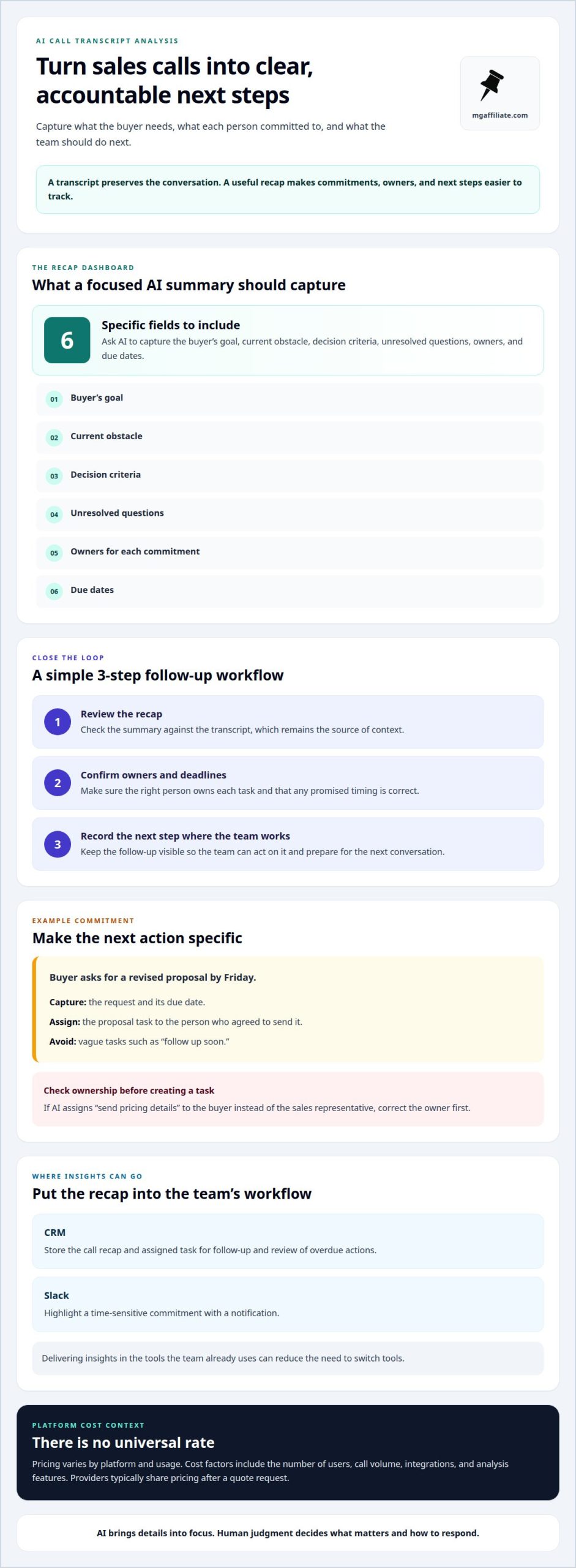
After a sales call, AI can turn the transcript into a concise recap, outcome, and list of follow-up tasks. It can identify the buyer’s needs, open questions, and what each person agreed to do. For example, if a buyer asks for a revised proposal by Friday, the summary can record the request and flag the proposal as a next step.
What insights can AI extract from sales call transcripts? It can surface buyer needs, pain points, objections, outcomes, and promised actions. It can also distinguish a representative’s commitments from the buyer’s, helping teams avoid vague tasks such as “follow up soon.”
How much do AI conversation intelligence platforms cost in the US? Pricing varies by platform and usage, with no universal rate. Cost factors include the number of users, call volume, integrations, and analysis features. Providers typically share pricing after a quote request.
Make summaries useful by asking AI to capture specific fields: the buyer’s goal, current obstacle, decision criteria, unresolved questions, owners, and due dates. Then check the output against the transcript. If the system assigns “send pricing details” to the buyer instead of the sales representative, correct the owner before creating a task.
Insight delivery matters, too. AI-generated conversation insights can flow into a CRM or Slack, reducing the need to switch tools. A CRM entry might contain the call recap and assigned task, while a Slack notification highlights a time-sensitive commitment. Keep the transcript as the source of context, and use the summary to guide action.
Close the loop with a consistent workflow: review the recap, confirm owners and deadlines, then record the next step where the team works. A sales manager can scan overdue actions in the CRM, while a representative can prepare for the next conversation using the buyer’s stated priorities. Clear summaries turn spoken commitments into visible work.
Beyond summaries, AI can extract call takeaways, outcomes, next steps, and action items, making a conversation’s practical results easier to use.
2. Sales representative coaching
Call transcripts give managers specific moments to coach, rather than relying on general impressions. AI can track filler words and show where a representative repeatedly says “um” or “you know.” That pattern can prompt a discussion about pacing or preparation. The count is a signal to review, not a verdict on selling ability.
Use a specific call to anchor feedback. Find a moment when the buyer raised a concern, then examine the representative’s response. Did they clarify the concern, ask a follow-up question, or move on too quickly? A coach can point to the exchange and suggest a practice response for a similar conversation.
Make feedback focused and actionable. Instead of telling a representative to “listen better,” identify a specific interruption or missed question in the transcript. Ask them to revisit the moment, consider what the buyer was communicating, and rehearse an open-ended follow-up. This makes coaching a repeatable skill, not a vague performance judgment.
AI can also help managers build collections or playlists of effective call moments. A strong discovery question, clear response to an objection, or concise explanation can become a learning example for the team. Shared clips and transcript excerpts support asynchronous coaching, so representatives can study effective techniques between team sessions.
Add context to make each example useful. Note the buyer’s concern, the representative’s response, and why the exchange worked. A moment that succeeds with one customer may not suit another situation. Ask learners to identify the tactic and adapt it to their own conversations instead of copying the wording mechanically.
Close each coaching review with one practice goal. A representative might pause after asking a discovery question or replace a repeated filler phrase with a brief silence. Review a later call for that behavior and discuss what changed. This cycle connects transcript evidence to targeted practice while keeping feedback specific, fair, and tied to observable choices.
By tracking filler words in call transcripts, AI can surface possible coaching opportunities. Managers can also organize effective call moments into collections or playlists, supporting sales enablement and asynchronous coaching.
3. Upsell and cross-sell opportunity detection
AI can scan sales conversations for buyer needs, pain points, workflows, and decision-makers. These details help representatives recognize when a related offer could solve a real problem, rather than forcing an unrelated pitch. For example, a buyer describing manual reporting may signal a need related to efficiency, while a new team workflow could reveal interest beyond the original purchase.
Start by looking for a gap between the buyer’s goal and current process. If a prospect says their team struggles to share information across departments, note the workflow, the people affected, and the consequences they describe. AI can surface these points across transcripts, helping representatives explore whether a complementary solution fits.
Then distinguish an upsell signal from a cross-sell signal. An upsell may fit when the buyer’s stated needs exceed the scope of the option under discussion. A cross-sell may fit when the conversation reveals a related need that another offering could address. The transcript provides clues, not a reason to pitch automatically.
Use a practical review sequence. First, identify the buyer’s exact words about goals or friction. Next, connect each point to a business impact the buyer described. Then note who owns the problem and whether that person influences the decision. Finally, prepare a relevant question, such as, “How does that delay affect your team’s current process?”
That question tests whether the need matters without assuming the answer. If the buyer confirms the impact, the representative can explore fit and timing. If the issue is minor or outside the buyer’s priorities, keep the conversation focused on the original decision.
Review patterns across calls, too. Repeated mentions of a workflow obstacle may reveal a broader customer need, while a passing comment may lack context. Compare the transcript with the account’s stated goals and the current conversation. This keeps opportunity detection grounded in buyer language, surfaces useful discovery questions, and helps representatives make timely recommendations based on needs rather than guesswork.
4. AI analysis of sales call transcripts
Transcript analysis goes beyond recaps by revealing patterns across conversations. AI can detect positive or negative buyer sentiment, track specified phrases, and compare calls against custom scorecards. Teams can also assess questions asked, lengthy monologues, and recurring deal risks.
What are the best AI tools for sales call transcription and analysis? Choose tools that produce searchable transcripts and support the insights your team needs, such as keyword tracking, scorecards, and CRM delivery. Test them on real calls and assess whether their outputs help representatives take clear next steps.
How do AI sales call analysis tools compare with manual review? AI can scan many transcripts for patterns, while manual review adds context and human judgment. Use AI to flag notable moments, then have a manager review the transcript before acting on a sensitive or ambiguous finding.
What privacy and consent laws apply to recording and analyzing sales calls in the US? Rules vary by state and situation, so establish a consent process and clear data-handling practices before recording. Define who can access recordings, how they’re used, and how long they’re retained.
How accurate are AI sales call transcription tools? Accuracy depends on audio quality, accents, overlapping speakers, and specialized terms. Check names, product details, and important commitments against the recording before relying on them; a misheard phrase can distort sentiment or scorecard results.
How do you set up an AI workflow for analyzing sales calls? Decide what your team wants to learn, then configure scorecards or keyword trackers. Route outputs to the appropriate CRM or team channel, and assign someone to review important flags. Compare results with call recordings and refine the prompts or criteria.
What are the risks and limitations of using AI to analyze sales calls? A transcript can miss tone, context, or nonverbal cues, while a mistaken label can mislead coaching or deal decisions. AI can also surface churn alerts, buyer objections, and win/loss patterns, but people should interpret those signals before responding. Strengthen your offer-making approach with focused practice.
MG Affiliate: BOSS Moves Book
MG Affiliate offers the BOSS Moves Book for readers building their business knowledge alongside their sales skills. AI can highlight what buyers say, but representatives still decide how to respond, refine an offer, and move a conversation forward. Use transcript insights to identify where your sales approach could grow, then explore learning resources that support your broader business goals.
BOSS Moves Book may be a fit if you’re ready to keep building your business mindset beyond call analysis. For a broader look at MG Affiliate’s resources, visit mgaffiliate.com or contact MG Affiliate.
Turn Conversation Insights Into Your Next Move
Make transcript analysis part of a deliberate sales practice. Choose one question your team wants to answer, such as which buyer concerns repeatedly stall conversations. Use that focus to guide how you apply AI insights, then let representatives decide how to respond with care and relevance. The goal isn’t to automate human judgment. It’s to give people a clearer starting point for thoughtful action.
Using AI to analyze sales call transcripts can also prompt a broader question: how can your business make its offers clearer and more compelling? MG Affiliate offers programs and resources suited for teams ready to develop their offer-making approach. For a next step that fits your goals, contact MG Affiliate to discuss your needs. Keep learning, stay intentional, and turn your next insight into forward progress.
Frequently Asked Questions
How can AI analyze sales call transcripts?
AI can label speakers, group statements by topic, and extract evidence to answer a specific question. For example, ask which product requirements the buyer stated directly, then review the matching exchange before updating account notes. Using AI to analyze sales call transcripts is more useful when your prompt requests a clear output, such as a theme, supporting quote, and follow-up question.
How can AI score sales calls and identify coaching opportunities?
AI can compare transcript evidence with defined behaviors, such as whether a representative confirmed decision criteria or summarized an agreement. To identify a coaching opportunity, review a low score alongside the exact exchange. Distinguish a missed behavior from one that wasn’t relevant to the call. Managers can apply the same rubric to a shared call, then discuss differences in scoring to align their standards.
How can AI detect customer sentiment, objections, and buying signals in calls?
AI can classify language and conversation patterns, but a phrase needs context before it becomes a reliable signal. “Send me the contract” may indicate buying intent, while “I need legal review” may describe a process step rather than rejection. Check the surrounding exchange and the buyer’s stated reason. This helps teams distinguish direct evidence from interpretations that need follow-up.
Leave a Reply