

More messages do not create better outreach; relevance does. Personalizing outreach at scale with AI means using prospect context to shape sales messages, while automation helps teams research, tailor, and deliver them efficiently. The goal is to make each message feel specific without losing the judgment and genuine interaction that build trust.
That balance matters. AI can help sales teams spot useful signals and adapt messaging, but every message still needs to be accurate, appropriate, and relevant to its recipient. Automation works best as support for thoughtful communication, not as a substitute.
Here, you’ll learn what personalized outreach involves, how AI can support it, and where human review matters. You’ll also see how outreach platforms can organize engagement and support conversions, helping you build a more relevant approach without writing every message from scratch.
Key Takeaways
- Use relevant prospect signals to shape messages around a person’s context, not just their name or job title.
- Let AI support research and drafting, then apply human judgment to keep outreach accurate, timely, and personal.
- Choose outreach platforms around the work you need them to support, from organizing prospect information to managing engagement.
- Assess whether messages are earning meaningful responses and moving conversations forward, not simply increasing activity.
What is Personalized Outreach?
Personalized outreach shapes a sales message around a prospect’s context, needs, or activity. AI can help teams apply relevant details across more conversations instead of sending identical pitches.
AI-Enabled Personalized Outreach
AI-enabled personalized outreach uses AI to adapt sales messages to a prospect’s known context. A tailored reference can make a message useful, while a generic pitch gives the recipient little reason to engage. For example, a seller might connect a software feature to a prospect’s stated business priority, then review the draft before sending. AI helps organize and apply those details across a larger audience without making every message identical.
Data for AI Personalization
Personalization data includes details that help explain a prospect’s interests, role, or business timing. Useful signals include website behavior, LinkedIn engagement, review activity, job changes, and company expansions. Teams can gather these through existing customer records and relevant prospect interactions, then organize them into clear fields for drafting. The goal is context, not data volume: a recent role change may matter more than a long list of unrelated details.
Building an AI Outreach Workflow
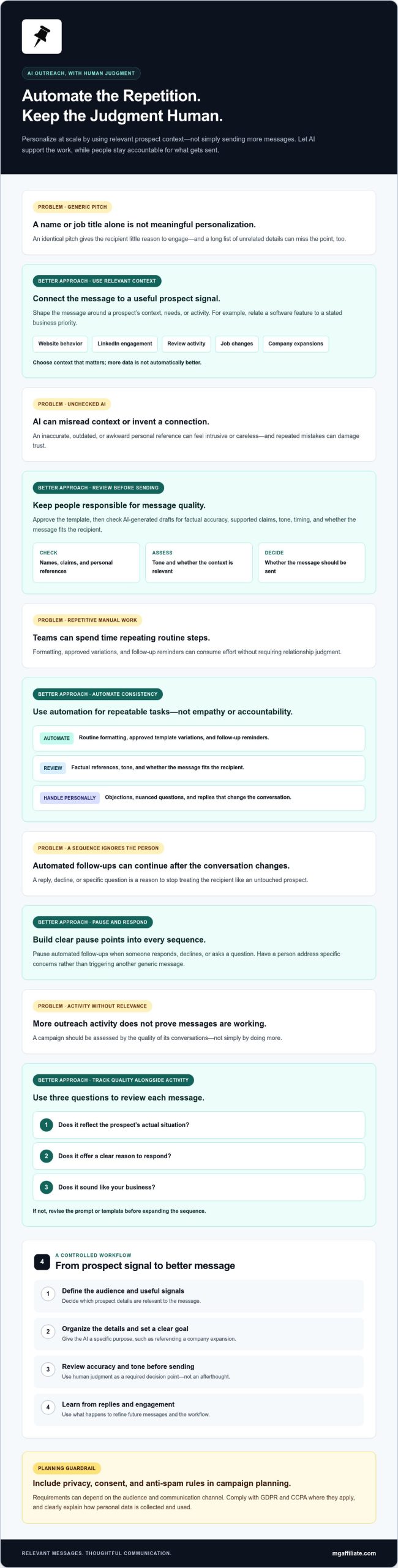
An AI outreach workflow connects prospect signals to a relevant message and human review. First, define the audience and the useful signals to consider. Next, organize the details and give the AI a clear message goal, such as referencing a company expansion. Review the draft for accuracy and tone before sending. Finally, use replies and engagement to refine future messages. Each step gives the team a decision point instead of letting automation send unchecked copy.
In the United States, privacy, consent, and anti-spam rules can depend on the audience and communication channel, so include them in campaign planning. Businesses should comply with GDPR and CCPA requirements where they apply, according to the European Union and California Privacy Protection Agency, and clearly explain how personal data is collected and used.
Balancing automation with human interaction
AI can draft and organize outreach, but people must decide whether a message should be sent. For example, automation can suggest an opening based on a prospect’s company announcement, while a salesperson checks that the announcement is current and relevant. This division saves repetitive effort without handing relationship judgment to software.
Use automation for repeatable tasks: adapting approved message templates, grouping prospects by shared needs, and scheduling follow-ups. Keep human review for claims, tone, timing, and sensitive conversations. If a prospect raises a specific concern, a person should address it rather than trigger another generic sequence. The practical rule is to automate consistency, not empathy or accountability.
What are the risks of using AI for outreach? AI can misread context or invent a connection, making a message feel intrusive or careless. If that error reaches prospects repeatedly, it can damage trust in your brand. Review names, claims, and personal references before sending.
Set clear review points before launching a sequence. Approve the template first, then inspect AI-generated drafts for unsupported claims or awkward personalization. Pause automated follow-ups when someone responds, declines, or asks a question. These controls help prevent a well-intended campaign from ignoring the person on the other end.
- Automate: routine formatting, approved template variations, and follow-up reminders.
- Review: factual references, tone, and whether the message fits the recipient.
- Handle personally: objections, nuanced questions, and replies that change the conversation.
Track quality alongside activity. A useful review asks whether the message reflects the prospect’s actual situation, offers a clear reason to respond, and sounds like your business. If the answer is no, revise the prompt or template before expanding the sequence. Strengthen your sales approach by exploring ways to make more relevant offers.
Choosing outreach platforms
The best platform depends on your workflow. A small team may prioritize AI drafting, while a larger team may need CRM coordination. Platform costs vary with features, user seats, and data or message volumes.
Selecting AI Outreach Platforms
Choose an outreach platform by matching its capabilities to the steps your sales or marketing team needs to manage. A tool that fits your process can reduce manual handoffs, while a mismatch adds complexity. Map a campaign from audience selection through message review and follow-up. Then compare platforms on those tasks, including how clearly they show prospect context and support human approval.
Test the workflow with one campaign before expanding. For example, check whether your team can segment CRM contacts, draft tailored email copy, and pause follow-ups after a reply. Consider how the platform handles data access and whether team members can correct inaccurate records. Evaluate the work people will actually do, not just a long feature list.
AI Tools for Sales and Marketing Outreach
AI outreach tools include CRM systems, email engagement platforms, and writing assistants that help tailor messages. Each can support a distinct task, from organizing customer context to drafting campaign copy. A CRM can hold prospect records, while an email platform can manage sequences. A writing assistant can adapt an approved message to a prospect’s role or stated business need.
Which tools work best? The strongest fit is a combination that supports your existing process, keeps prospect context accessible, and lets people review messages before sending. A marketing team might use audience segmentation and email automation, while sales representatives may need CRM notes and personalized draft suggestions.
- Review connections: Confirm the platform can work with your existing CRM and contact records.
- Assess control: Look for clear approval steps and easy edits to AI-generated copy.
- Compare costs: Consider seats, features, message volumes, and data requirements together.
Finally, assign one campaign owner to test the chosen workflow and gather feedback from its users. This review can show whether the platform saves effort without making messages less relevant.
Engagement and conversion benefits
Relevant outreach gives recipients a clear reason to respond. A message tied to a prospect’s role or business priority can start a useful conversation, while a generic pitch may not. For example, a note that connects a product to a company expansion gives the recipient a specific point to consider. Track whether that context leads to replies, qualified conversations, and next steps.
Personalized emails can increase conversion rates by 10-15%. Treat that figure as a benchmark, not a promised outcome for every campaign. Results depend on factors such as audience fit, offer relevance, message quality, and follow-up. Compare similar audience segments and campaign goals to understand whether personalization is improving your own results.
How do you measure the ROI of AI-powered outreach campaigns? Compare campaign-attributed revenue with its costs, including platform use, data preparation, and staff time. Also track the steps between sending and revenue, such as qualified replies, meetings booked, and opportunities created, to see where the campaign succeeds or stalls.
- Engagement: Review replies and meaningful responses, not just messages sent.
- Conversion: Track how many conversations become qualified opportunities or customers.
- Efficiency: Compare staff time and campaign costs with outcomes generated.
Interpret the metrics together. A high reply rate but few qualified meetings may mean the message attracts attention but misses the right audience. If meetings progress but revenue remains limited, examine the offer and follow-up. Use these findings to adjust audience selection, message content, or timing, then compare the next campaign using the same measures.
Keep attribution consistent: define which replies or opportunities came from the campaign, and use that method across comparisons. To turn better engagement into stronger offers, develop a more focused offer strategy.
MG Affiliate: BOSS Moves Book
MG Affiliate’s BOSS Moves Book is a natural next step for readers ready to strengthen their business focus. AI can help tailor outreach, but your direction still matters: decide who you want to reach, what value you offer, and what action you want a prospect to take. Let those choices guide your messages and help you evaluate whether they lead to meaningful conversations.
Consider the book as part of your continued development as you turn ideas into purposeful business moves. The goal is not to automate every decision, but to pair useful tools with clear thinking about how you create and communicate value.
To explore BOSS Moves Book, visit mgaffiliate.com.
Put your next business move into action
Make your next step deliberate. As you apply personalizing outreach at scale with AI, keep your business goals in view and define progress beyond a sent message. How you frame an offer and the choices you make around it shape the role outreach plays in broader growth.
If you want to keep developing your business approach, MG Affiliate offers the Make More Offers Challenge – General Admission, the Make More Offers Challenge – VIP Experience, and the BOSS Moves Book. Explore the resource that best fits what you want to focus on next.
To learn more about MG Affiliate’s offerings, visit MG Affiliate. Keep learning, stay purposeful, and take the next step with confidence.
Frequently Asked Questions
What is AI-personalized outreach, and how does it work at scale?
AI-personalized outreach uses prospect information to tailor sales communication, while automation helps apply that approach to a broader audience. For example, a team can group prospects by business growth stage and adapt a message to each group’s priorities. Personalizing outreach at scale with AI works best when the selected details genuinely relate to the recipient, rather than merely filling a template with data.
How can AI personalize emails, LinkedIn messages, and other outreach channels?
AI can adjust a message’s opening, emphasis, and format to fit each channel and recipient. An email might explain how an offer relates to a prospect’s stated business need; a LinkedIn message could briefly reference a relevant professional update. Keep the core offer consistent, but adapt the context and length to the channel. Review each version to ensure the details make sense there.
What response-rate or conversion improvements does AI-personalized outreach typically deliver?
Personalized emails can increase conversion rates by 10-15%, but that benchmark does not predict the result of every campaign. Compare similar audiences and offers, and track the path from response to conversion. For example, a higher reply rate may not mean more customers if responses come from poor-fit prospects. Use qualified opportunities and completed sales to judge business impact.
How can teams keep AI outreach messages authentic and avoid sounding automated?
Give AI clear examples of your natural voice, then edit drafts so they sound like a person addressing a specific recipient. Remove stock phrases and details that add no meaning. For example, replace a broad compliment about someone’s company with a concise reference to a relevant product launch. Keep messages focused, and have a team member handle replies that need judgment or a personal response.
What privacy, consent, and anti-spam rules apply to AI-generated outreach in the United States?
In the United States, privacy, consent, and anti-spam requirements can depend on the audience and communication channel. Plan for them, comply with GDPR and CCPA requirements where they apply, and clearly explain how personal data is collected and used.
Leave a Reply