

Creating a customer persona with ChatGPT works best when you start with real customer data, not assumptions. Bring together evidence from reviews, surveys, support conversations, social comments, and website analytics. Ask ChatGPT to identify patterns and group them into segments. Describe each segment’s role, challenges, goals, and decision criteria, then check every claim against the original evidence before using it.
A vague persona rarely helps you make sharper marketing decisions. The opportunity is to turn scattered customer insights into a practical guide to what buyers need to hear, while keeping their real motivations and language in view. This walkthrough shows how to prepare your data, prompt ChatGPT to find useful segments, and build buyer profiles without mistaking AI-generated ideas for verified facts. You’ll also learn to review the output for stereotypes and gaps, so your personas can inform more relevant content and better decisions.
Key Takeaways
- Use customer reviews, surveys, support conversations, and other real-world signals to build a stronger foundation for persona research.
- Prompt ChatGPT to group customers by shared needs, then treat its suggestions as ideas to compare with your data.
- Shape each profile around the buyer’s role, challenges, goals, objections, and decision criteria.
- For B2B personas, prioritize business context over personal demographics so your marketing speaks to relevant needs.
Limitations of generic AI-generated marketing recommendations
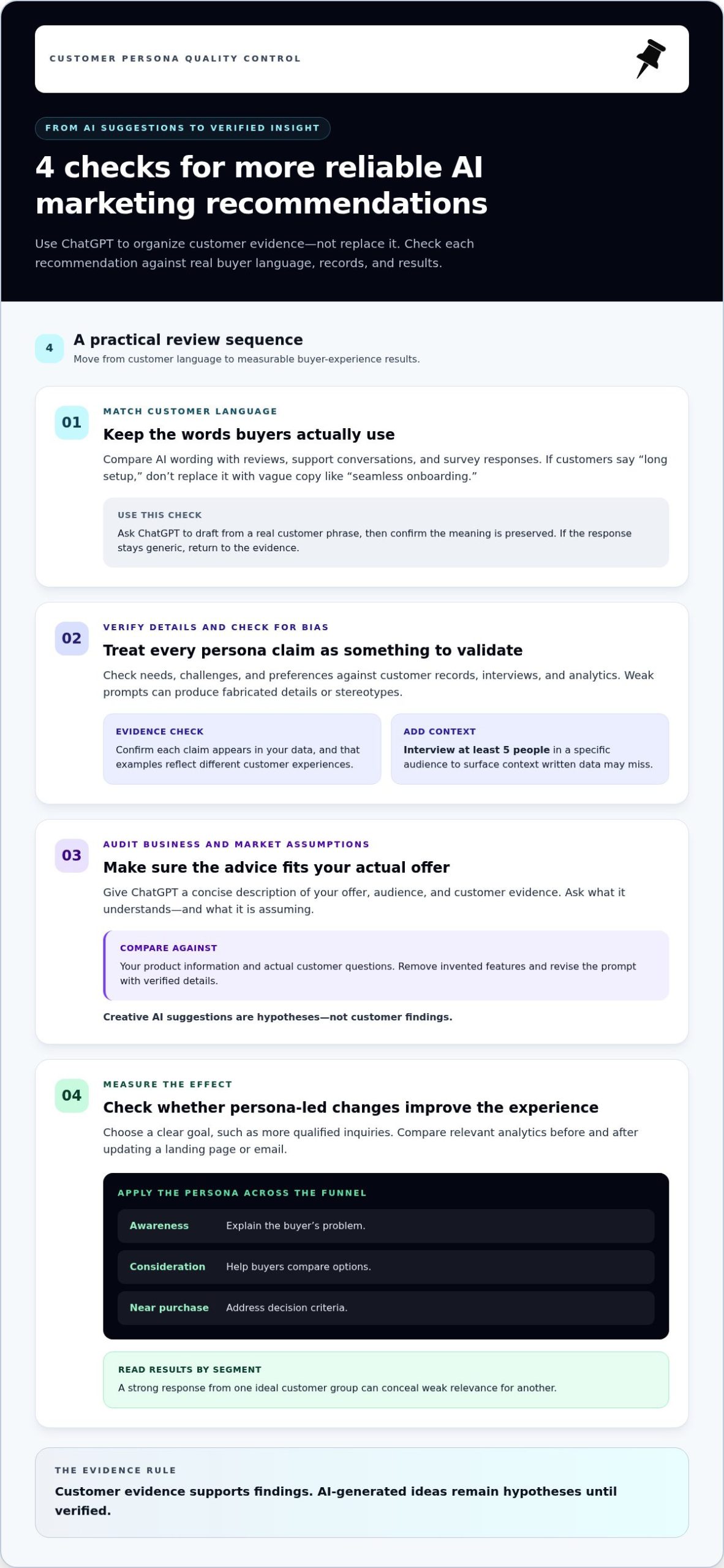
ChatGPT can organize customer evidence, but its recommendations need scrutiny. Use the steps below to improve accuracy and relevance, then track whether the resulting changes work.
-
Align Marketing Language With Customer Language
Compare ChatGPT’s suggested phrases with the words buyers use in reviews, support conversations, and survey responses. If customers describe a “long setup,” don’t replace that with polished but vague copy about “seamless onboarding.” Ask ChatGPT to draft language using a real customer phrase, then check that it preserves the meaning. A few follow-up prompts can still produce generic responses, so return to customer evidence instead of endlessly refining the prompt.
-
Verify Persona Details and Check for Bias
Validate each persona claim against customer records, interviews, and analytics before treating it as insight. An AI-generated persona won’t be completely accurate, and a weak prompt can produce fabricated details or stereotypes. Check whether each stated need, challenge, or preference appears in your evidence, and whether the examples represent different customer experiences. For a specific audience, interview at least 5 people to add context that written data may miss.
- Test ChatGPT’s understanding of your business and market before using its advice. Provide a concise description of your offer, audience, and customer evidence, then ask what it understands and what it is assuming. Compare its response with your product information and actual customer questions. If it invents a feature, remove the claim and revise the prompt with verified details. Treat creative AI marketing suggestions as hypotheses, not customer findings.
- Measure whether persona-led changes improve the buyer experience. Choose a clear goal, such as more qualified inquiries, then compare relevant analytics before and after updating a landing page or email. Apply the persona across funnel stages: explain the problem in awareness content, compare options during consideration, and address decision criteria near purchase. Review results by segment, not just overall, so a strong response from one ideal customer group doesn’t conceal weak relevance for another.
Prompting ChatGPT to identify customer segments
Creating a customer persona with ChatGPT starts with a focused audience and a clear task. Ask it to group supplied evidence, then refine the segments using your business context.
-
Generate a Basic Persona From a Prompt
Ask ChatGPT to draft a basic profile from a description of one audience and its observed behavior. For example: “Group these customer comments by shared needs. Draft a profile for each group, and separate evidence from assumptions.” Check that each segment differs in a meaningful way, such as its purchase trigger or preferred solution. Don’t treat generated names or unsupported preferences as research findings.
-
Draft a B2B Buyer Persona With an AI Prompt
For B2B buyers, specify job title, company size, business category, geography, company purpose, challenges, goals, pain points, and selection criteria. Ask ChatGPT to contrast roles, such as a finance lead prioritizing cost control and an operations manager prioritizing workflow. Keep the profile focused on responsibilities and purchasing influence. Avoid treating a job title as proof of an individual buyer’s priorities.
-
Use a Persona Generation Prompt Template
Create a reusable prompt with fields for customer evidence, audience, goals, challenges, decision criteria, and unanswered questions. Add: “Label each point as evidence or hypothesis, and don’t fill gaps with invented details.” Treat creating a customer persona with ChatGPT as a structured analysis task, not permission to share private customer records. Remove names, email addresses, and other direct identifiers first.
- Explore likely AI search prompts by asking what questions a defined segment might ask at different buying stages. For a meal service, a possible query is, “How can I eat well without cooking?” Compare suggestions with actual search queries and customer questions. Keep ideas that reflect observed behavior, and revise the prompt if the proposed language doesn’t match how your audience describes its needs.
Turn audience insights into clearer offers with ways to shape stronger offers.
Defining buyer roles, challenges, goals, and decision criteria
A buyer persona is a research-based profile of an existing or potential customer. Creating a customer persona with ChatGPT means turning evidence into a useful guide, not filling a template with assumptions.
-
Define the Persona’s Role and Target Audience
Specify the audience and role the profile represents, such as a purchasing manager evaluating software for a regional company. For B2B buyers, describe job title, company size, business category, geography, and organizational purpose. Separate decision-makers from users and influencers. Creating a customer persona with ChatGPT works best when each profile focuses on a distinct role, rather than blending several people’s responsibilities into one fictional buyer.
-
Describe Persona Demographics and Lifestyle
Include demographic and lifestyle details only when they affect the purchase or message. For example, a meal service might target professionals aged 25 or older in a large US city who want healthy food without cooking. Describe relevant routines, preferences, and media habits, but don’t assume age or location explains motivation. For B2B profiles, prioritize the organization and role over personal demographics.
-
Identify Buyer Challenges, Goals, and Decision Criteria
Record the buyer’s challenge, desired outcome, emotional driver, likely objection, and selection criteria. A purchasing manager may want consistent reporting and less manual work while comparing integration options and implementation support. Ask ChatGPT to distinguish evidence from interpretation, then assess each point against customer feedback. This gives the profile a practical purpose: helping you shape relevant messages for the buyer’s decision.
- Use a consistent template covering audience, role, context, behavior, challenges, goals, objections, and criteria. Ask ChatGPT to draft a separate version for each distinct segment, then identify what differs and why. Keep the final profile focused on decisions your marketing can influence, rather than building a detailed biography that doesn’t help you serve buyers.
A persona can also include demographics, lifestyle, pain points, goals, psychological drivers, objections, and media habits. ChatGPT can help identify information relevant to a purchase decision and support content planning for different stages of the sales funnel.
What are buyer personas?
Buyer personas are research-based profiles of existing or potential customers. Build yours from reviews, surveys, support conversations, social comments, and website analytics. Focus on business needs rather than demographic labels alone.
-
Gather Actual Customer Research
Collect feedback that shows what customers experience, value, and struggle with. Review product feedback, survey answers, support conversations, and social media comments for recurring pain points, purchase triggers, objections, and desired outcomes. For example, note whether customers mention setup difficulty before buying or only after purchase. Different experiences can reveal distinct audience needs, so keep the context with each quote rather than treating every comment as interchangeable.
-
Combine Analytics With Public Information
Compare direct feedback with behavior shown in your analytics. Website paths can indicate which pages audiences visit before taking action, while search queries may reveal the questions they have. AAA has used Google Analytics and public sources as inputs for AI-driven personas. Use public information to add market context, but don’t let broad industry commentary outweigh specific customer evidence or turn assumptions into facts about your buyers.
-
Create Evidence-Informed Buyer Personas
Organize the evidence into profiles that connect a buyer’s role and needs with their likely decision process. Ask ChatGPT to label each insight as a repeated finding, a single example, or a hypothesis. If several customers praise quick setup, for instance, record it as a recurring theme, but don’t assume every customer shares it. Keep supporting quotes or analytics alongside each profile so you can trace claims to their sources.
- Use each persona to guide a real marketing choice. For example, address a common setup concern with clearer onboarding content, then compare relevant page engagement or customer questions. Prioritize business-relevant factors, such as purchasing role, workflow, and selection criteria, over personal details that don’t affect the buying decision. Update profiles when new research changes the picture, rather than treating them as permanent descriptions of entire audiences.
Turn clear audience needs into stronger offers with offer-building resources.
MG Affiliate: BOSS Moves Book
MG Affiliate’s BOSS Moves Book is a relevant next step if you want to keep developing your business mindset after clarifying who you serve. Persona work can help you think more deliberately about the audience behind your offers, the problems they want to solve, and how your business decisions respond to their needs.
Use customer insights as a practical reference when reflecting on your next move. BOSS Moves Book is one resource from MG Affiliate for readers focused on business growth; it doesn’t replace customer research or validate an AI-generated persona. Keep testing your assumptions against actual buyer feedback as you put your understanding into practice.
Visit mgaffiliate.com to explore BOSS Moves Book and other offerings.
Put Your Customer Insight Into Action
A useful persona earns its place through the decisions it helps you make. Choose one audience profile and use it to shape a focused marketing experiment, such as adjusting a message or clarifying an offer. Observe how real buyers respond, then let that feedback guide your next move.
That’s the value of creating a customer persona with ChatGPT: it can help turn customer knowledge into a working direction for your business. Keep human evidence at the center, and treat each new insight as a reason to refine your approach, not an assumption that every buyer thinks alike.
If you’re ready to explore how your customer insights can support your next business step, contact MG Affiliate to discuss your marketing needs. Take the next step with purpose and keep building on what you learn from your customers.
Frequently Asked Questions
How to Find Out This Information and Where to Get It?
Start with places where customers already share feedback: product reviews, sales notes, support conversations, survey replies, and website search terms. For example, compare questions asked before purchase with complaints raised after onboarding. Tag each observation by topic and audience, then look for repeated patterns. This helps distinguish a buyer’s real concern from a single unusual comment or an internal assumption.
What is a Chat GPT Persona?
A ChatGPT persona is a customer profile drafted with ChatGPT from the context and evidence in your prompt. For example, provide anonymized notes about buyers who abandon a checkout, then ask the model to describe shared barriers and possible questions. The output is a working draft, not a real customer or proof of a pattern. Keep observations separate from AI-generated interpretations.
ChatGPT vs persona generators and marketing research tools
ChatGPT can organize customer evidence and suggest segments, but check its persona claims against real customer data. Persona research can also use surveys, interviews, and website analytics. For a specific audience, interview at least five people to add context.
Leave a Reply