

The smartest way to qualify leads with AI is to automate the sorting, not the judgment. AI can assess a prospect’s company fit, profile, and engagement signals, assign a score, and sync the result and relevant activity to a CRM. Salespeople can review the context, adjust the score, and decide how to handle opportunities that need a closer look.
It makes sense to want faster follow-up without losing the human insight that turns a promising lead into a real conversation. Learning how to automate lead qualification with AI means setting clear criteria, connecting relevant lead data, and using scores to guide prospecting and routing, not treating them as final decisions. This article explains AI lead qualification, how scoring and CRM synchronization work, and where human review matters. You’ll also see how prospecting tools can help find potential buyers and organize outreach, so your team can focus on the conversations that matter.
Key Takeaways
- Set qualification criteria around the customer traits and actions that signal genuine fit, so lead scores support your sales priorities.
- Connect CRM and other relevant systems so qualification results, engagement context, and routing decisions stay aligned in lead records.
- Use AI scores to focus prospecting, but let sales representatives review edge cases, correct missed signals, and apply human judgment.
- Track how qualified leads progress and gather sales-team feedback to improve scoring and routing over time.
CRM integration and synchronized lead records
To automate lead qualification, connect your CRM, website tracking, and support platform, then define score-based routing rules and synchronized fields. Measure results by comparing qualification rates, qualified-lead conversions, manual workload, and sales-team feedback before and after automation.
Data Quality and Hygiene
Data quality and hygiene mean keeping lead records accurate, complete, and consistent across connected systems. An AI engine can only score the profile and engagement signals it receives, so duplicate contacts, missing company details, or conflicting statuses can distort qualification. Audit a sample of 100 CRM records before connecting systems. Standardize fields such as company name, industry, job title, and lead status, then decide which system owns each field when records conflict.
Sales Automation Integration
Sales automation uses CRM scores and qualification responses to trigger follow-up, assignment, or nurturing. Set routing rules around score thresholds and practical criteria such as territory, industry, or account size. High-quality leads can go straight to sales, while medium-quality leads can enter a nurture sequence or go to an SDR. A useful handoff includes the prospect’s answers, engagement history, and recommended next step, reducing manual research and helping representatives respond faster.
Implementation Steps and ROI Measurement
Implementation connects lead sources, scoring logic, CRM fields, and routing rules, then measures the effect on sales outcomes. First, review CRM records for missing or inconsistent fields. Next, connect the CRM to relevant website and support data, map qualification responses to record fields, and test routing with sample leads. Then compare results with your baseline: track qualification rates, qualified-lead conversions, time spent on manual tasks, and sales-team feedback. If leads move faster but conversion weakens, revisit the scoring criteria or handoff rules. Keep records synchronized so the team sees current status and engagement signals instead of working from separate, outdated profiles.
Lead scoring using firmographic, demographic, and behavioral data
AI scoring combines who a lead is with what that person does. Together, profile and behavioral scores help prioritize leads by fit and buying signals.
Firmographic and Demographic Signals
Firmographic and demographic signals describe a lead’s organization and professional role, helping you assess fit with your ideal customer profile. Company size, industry, location, and job title can distinguish a target account from a poor-fit inquiry. Compare these attributes with past won and lost deals to identify patterns associated with conversion. Base criteria on actual customer outcomes, not assumptions about a particular group.
Behavioral Scoring and Prioritization
Behavioral scoring assigns value to a lead’s actions, such as site visits, email engagement, and content downloads. These signals show interest, but their meaning depends on context. A demo request may receive 30 points in an illustrative model, while intent signals may add 15 points. Combine engagement with profile fit: repeated visits from a relevant company can merit attention before an isolated email open. This helps sales prioritize promising leads without treating one action as proof of purchase intent.
Real-Time Scores and Qualification Thresholds
Real-time scoring updates a lead’s position as new profile or behavioral data arrives. Set a qualification threshold that triggers a defined action, such as sales review or further nurturing. In an illustrative model, a lead reaching 80 points routes to sales immediately. Review threshold performance against qualified-lead conversion and adjust criteria when scores prioritize activity without producing relevant conversations. Clear routing rules make scores useful to the team.
Accurate data and oversight are essential to modern scoring. Incomplete records can produce misleading rankings, while historical sales data may reproduce bias, such as favoring certain company sizes or regions. Review how the system weighs signals and make its criteria understandable to the team. Account for GDPR and the California Consumer Privacy Act (CCPA) when handling personal information. Regularly compare scores with actual outcomes, and refine the model if it prioritizes leads unfairly or unreliably.
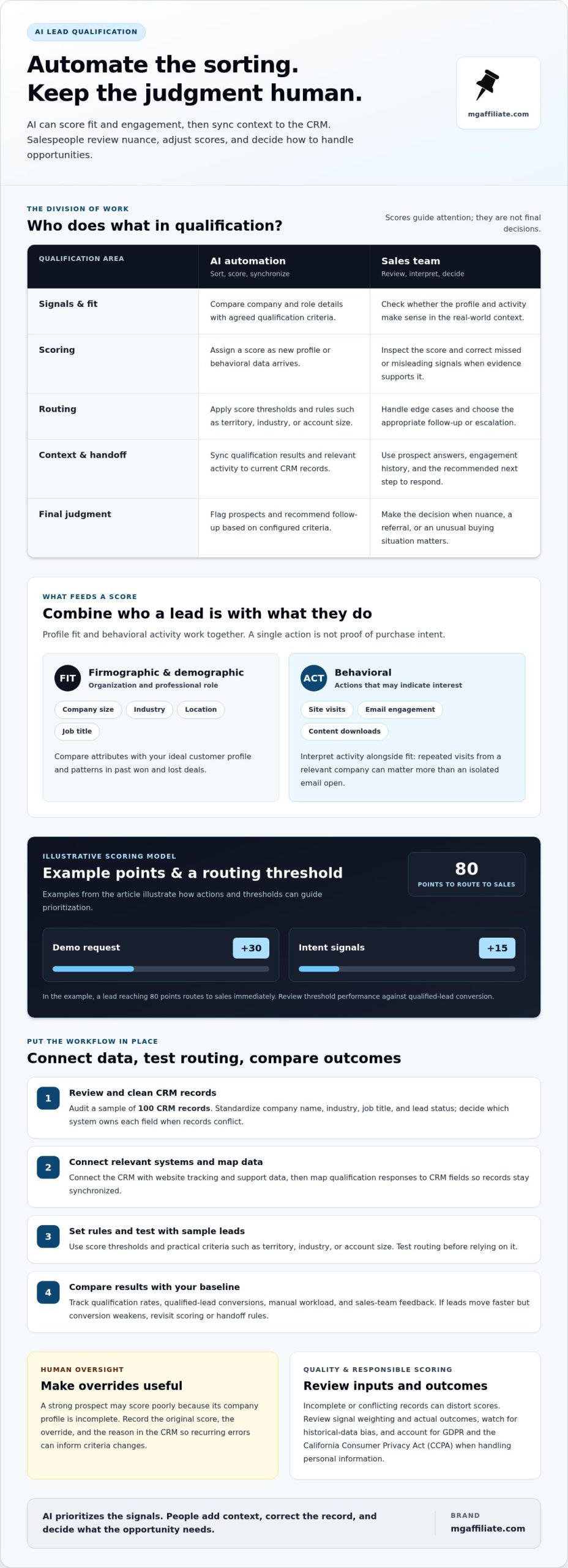
AI lead qualification and the division between automation and human judgment
AI can sort and qualify prospects, while people decide how to handle context the scoring engine can’t interpret. This division matters because an instantly assigned score can guide outreach, but sales teams still shape the conversations that build revenue.
Automation and Human Judgment
Automation applies agreed qualification criteria to prospect data; human judgment interprets nuance and chooses the right response. An AI-powered system can flag a prospect’s engagement, compare it with your criteria, and recommend follow-up. A representative can then recognize context the system may miss, such as a referral or an unusual buying situation. This balance directs attention toward valuable opportunities without treating a score as a final verdict.
Human Review and Score Overrides
Human review lets representatives inspect a score, add context, and override it when the evidence supports a different decision. For example, a lead may score poorly because its company profile is incomplete, even though a sales conversation reveals a strong need. Record the original score, the override, and the reason in the CRM. These audit details help managers identify recurring errors and decide whether to adjust the qualification criteria.
Escalation to Sales Teams
Escalation routes a lead to a person when its needs, responses, or signals require judgment beyond the automated rules. Send a prospect to an SDR or sales manager when answers conflict, a question needs a tailored response, or the score misses important context. Include the qualification responses and engagement history so the representative can start with relevant information instead of repeating questions the prospect has already answered.
Oversight needs a regular routine. Train sales teams to understand score explanations, apply overrides consistently, and document exceptions. Review qualification rates, qualified-lead conversions, and representative feedback together. If overrides repeatedly rescue leads from the same segment, investigate and refine the model or its inputs. If sales teams routinely reject high scores, examine the qualification criteria before expanding automated outreach. People remain accountable for decisions; the system makes signals easier to assess.
AI lead qualification and prospecting tools
Prospecting tools extend qualification beyond leads already in your CRM. They can help discover prospects, interpret intent signals, and organize outreach, but work best when paired with clear customer-fit criteria.
Which tools are best for small businesses and enterprises? The right fit depends on lead volume, existing systems, and how much prospecting you want to automate. A small business may prioritize a tool that connects easily with its CRM and captures website inquiries; an enterprise may need data connected across multiple teams and sales systems.
Look for capabilities that support the full prospecting process: lead enrichment, intent analysis, qualification against your ideal customer profile, and personalized outreach. AI chatbots can answer visitor questions, guide people through a site, and capture contact information. Qualification conversations can also happen through email, chat, or phone. Choose channels your prospects already use, then define what information to collect and what action should follow each response.
In the United States, AI lead qualification tool costs depend on the case and are provided after a quote request; cost factors include required features, connected systems, usage, and implementation needs. Compare options by whether they integrate with your CRM, capture useful firmographic details, and pass qualified prospects into your existing sales process. Don’t judge value by automation alone: assess whether the tool helps your team prioritize relevant conversations and track conversion.
Start with a defined prospect segment, such as companies in a target industry, and test how the system identifies fit and intent. Check whether its suggested actions match your sales process: a high-intent inquiry might prompt a representative to follow up, while an early-stage prospect could receive relevant educational outreach. Review the resulting records and conversations, then refine the qualification logic if it misses meaningful signals. This keeps prospecting evidence-based rather than turning it into a growing list of names.
Turn better prospecting into a stronger offer strategy with practical offer-making guidance.
Small businesses should favor tools that fit their CRM and capture website inquiries, while enterprises should look for connected data across teams and sales systems. In either case, prioritize prospecting features that fit your customer criteria and existing sales process.
MG Affiliate: BOSS Moves Book
MG Affiliate’s BOSS Moves Book offers a business-focused next step for readers developing their entrepreneurial perspective alongside their sales systems. AI can help organize qualification and prospecting, but it doesn’t replace the broader decisions involved in building a business, shaping offers, and choosing where to focus.
Consider the book when you’re ready to connect daily sales activity with your wider business goals. It isn’t a lead-scoring tool or CRM integration guide; it’s a separate resource from the technical setup covered in this article. Apply this guide to improve how your team handles prospects, then explore the BOSS Moves Book for ideas to support your business journey.
Explore the BOSS Moves Book from MG Affiliate to continue developing your business perspective.
Turn Your Next Business Decision Into Momentum
Your next step is to decide how to automate lead qualification with AI while keeping people responsible for decisions that shape customer relationships. Start with one prospecting goal, define what progress looks like, and build a process your team can learn from as it develops. The technology matters, as does the business thinking behind the offers and conversations it supports.
If you’re ready to strengthen your broader entrepreneurial foundation, MG Affiliate offers the Make More Offers Challenge – General Admission, the Make More Offers Challenge – VIP Experience, and the BOSS Moves Book. Each is a separate resource for developing your business perspective alongside practical sales decisions.
Choose the next move that fits your goals, then put it into action with focus. Contact MG Affiliate to discuss your needs and explore a path forward that works for you.
Frequently Asked Questions
What is AI lead qualification?
AI lead qualification uses software to assess whether a potential customer is worth pursuing, based on information and activity linked to that prospect. For example, it can identify an inquiry that matches your customer profile and shows buying interest. The result guides sales prioritization; it does not guarantee a purchase or replace a human conversation.
How accurate is automated lead scoring?
Accuracy depends on whether the scoring model reflects your actual customers and receives reliable information. A model trained on incomplete or outdated records may rank leads poorly, even if its calculations are consistent. Review a sample of scored leads against sales outcomes, noting both promising leads the model missed and high-scoring leads that didn’t progress. Use those findings to refine its criteria.
What is AI lead qualification and how does it work?
AI lead qualification is an automated way to assess prospect fit and interest, then recommend a next action. It can analyze information from a form alongside signals such as a support question or email reply. For instance, a prospect asking about a relevant product capability may warrant a timely sales conversation. A representative can verify the need and tailor the discussion.
What data and signals should AI use to score leads?
Use information that helps distinguish likely customers from poor-fit prospects, including company attributes, job roles, purchase history, and prior support interactions. Email replies and prospects’ questions add context beyond clicks or page views. For example, a detailed inquiry about a product limitation may signal a concrete need. Avoid feeding the model fields that don’t inform fit or sales action.
How to connect AI lead qualification to a CRM and marketing automation tools?
Before enabling automated actions, map the data flow. Match fields such as email address, company, qualification status, and score between the AI system and CRM, then define which tool updates each field. Test with sample records, confirm duplicate leads don’t create conflicting histories, and connect marketing automation triggers to reviewed statuses rather than scores alone.
How accurate is AI lead scoring compared with manual qualification?
Neither approach is automatically more accurate; performance depends on the criteria, data, and consistency of review. Compare them by having sales staff and AI assess the same set of leads, then check which assessments align with later sales outcomes. Review disagreements individually: a person may catch important context, while a model may apply agreed criteria more consistently across a large lead queue.
Leave a Reply