

AI can help you overcome sales objections by revealing the concern behind a prospect’s words, rather than merely reacting to the words themselves. To learn how to use AI to overcome sales objections, combine call transcripts, real-time coaching prompts, and tailored follow-ups, then use your judgment to shape the response. The goal isn’t a perfect script. It’s understanding what’s holding the buyer back and addressing that specific concern.
It’s natural to want a faster, more confident way to handle objections. But an instant AI-generated rebuttal can miss important context: a pricing concern may point to unclear value, while “I need to think about it” may signal an unanswered question or another decision-maker. Listening and asking a focused follow-up question still matter.
This guide explains how to use AI coaching cards during calls, create relevant follow-ups for unresolved concerns, and analyze transcripts to understand what led to an objection. Use AI to spot patterns and prepare your next move, while keeping the conversation personal, grounded, and focused on the buyer.
Key Takeaways
- Treat an objection as a clue to the buyer’s priorities, then ask a focused question before shaping your response.
- Use coaching cards to prompt a listen, acknowledge, explore, and respond approach without letting a script take over the conversation.
- Turn unresolved concerns into personalized follow-ups that address the buyer’s issue and make the next step clear.
- Review call transcripts to uncover the context behind objections and spot patterns that can sharpen future conversations.
How AI-Driven Sales Tools Assist in Real-Time Objection Handling?
Use AI to surface the concern behind a prospect’s words and guide a relevant response. Thoughtful objection handling builds trust by helping buyers clarify what they need before deciding.
-
Identify Traditional Method Limitations
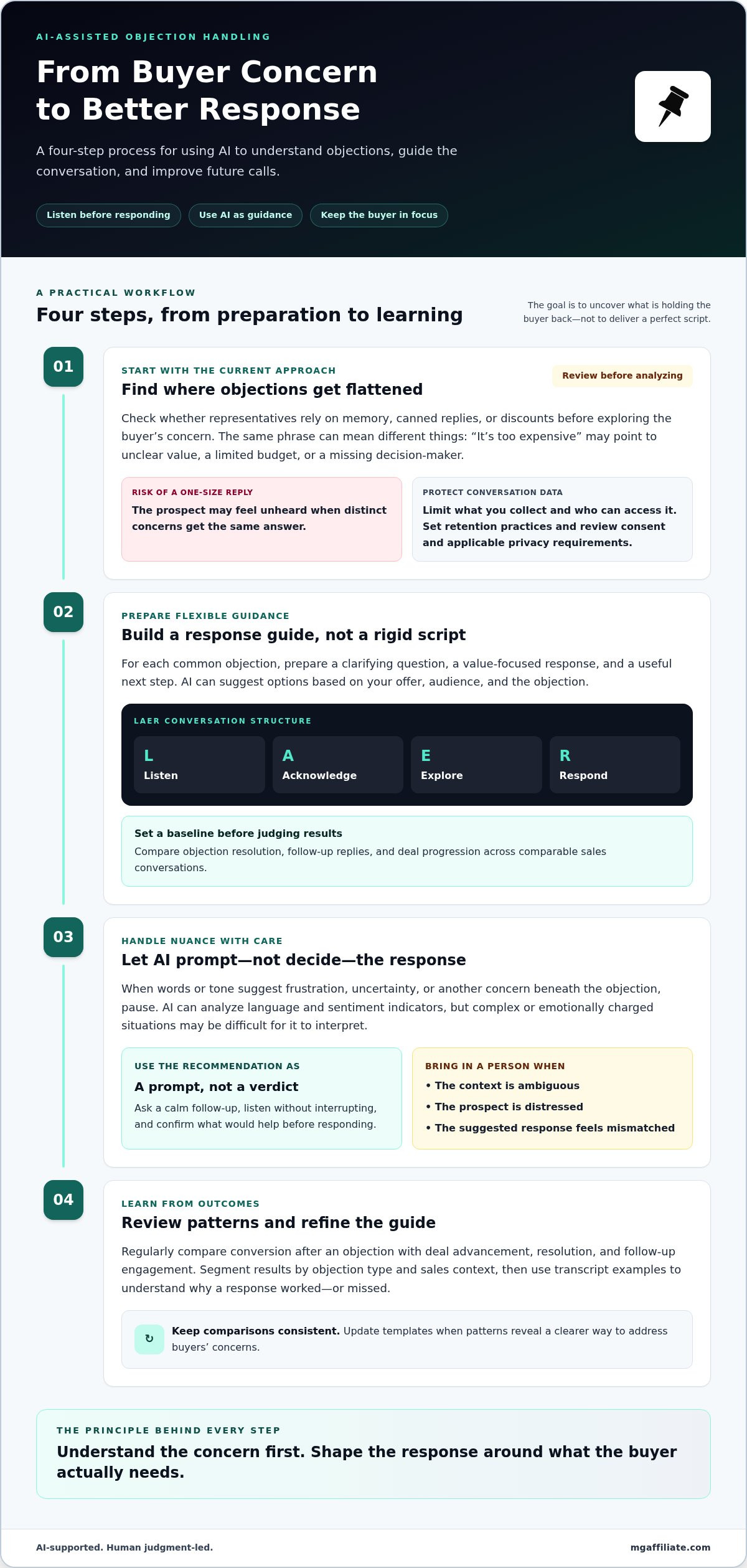
Start by reviewing how your team handles objections. Do representatives rely on memory, canned replies, or discounts before exploring the buyer’s concern? For example, “It’s too expensive” could mean unclear value, a limited budget, or a missing decision-maker. Treating every version the same can leave a prospect feeling unheard. Before analyzing calls, limit the conversation data you collect, restrict access, set retention practices, and review consent and applicable privacy requirements.
-
Prepare Techniques and Templates
Build a response guide around common objections, not rigid scripts. For each one, prepare a clarifying question, a value-focused response, and a useful next step. Use LAER, meaning listen, acknowledge, explore, and respond, to structure the exchange. AI can suggest response options based on your offer, audience, and the objection. To assess results, record a baseline, then compare objection resolution, follow-up replies, and deal progression across comparable sales conversations.
-
Address Nuanced or Emotional Objections
Pause when a prospect’s words or tone suggest frustration, uncertainty, or another concern beneath the stated objection. AI can analyze language and sentiment indicators, but it may struggle with complex or emotionally charged situations. Treat its recommendation as a prompt, not a verdict. A person should take over when the context is ambiguous, the prospect is distressed, or the suggested response feels mismatched. Ask a calm follow-up question, listen without interrupting, and confirm what would help before responding.
- Review outcomes regularly. Compare conversion after an objection with deal advancement, resolution, and follow-up engagement. Segment results by objection type and sales context, then use transcript examples to understand why a response worked or missed. Keep comparisons consistent, and update templates when patterns reveal a clearer way to address buyers’ concerns.
Using AI coaching cards for real-time sales guidance
Give your sales team concise prompts for live sales calls. Build each coaching card around a common objection, a useful question, and proof relevant to the prospect.
-
Personalize Rebuttals and Adapt in Real Time
Configure coaching cards to draw on the prospect’s stated concern and the conversation context. For a price objection, prompt the representative to ask what outcome would make the investment worthwhile. Include a relevant case study or customer testimonial as proof. Treat suggestions as flexible responses, not scripts. Notice whether the prospect’s next comment changes the concern, and adapt instead of repeating the original card.
-
Practice Responses to Common Objections
Prepare distinct prompts for price, timing, and competitor objections. For price, explore the buyer’s priorities before discussing value. For timing, ask what needs to happen before a decision. If a prospect prefers a competitor, ask which criteria matter most, then respond to those priorities with accurate evidence. Learning how to use AI to overcome sales objections means using generated responses to guide a real discussion, not pressure someone to buy.
-
Train with Real-Life Examples
Turn anonymized moments from sales calls into short practice scenarios for your team. Present the prospect’s objection, then compare the representative’s response with the coaching card’s suggested question and proof point. For example, pause after “We already use another solution” and practice asking what works well and what could improve. Review how the response shapes the exchange, not just whether it follows a template.
-
Practice with AI Role-Play
Ask an AI role-play partner to act as a prospect raising one objection at a time. Practice listening, asking a follow-up question, and responding with evidence suited to the buyer’s concern. After each round, assess whether you addressed the concern or jumped straight to a rebuttal. Change the prospect’s priorities and try again. This gives representatives practical experience applying how to use AI to overcome sales objections without memorizing a fixed answer.
Build confidence through deliberate practice and making more offers, while keeping live responses grounded in the buyer’s needs.
Automated follow-ups for unresolved objections
Turn each unresolved concern into a relevant next step, not a generic email sequence. AI can connect call notes, CRM records, and follow-up tasks to help sales teams keep valuable conversations moving.
- Capture the objection and agreed next step in the CRM immediately after the conversation. For example, note that a prospect needs input from finance and agreed to review a tailored cost breakdown. This context lets AI draft a follow-up that addresses the actual concern instead of sending a broad product pitch.
- Set rules for when an AI app should run. A trigger could be a call marked “pricing concern,” a deal-stage change, or a missed follow-up date. Have the app draft a message and create a task for the assigned representative. Review the draft before sending, especially if the prospect’s comments include sensitive context.
- Connect AI tools to CRM fields your sales team already uses, such as objection category, owner, next step, and last interaction. This keeps the pipeline record aligned with the follow-up. If a prospect’s concern remains unresolved, the system can suggest relevant material and prompt the representative to set a specific follow-up date and time.
- Personalize follow-up timing and content based on buyer behavior, not a rigid sequence. AI can suggest when to reconnect based on interaction patterns and identify stakeholders who may need to join. If a prospect asks to consult a manager, prepare a concise summary or relevant resource for that decision-maker instead of repeating the original pitch.
- Use qualification signals to guide follow-up attention. AI can organize stated needs, buying questions, and engagement into a clearer picture of readiness. For example, a prospect asking about implementation may need a different next conversation from someone still comparing priorities. Treat these signals as prompts for human review, then refine automation rules when messages miss the prospect’s concern.
Using AI call transcripts to analyze objection context
A transcript lets you examine what happened before and after an objection. Use that context to improve responses, not just collect quotes.
- Review the full exchange around each objection, including the question that prompted it and the representative’s reply. If a prospect says, “That’s too expensive,” check whether pricing came up before the seller explained the relevant value. The preceding turns may reveal whether the concern reflects budget, unclear benefits, or missing information.
- Tag objections by topic, such as price, timing, or competitor, then compare similar conversations. Look at what buyers asked next and whether the representative explored the concern. This turns call intelligence into practical patterns: repeated pricing objections after a feature list may signal that the seller needs to connect features to the buyer’s goals.
- Use AI to identify language and sentiment signals that may point to a deeper concern. For example, a prospect might say “I’m not sure” after describing pressure to avoid implementation disruption. Treat the signal as a prompt to review the transcript and ask a clarifying question, not as proof of what the buyer feels.
- Compare a suggested response with the full conversation before using it. AI can draw on historical sales interactions and context to suggest a rebuttal, but a short excerpt may miss a qualification, promise, or stakeholder concern. Check the surrounding turns, then choose a response that accurately reflects what the prospect said.
- Turn reviewed transcripts into specific coaching actions. Select one example where the representative addressed a concern well and another where the response missed the context. Use both in a team review to refine prompts and templates. As transcript analysis grows, track recurring objection themes and update guidance when buyer conversations reveal new questions.
Make transcript reviews part of a consistent selling routine, then practice making more offers with greater purpose.
MG Affiliate: BOSS Moves Book
After putting AI-guided objection handling into practice, MG Affiliate’s BOSS Moves Book offers a way to keep building your business skills. Use the ideas in this article to review sales conversations, then decide which parts of your selling approach you want to strengthen. AI can help organize insights, but your judgment and consistent action shape how you apply them.
Choose a resource that fits your next goal, whether you want to improve how you approach prospects or develop your broader business mindset. The BOSS Moves Book lets you continue learning at your own pace. Visit MG Affiliate to explore the book and decide whether it fits your next move.
Turn Better Conversations Into Your Next Move
Make your next step deliberate. Choose one sales conversation, identify what you want to improve, and use that insight to shape your next practice session. Learning how to use AI to overcome sales objections isn’t about letting a tool take the lead. It’s about making sharper decisions, asking more useful questions, and showing up with greater purpose.
Keep building your business skills with a resource that fits your goals. MG Affiliate offers the Make More Offers Challenge in General Admission and VIP Experience, along with the BOSS Moves Book. Consider which option best matches the action you’re ready to take next.
Contact MG Affiliate to discuss your needs, and keep moving forward with confidence.
Frequently Asked Questions
What Is a Sales Objection Answer Generator?
A sales objection answer generator is an AI tool that drafts possible replies to a prospect’s concern. It can help a representative prepare responses to objections like “We already have a provider” or “I’m unsure this fits our needs.” Treat the output as a first draft: check the claims, match the response to the prospect’s situation, and revise wording that sounds impersonal.
How does it do this?
The tool uses information in your prompt to create response options. Include what you sell, who you serve, the prospect’s exact concern, and the conversation goal. For example, ask for a clarifying question and a concise reply to a buyer worried about switching. More context usually makes a draft more relevant, but you’re responsible for checking that every product claim is accurate.
Why Overcoming Objections is Crucial for Sales Success?
Addressing objections helps buyers make informed decisions and gives sellers a chance to discover what matters most. A prospect raising implementation concerns may need a clear explanation of the transition, while someone comparing options may need help defining decision criteria. Thoughtful responses can strengthen credibility. Pushing past concerns without understanding them can weaken trust and stall a promising conversation.
How can AI help sales reps identify and respond to customer objections?
AI can flag phrases that suggest hesitation, group feedback by theme, and propose a follow-up question for the representative. For instance, repeated questions about onboarding might point to uncertainty about adoption rather than price. Use those signals to prepare a relevant discussion, then confirm the concern directly with the prospect. This lets you apply AI while keeping the human conversation central.
What AI tools are best for handling sales objections?
The right fit depends on where your team needs support. A writing assistant can draft practice replies, a conversation intelligence platform can search transcripts, and a CRM-integrated tool can organize objection notes with deal records. Compare tools by the tasks they handle, how easily representatives can review suggestions, and how well the outputs fit your sales workflow. Start with one clear use case.
How to use AI to analyze sales calls and find common objections?
Start by reviewing a set of call transcripts and applying consistent labels, such as budget, timing, product fit, or decision process. Ask AI to group similar phrases and show representative examples for each theme. Then compare those themes with deal outcomes and review the underlying conversations. This helps distinguish frequent objections from isolated comments and shows where your team can improve its approach.
Leave a Reply