

The more you pile into a sales offer, the harder it can be for buyers to see why it matters. If your pitch reads like a list of features, adding another bonus or discount may not clear things up. The real shift is showing the right buyer how your offer connects to a priority they already care about. That’s how to write an irresistible sales offer without relying on pressure or inflated promises.
You might already know your offer is valuable. But if prospects can’t tell what they’ll receive, what it will help them do, or what to do next, hesitation makes sense. Clarity builds confidence, as does a promise you can credibly support.
In this article, you’ll learn how to shape your offer around a real buyer need, explain its value and delivery plainly, and give prospects a confident next step. You’ll also create a practical draft you can refine using buyer feedback. No bonus overload required, just a focused offer that helps the right people understand why it may be a fit.
Key Takeaways
- Define your offer as more than a product: make the promise, delivery, terms, and next step easy to understand.
- Build around a specific buyer’s needs, then connect the value you promise to what you can credibly deliver.
- Compare scope, proof, support, pricing, and timing on their own merits; add bonuses only when they address a related buyer need.
- Learn how to write an irresistible sales offer with five practical steps, from defining the buyer to clarifying the action they can take.
- Use buyer feedback to improve clarity and fit without relying on pressure or promising guaranteed results.
What Makes a Sales Offer Irresistible to the Right Buyer?
A sales offer is more than the thing you sell. It brings together the value you promise, what the buyer will receive, the terms of the exchange, and the next step they can take. Each part helps a potential customer decide whether the offer fits their needs and feels worth considering.
A product is what you deliver; an offer is the clear, credible case for why a particular buyer should choose it, what they can expect, and how to move forward. That distinction matters. A product can have excellent features and still be hard to buy if the buyer can’t see how those features relate to a priority they care about.
“Irresistible” doesn’t mean universally appealing or impossible to decline. It means relevant and compelling to a suitable buyer. An offer built for everyone may sound so broad that no one recognizes themselves in it. Focus instead on a buyer with a specific need, and explain how your offer addresses that need within what you can genuinely deliver.
Offer, product, and pitch: what is the difference?
The product is the good, service, or experience being delivered. The offer explains its value and practical details, such as who it’s for, what’s included, and what the buyer does next. The pitch is the message used to communicate that offer. A memorable pitch can draw attention, but it can’t make vague scope or an unsupported promise solid.
For example, a language tutor’s product might be a set of tutoring sessions. The offer could explain that the sessions help a beginner practise everyday conversation, describe how lessons are delivered, and clarify how to sign up. The pitch shares that information in a concise, engaging way. It’s the same product, presented as a clearer buying decision.
Why a clear offer can matter more than louder promotion
If a prospect can’t tell what they’ll receive, whether it suits their situation, or what happens after they say yes, hesitation is understandable. More promotion may put the message in front of them again, but repetition alone doesn’t answer those questions. Sales promotions such as discounts, coupons, and samples are distinct tactics, as outlined in Sales Promotion Strategies. They don’t replace a clear explanation of the offer itself.
Before changing the product or service, improve how you explain it. Make the existing value easier to recognize. Check whether your description answers these questions:
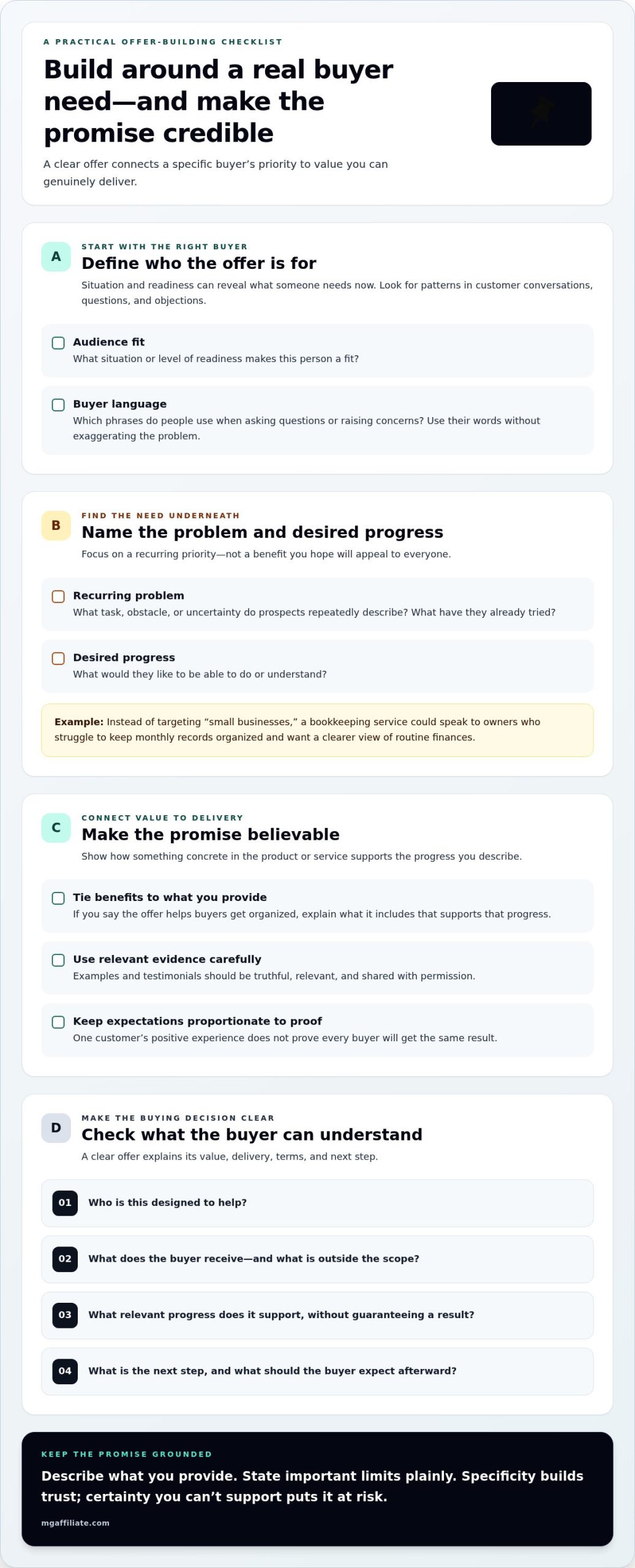
- Who is this designed to help?
- What does the buyer receive, and what is outside the scope?
- What relevant progress does it support without promising a guaranteed result?
- What is the next step, and what should the buyer expect after taking it?
Clarity won’t make every prospect a fit, and it can’t guarantee a sale. It does give suitable buyers a stronger basis for deciding. If you’re learning how to write an irresistible sales offer, start by making the value, delivery, and decision easier to understand, not by turning up the pressure.
Build the Offer Around Buyer Needs, Value, and Credibility
A compelling offer starts with a buyer you understand, not a benefit you hope will appeal to everyone. Identify a specific audience, the problem that keeps returning, and the progress they want to make. Then connect that progress to a product or service you can genuinely deliver. A credible promise speaks to a defined audience, addresses a real need, and stays within what the business can substantiate.
Identify the buyer and the problem they want solved
Demographics can describe an audience, but situation and readiness often reveal what they need now. Look for patterns in customer conversations, sales questions, and objections. What keeps coming up? What have prospects already tried? What makes them consider taking action now? Use their own words to describe the problem, without exaggerating its consequences to make the offer sound urgent.
For a hypothetical bookkeeping service, “small businesses” is broad. A more useful audience might be owners who struggle to keep monthly records organized and want a clearer view of routine finances. That description points to a relevant need without claiming that every owner faces the same issue.
- Audience: What situation or level of readiness makes this person a fit?
- Recurring problem: What task, obstacle, or uncertainty do they repeatedly describe?
- Desired progress: What would they like to be able to do or understand?
- Buyer language: Which phrases do they use when asking questions or raising concerns?
These answers help you distinguish a real priority from an assumption. If several prospects ask about the same part of your process, that may be a signal to explain it more clearly in the offer.
Make the promised value believable
Connect each promised benefit to something concrete in your delivery. If you say the offer helps buyers get organized, explain what your product or service includes that supports that progress. Relevant process details and accurate examples can make the connection easier to understand. Use testimonials or other evidence only when they’re truthful, relevant, and shared with permission.
Keep the promise proportionate to the proof. A customer’s positive experience can show what was possible for that person; it doesn’t prove every buyer will get the same result. Outcomes may depend on circumstances beyond your control, so describe what you provide and what buyers can reasonably expect from the experience. State important limits plainly. Specificity builds trust; certainty you can’t support puts it at risk.
To practise how to write an irresistible sales offer, connect the dots in one sentence: “For [buyer in a specific situation], [offer] provides [relevant value] through [what you deliver].” Treat it as a starting point, not a universal formula. Test whether your chosen buyer recognizes the need and whether your delivery supports the promise.
If you’re ready to develop your offer further, you can explore professional programs and resources through MG Affiliate to help entrepreneurs refine their offers, secure registration options, and gain additional coaching time for their business ventures.
Compare Offer Elements Without Relying on Discounts or Pressure
A discount is only one way to shape an offer, and it may not address what’s making a buyer pause. Compare each element by asking what decision it helps the buyer make, what supports the claim, and what extra complexity it introduces. The goal isn’t to include everything. It’s to make the offer easier to evaluate.
| Offer element | Buyer benefit | Proof to provide | Possible drawback |
|---|---|---|---|
| Clear scope | Shows what’s included and what to expect. | A specific description of deliverables or boundaries. | Too much detail can bury the central value. |
| Relevant proof | Helps buyers assess whether the offer is credible. | Accurate examples, process details, or permissioned testimonials. | Irrelevant or overstated evidence can weaken trust. |
| Useful support | Clarifies what help is available during delivery. | A defined description of the support provided. | Vague support language can create mismatched expectations. |
| Pricing presentation | Makes the financial decision easier to understand. | Plainly stated price and any required terms. | Hidden or confusing charges can create doubt. |
| Timing | Helps buyers understand when to act or what to expect. | A real schedule, deadline, or capacity limit. | Invented urgency can feel manipulative. |
When should an offer use bonuses, guarantees, or added support?
Add an element only if it helps with a related buyer need. A bonus that complements the main offer may make it more useful; an unrelated extra can distract from the core value. Ask whether the buyer would still understand why the offer fits without it. If not, clarify the offer itself first.
A guarantee is optional, not a default ingredient. Include one only when you’ve defined terms you can deliver and explain clearly. Added support needs the same care: state what it includes and its boundaries. “Extra help” is too vague to guide a decision. Clear terms help both sides understand the commitment.
How can urgency remain honest and useful?
Use a deadline only when a genuine timing constraint exists, such as a scheduled enrollment period or a real delivery cutoff. Explain the constraint plainly. Don’t claim limited availability if there’s no actual limit, or reset a countdown to pressure buyers into acting.
Pressure can rush a decision without improving fit. Honest timing gives a suitable buyer useful information; it doesn’t manufacture a reason to buy. As you consider how to write an irresistible sales offer, prioritize scope, relevant proof, and understandable terms before adding incentives or urgency.
For entrepreneurs ready to keep working on their offers, the Make More Offers Challenge is a five-day business intensive with General Admission and VIP registration options. The VIP Experience includes additional coaching time.
Write and Refine Your Sales Offer in Five Practical Steps
Turn what you know about your buyer into a draft they can quickly understand. This sequence gives you a practical starting point, not a rigid formula. Adapt the language and level of detail to your business, the offer, and what your buyer needs to decide.
- Define the buyer. Name the situation, need, or stage that makes someone a good fit. “Independent professionals preparing to sell their first service” is more useful than “everyone who wants to grow.”
- Name the need. Describe the challenge in plain language. Focus on what the buyer wants to address, not a dramatic consequence you can’t substantiate.
- State the promise. Explain the useful progress your offer is designed to support. Keep the claim within what you can reasonably deliver; don’t promise an outcome that depends on circumstances you can’t control.
- Show the delivery. Specify what the buyer receives, how it’s delivered, and any meaningful boundaries. Concrete scope helps the buyer judge whether the offer fits.
- Clarify the action. Tell the buyer what to do next and what to expect after taking that step. Avoid vague instructions that leave them guessing.
Draft a concise offer statement buyers can understand
Use this fill-in template as a first draft: “For [buyer and situation], [offer] helps address [specific need] by providing [delivery and useful progress]. To take the next step, [clear action].” Replace placeholders with language your audience uses. One business may need to explain a service process; another may need to describe a product’s scope. The best version accurately fits the offer, rather than following a formula word for word.
Trade vague superlatives such as “best,” “ultimate,” or “game-changing” for details buyers can assess. Describe what’s included and why it matters to this audience. If you’re positioning a premium offer, consider how its scope and value are explained in this high-ticket sales guide.
Test clarity and improve from real responses
Before publishing, share the draft with prospective buyers or people who understand the audience. Ask what they think is included, who they believe it’s for, and what they’d need clarified before deciding. Listen for repeated questions, not just whether someone says they like the wording. A single response is useful feedback, not proof that every buyer sees it the same way.
Review the draft for four things: clarity (is it easy to understand?), credibility (can you support the promise?), relevance (does it address a real buyer need?), and feasibility (can you deliver it as described?). Revise the unclear parts, then ask for feedback again. This is a practical way to improve how to write an irresistible sales offer without assuming any wording guarantees a sale.
Ready to keep developing your offer? Explore the Make More Offers Challenge, a five-day business intensive for entrepreneurs working on their offers. You can also explore MG Affiliate for business education resources.
Turn Your Offer Draft Into a More Confident Next Step
Your draft now has the essential pieces: a defined buyer, a need that matters to them, a useful promise, delivery you can stand behind, and a clear action. The next move isn’t to add more claims. It’s to check whether those pieces work together and make the offer easy for the right person to assess.
Decide what to improve before publishing
Read the offer as if you’ve never seen it before. Can you quickly tell who it’s for, what value it offers, what’s included, and what to do next? If a buyer has to guess, revise the specific phrase or detail that caused confusion. Keep the offer aligned with what your business can actually deliver.
- Buyer: Is it clear who the offer is meant to serve?
- Value: Does the promise connect to a real need without overstating the result?
- Scope: Can a buyer understand what’s included and any relevant boundaries?
- Action: Is the next step direct and easy to identify?
- Credibility: Can you support each claim, bonus, and deadline you’ve included?
Now compare that review with buyer feedback. If several people ask the same question, that’s stronger evidence of a clarity gap than one person’s preference. Choose one improvement based on the clearest recurring signal. Remove any claim, extra, or deadline you can’t substantiate. Then read the revised version again. This focused cycle helps you improve fit without assuming every buyer will respond in the same way.
Continue developing your offer through structured learning
Writing a clear offer is a skill you can keep building. Each round of feedback can show you where buyers understand the value, where they hesitate, and what needs a more precise explanation. Use those observations to improve the draft, not to promise guaranteed sales or outcomes. A stronger offer makes the decision clearer; it can’t control every factor behind a buyer’s choice.
For entrepreneurs who want to keep working on their offers, the Make More Offers Challenge is a recurring five-day business intensive. General Admission and VIP registration options are available, and the VIP Experience includes additional coaching time. Choose the learning format that suits how you want to work on your offer, without treating participation as a promise of specific business results.
You’ve got a draft and a practical way to refine it. If you’re ready to continue developing your offer, explore the Make More Offers Challenge and take your next step in the work.
Put Your Offer Into Motion
Your offer doesn’t need to be perfect before you put it in front of the right people. Treat it as a working draft: share it, notice where buyers pause or ask questions, and make one thoughtful improvement at a time. That feedback loop is a practical way to strengthen how to write an irresistible sales offer while keeping your message grounded in what you can genuinely provide.
If you’re ready to keep developing your offer, the Make More Offers Challenge is a recurring five-day business intensive for entrepreneurs. General Admission and VIP registration options are available, with additional coaching time included in the VIP Experience. It’s an educational next step for refining your approach, not a promise of a particular business result.
Explore the Make More Offers Challenge and keep building with clarity, credibility, and confidence. Your next improvement can start with one useful conversation.
Frequently Asked Questions
Can an offer be irresistible without a discount?
Yes. Buyers may value a clear explanation, a relevant example, or a smoother way to get started more than a lower price. If someone hesitates, find out what’s behind the pause before changing the price. Is the value hard to picture, or does the buyer need information about how the offer works? That’s a useful starting point for how to write an irresistible sales offer without relying on a discount.
How long should a sales offer be?
There’s no fixed word count. A simple product may need only a concise description and an obvious way to buy, while a complex service may require more detail about stages, responsibilities, or exclusions. Put the most decision-relevant information first, then provide supporting explanations nearby. For example, use a short summary at the top of a service page and place process details below it. Cut repetition, not details buyers need.
Should every prospect receive the same sales offer?
Not always. Keep the underlying product, terms, and delivery consistent, but adjust the explanation to reflect a suitable audience’s priorities. For example, the same bookkeeping service might be introduced to a new business owner through setup needs and to an established owner through recurring record-keeping tasks. The offer should still describe what’s actually provided. If audiences need different deliverables or commitments, consider separate versions and assess each on its own merits.
What happens if prospects still do not respond to an offer?
Look beyond the wording before rewriting the whole offer. Check whether it’s reaching people who have the need, whether they understand the next step, and whether the timing suits their situation. Keep a simple record of questions, objections, and where conversations stop. If prospects understand the offer but aren’t ready to act, the issue may be timing rather than clarity. Make one evidence-based adjustment and watch for a pattern.
Can I use urgency in a sales offer without sounding pushy?
Yes, if the timing information helps buyers make a genuine decision. A scheduled program with a real enrollment closing date, for instance, can state that date and explain what happens afterward. Make the limit easy to understand, and keep it accurate wherever the offer appears. Avoid countdowns or “last chance” language that doesn’t reflect a real constraint. Buyers should be able to decide without being misled or rushed by invented scarcity.
How do I know whether my sales offer is clear?
Ask someone in your intended audience to read it without your explanation, then describe what they think the offer includes and what they’d do next. Notice where their interpretation differs from your intent. If they assume a service includes ongoing support, for example, but it doesn’t, clarify the scope. Repeat the exercise after revising. This read-back test can uncover assumptions that are easy to miss when you know the offer well.
Can a strong sales offer guarantee more sales?
No. A strong offer can make its value easier to assess, but it can’t control whether a buyer is ready, trusts the business, or has the right circumstances. Track more than purchases: note whether qualified prospects understand the offer, complete the next step, or raise recurring questions. Those signals can guide improvements without turning uncertain outcomes into promises. Describe what your business delivers accurately, and let results inform the next revision.
Leave a Reply