

Why are you working forty hours a week to sell a digital product that costs less than a lunch special? If you’re trapped in the cycle of peddling twenty-seven dollar ebooks and praying for a viral miracle, you aren’t building an empire; you’re managing a digital flea market. You likely fear that raising your prices will instantly kill your sales volume. It’s a valid concern, but it’s also the primary barrier keeping you from the seventy to ninety percent profit margins common in the five hundred billion dollar digital goods market. Mastering the art of pricing digital products for maximum profit isn’t about adding more pages to a PDF. It’s about fundamentally shifting how your audience perceives the transformation you provide.
You’ve already realized that chasing millions of leads just to sustain your lifestyle is a recipe for burnout. We agree that your expertise is worth more than an impulse-buy price tag, yet the path to high-ticket success often feels like a mystery. This article will teach you how to transcend commodity pricing by leveraging the psychology of value. We’ll preview the specific offer structures that allow you to scale without requiring a massive audience. It’s time to stop competing on cost and start commanding the profit your results deserve.
Key Takeaways
- Stop viewing price as just a revenue collector; learn why pricing digital products for maximum profit requires using your price tag as a psychological signal of authority and results.
- Identify where you sit on the 4 Levels of Value framework and why moving beyond simple implementation is the key to unlocking premium margins.
- Master the Offer Architecture needed to command 2,000 dollars or more for your digital solutions without needing a massive audience.
- Apply tactical strategies like the Rule of 10 and price anchoring to make your high-ticket offers feel like an undeniable bargain for your ideal clients.
- Discover how the Make More Offers Challenge provides the strategic roadmap to transition from Trash Man to Cash Man thinking and scale your professional impact.
The Psychology of Price vs. Value in Digital Markets
Price isn’t just a number on a checkout page. It’s a loud, clear signal about who you are and what you deliver. When you’re pricing digital products for maximum profit, you must stop treating your price tag as a mere receipt for your time. It’s a communication tool. If you price your expertise at the same level as a fast-food meal, don’t be surprised when customers treat your hard-earned knowledge as disposable. High-value clients aren’t looking for the cheapest option. They’re looking for the most certain solution. To them, “cheap” often translates to “risky” or “low quality.”
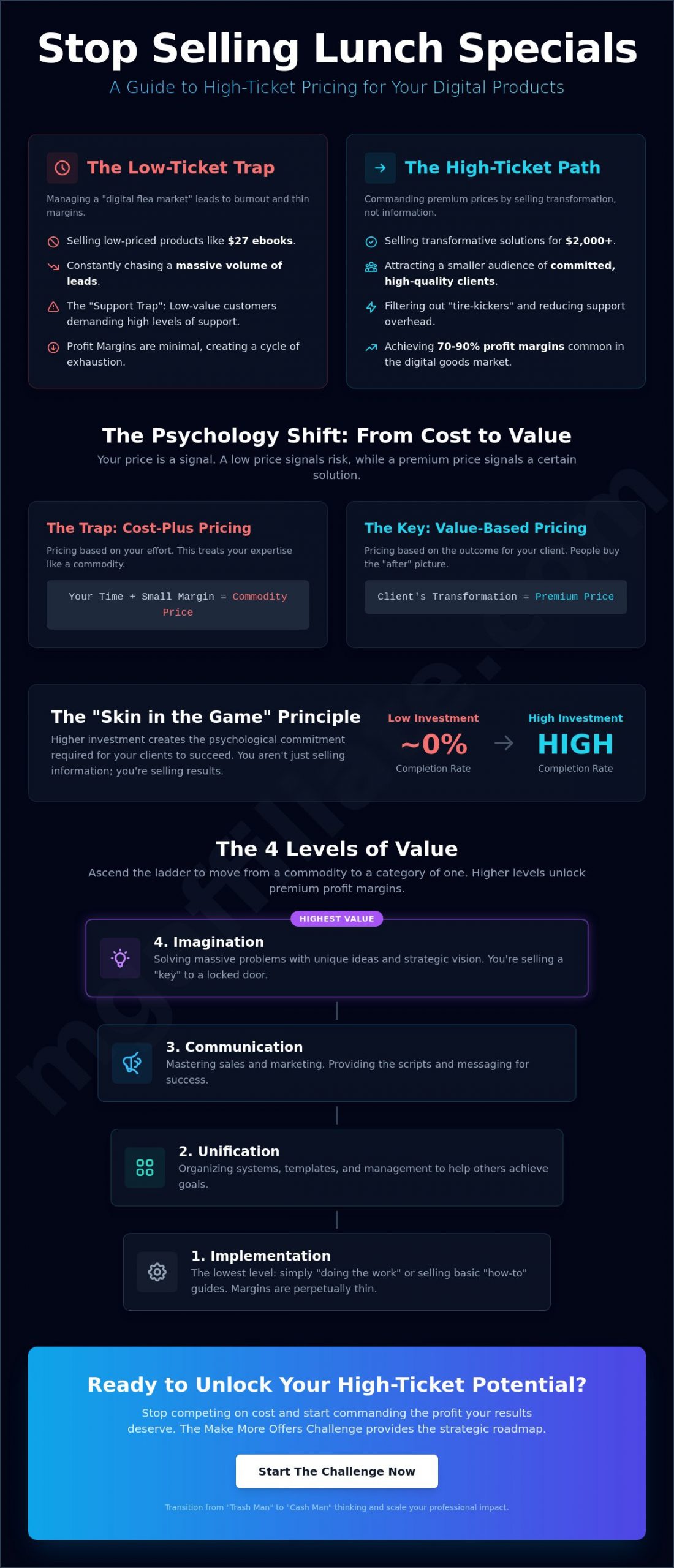
Why do most creators stay broke? They use cost-plus pricing. They look at how many hours they spent making a course and add a small margin. This is the commodity trap. Instead, you must adopt Value-Based Pricing. This strategy focuses on the economic and emotional impact your product creates for the buyer. People don’t buy pixels, PDFs, or video modules. They buy the “after” picture. They buy the promotion, the saved marriage, or the extra ten thousand dollars in monthly revenue. If your digital product solves a fifty thousand dollar problem, charging five thousand dollars isn’t expensive. It’s a bargain.
Why Low Pricing Can Kill Your Digital Business
Selling five hundred ebooks at twenty dollars sounds great until the refund requests and support tickets start rolling in. This is the “Support Trap.” Low-ticket buyers often demand more hand-holding than high-ticket clients while contributing the least to your bottom line. Scaling this model requires a massive, never-ending stream of new leads, which is expensive and exhausting. Price acts as a high-performance filter that attracts committed achievers and repels the entitled tire-kickers who drain your energy.
The Correlation Between Price and Student Success
Why do free courses have a completion rate near zero? It’s because the “cost of inaction” is also zero. When a student invests significantly, they develop “skin in the game.” This financial commitment forces them to pay attention, implement the work, and actually achieve the transformation you promised. Premium pricing is actually a service to your customer because it creates the psychological urgency required for them to succeed. You aren’t just selling information; you’re selling the accountability that leads to life-changing results.
The 4 Levels of Value: A Framework for Maximum Profit
Stop guessing what your expertise is worth. Most digital creators fail because they price based on their effort rather than their impact. If you want to master pricing digital products for maximum profit, you must understand the proprietary framework of the 4 Levels of Value: Implementation, Unification, Communication, and Imagination. Most entrepreneurs are stuck in the “Implementation” trap. This is the lowest level of value where you’re simply “doing the work” or selling a basic “how-to” guide. Because Implementation is easily outsourced or replaced by AI, its profit margins are perpetually thin.
As you move up the ladder, your income potential explodes. Unification involves management and organizing systems to help others achieve a goal. Communication focuses on sales and marketing, which are the lifeblood of any business. However, the peak of this framework is Imagination. This is the level where you solve massive problems with unique ideas and strategic vision. When you sell Imagination, you aren’t selling a product; you’re selling a “key” to a locked door. This is where high-ticket pricing lives and where your brand becomes irreplaceable.
Moving Up the Value Ladder
How do you turn a twenty-seven dollar ebook into a two thousand dollar strategic system? You stack value. Instead of just showing someone “how” to do a task, you provide the Unification (templates and systems) and the Communication (the scripts and messaging) they need to succeed. You can learn more about this in our guide on The 4 Levels of Value: Why Your Current Business Model is Capping Your Income. By shifting your digital offer from a simple tutorial to a comprehensive solution, you move from a commodity to a category of one. If you’re ready to make this shift, the Make More Offers Challenge is the perfect next step to refine your offer architecture.
Pricing Based on the Magnitude of the Problem
Profit is a byproduct of the value you create for the end user. Think about the math. If your digital product helps a business owner solve a ten thousand dollar problem, justifying a two thousand dollar price point is easy. The Psychology Of Pricing confirms that consumers often equate higher costs with higher effectiveness. A digital course that solves a minor inconvenience, like how to organize your desk, will always have a low ceiling. Conversely, a product that solves a massive problem, such as how to generate fifty high-quality leads per week, has virtually unlimited profit potential. Focus your Imagination on solving the biggest problems in your niche, and the market will reward you with premium margins.
Transitioning from Low-Ticket to High-Ticket Digital Offers
Why are you still fighting for scraps in the low-ticket arena? In 2026, a high-ticket digital offer is defined by its ability to deliver a specific, high-value outcome, typically starting at the two thousand dollar mark. Achieving this level of pricing digital products for maximum profit requires a total overhaul of your “Offer Architecture.” You can’t just slap a premium price on a basic video course and hope for the best. You must build a structure that supports the weight of that price point through deep implementation tools, high-level strategy, and a clear path to a massive ROI.
Think about the energy you spend on marketing. Did you know it takes nearly the same psychological effort to convince a stranger to spend fifty dollars as it does to get them to spend five hundred? Both require trust. Both require a sales page. Both require a persuasive email sequence. If you’re going to use your breath to sell, why not use it to sell something that actually changes your bank account? The objection of “who would pay this much for a digital product?” is a poverty-mindset trap. Sophisticated buyers don’t want more “stuff”; they want the fastest path to a result. They’ll pay for the speed and the certainty you provide.
The Premium Digital Product Checklist
Your offer must be undeniable to command premium rates. A high-ticket digital product isn’t just content; it’s an environment. This includes access to a curated community, live Q&A components, and, most importantly, your proprietary frameworks. This is where BOSS Moves by Myron Golden becomes your playbook. By applying these business optimization principles, you ensure your offer isn’t just another digital file, but a scalable asset that delivers consistent excellence to every student who enters your ecosystem.
Structuring Your Tiered Pricing Model
Don’t leave money on the table by offering only one way to work with you. Use a “Good, Better, Best” model to guide your customers through their professional evolution. A “General Admission” tier provides the essential foundation, while a “VIP Experience” offers the proximity and depth that high-level achievers crave. We see this model work perfectly in the Make More Offers Challenge. By providing these distinct entry points, you capture the widest range of committed buyers while significantly increasing your profit per sale. This structure doesn’t just increase revenue; it builds a logical ladder for your clients to climb as they grow.
Tactical Pricing Strategies for Digital Conversions
How do you make a two thousand dollar price tag look like an absolute steal? You use price anchoring. By presenting a higher-priced premium option first, you establish a mental benchmark for value. When your target offer appears next, the customer doesn’t see it as “expensive.” They see it as a logical, high-value investment. This tactic is essential when pricing digital products for maximum profit because it resets the buyer’s internal compass. Without an anchor, your audience has no choice but to compare your price to the cheapest thing they saw on a social media ad. Don’t let them do that. Control the comparison.
Next, you must master the Rule of 10. This principle dictates that your digital offer should be worth at least ten times the price you are asking. If you want to command a one thousand dollar price point, you must demonstrate ten thousand dollars in tangible results, time saved, or future earnings. This creates an irresistible mathematical gap. You can further sharpen this with decoy pricing. By offering a middle tier that is only slightly cheaper than your top tier but lacks the most valuable features, you nudge the buyer toward the premium option. This strategy maximizes your average order value by making the “best” choice the only logical one.
The “Make More Offers” Mindset
Stop obsessing over how much you can charge and start focusing on how much value you can pack into your “Offer Wrapper.” If your product isn’t selling, the solution is rarely to lower the price. The solution is to make a better offer. You should iterate on your pricing by testing different bonuses, implementation tools, and support structures until the value becomes undeniable. Your price is a direct reflection of your self-worth and business maturity. When you value your expertise, the market follows suit. If you’re ready to stop guessing and start winning, the Make More Offers Challenge provides the exact framework you need to build high-converting, high-ticket offers.
Psychological Triggers That Justify Premium Prices
Why can an expert charge ten times more than a novice for the same information? It’s the authority trigger. Social proof, case studies, and proprietary frameworks signal to the buyer that you are the “key” to their success. You can amplify this by adding exclusivity. A static, evergreen download feels common, but a limited-time digital cohort with live components feels like a rare opportunity. Finally, use risk reversal to remove the friction of the sale. A bold, results-based guarantee proves you have skin in the game. When you combine authority, exclusivity, and a solid guarantee, you create the psychological environment where high-ticket sales become inevitable.
Scaling Your Profit with the Make More Offers Challenge
Mastering the art of pricing digital products for maximum profit is a skill that must be forged in the fire of real-world application. You’ve learned the psychology of value and the architecture of a high-ticket offer. However, knowing the framework isn’t the same as executing it with precision. This is where the Make More Offers Challenge (MMOC) becomes your competitive advantage. This 5-day immersive experience is designed to strip away the hesitation and technical confusion that keeps most entrepreneurs stuck. It provides the tactical environment you need to build, price, and launch an offer that reflects your true worth.
Mentorship is the “key” that unlocks the latent potential already residing within your business. You can spend years trying to figure out the nuances of high-ticket sales psychology through trial and error, or you can spend five days learning from someone who has already mastered the system. The challenge guides you through the transition from “Trash Man” to “Cash Man” thinking. This isn’t just a catchy phrase; it’s a fundamental shift from a scarcity-based professional existence to a state of financial autonomy and authority. You’ll learn to stop asking what the market will “allow” you to charge and start dictates the value you provide.
Why Most Entrepreneurs Get Pricing Wrong
The biggest obstacle to your success isn’t your product; it’s your mental framing. Most creators are infected with a “Poverty Mindset” that compels them to look at their competitors and try to underprice them. This race to the bottom ensures that no one wins. In contrast, a “Wealth Mindset” understands that exclusivity and premium pricing actually attract the best clients. Myron Golden’s BOSS Moves book provides the essential blueprint for Stage Four growth, teaching you how to optimize your business so it serves your life rather than consuming it. If you’re basing your prices on “competitive research,” you’re just copying someone else’s limitations.
Your Next Step to Financial Freedom
The journey to elite profitability follows a clear path: Value leads to a structured Offer, which justifies a premium Price, resulting in maximum Profit. You now have the map. It’s time to take the first step. We invite you to join the next Make More Offers Challenge to begin your professional evolution. Whether you choose the General Admission path or the Make More Offers Challenge – VIP Experience for high-level implementation and proximity, the goal remains the same. Stop playing small with low-ticket ebooks. Build an irresistible, high-profit offer that commands the respect and the revenue you deserve.
Claim Your Seat at the High-Ticket Table
You now possess the strategic keys to unlock a new level of professional autonomy. We’ve explored how your price tag acts as a filter for the quality of clients you attract and how the proprietary 4 Levels of Value framework can finally break your income ceiling. You’ve discovered that pricing digital products for maximum profit isn’t about greed; it’s about matching your compensation to the magnitude of the transformation you provide. Stop competing on cost and start commanding the respect your results deserve.
For over 15 years, these proven business growth strategies have helped thousands of entrepreneurs transition from selling low-ticket commodities to launching 5, 6, and 7-figure offers. The Cash Man life isn’t reserved for the lucky; it’s designed for the disciplined. Are you ready to stop guessing and start scaling? Your next move is to apply these principles under direct mentorship. Join the Make More Offers Challenge and Master High-Ticket Pricing today. It’s time to build the wealth and impact you were meant to achieve. We’ll see you at the top.
Frequently Asked Questions
How do I know if my digital product is priced too high?
Your product is only priced too high if the perceived value fails to outweigh the cost in the mind of your prospect. If you’re driving targeted traffic but seeing zero conversions despite testing different offer structures, you likely have a communication problem rather than a pricing problem. High-ticket buyers don’t look for the lowest price; they look for the highest certainty of a result. Ensure your marketing reflects the massive transformation you deliver.
Should I offer discounts or coupons for my digital products?
Stop using discounts as a crutch. Lowering your price devalues your expertise and trains your audience to wait for a deal rather than taking immediate action. If you want to increase sales, add more value through bonuses or implementation tools that solve adjacent problems. This maintains your premium positioning while making the decision to buy easier for your prospect without eroding your profit margins.
What is the best price point for a new digital course?
The ideal price point is determined by the magnitude of the problem you solve. If your course helps someone generate an extra five thousand dollars a month, a two thousand dollar price tag is an incredible bargain. When pricing digital products for maximum profit, always lead with the economic impact of the transformation. Don’t look at what others are charging; look at the value of the “after” picture you create.
Is it better to sell a one-time product or a monthly subscription?
The most scalable businesses utilize a hybrid model to maximize both cash flow and stability. High-ticket one-time offers provide the immediate capital needed for aggressive growth, while monthly subscriptions build long-term predictability and community. Start with a premium core offer to capture high-value clients, then offer a recurring membership for those who want ongoing proximity and support as they implement your strategies.
How do I justify a high-ticket price for a digital product with no physical costs?
You don’t justify price based on production costs; you justify it based on the speed of the result. Your customers aren’t paying for a video file or the storage space of a PDF. They’re paying to skip the years of struggle and expensive mistakes you’ve already navigated. The lack of physical overhead is a benefit to your business model, not a reason to lower your worth or your standards.
Can I change my pricing after I have already launched?
Absolutely. Your price should evolve as your authority, student results, and social proof increase over time. In fact, announcing a future price increase is one of the most effective ways to create genuine urgency in your marketing. Give your audience a clear deadline to secure the current rate before the price moves up to reflect the growing value of the ecosystem you’ve built.
What is value-based pricing and how do I calculate it?
Value-based pricing is a strategy that sets prices based on the perceived value to the customer rather than the cost of creation. To calculate it, estimate the total financial gain or time saved your client will achieve by using your product. Aim to price your digital offer at approximately ten percent of that total value. This ensures you maintain high margins while providing the customer with a ten-to-one return on their investment.
How does Myron Golden recommend pricing high-ticket offers?
He recommends moving away from the low-margin “Implementation” level and pricing based on “Imagination” and “Communication.” By using the Rule of 10, you ensure the value of your offer is ten times the price you’re asking. This creates a psychological environment where the prospect feels like they are winning the moment they invest. It shifts the focus from what the product costs to what the product creates.
Leave a Reply