

You aren’t struggling because you lack talent; you’re struggling because you’re playing in the low-margin dirt. Most entrepreneurs think they need a higher volume of leads, but what they actually need is a higher barrier to entry. So, what’s high ticket sales in the 2026 economy? It isn’t just about adding extra zeroes to your invoices. It’s a fundamental shift in how you provide value and who you choose to serve. High-ticket sales represent products or services priced at $1,000 or more, often reaching well beyond $20,000 for transformational results.
You likely feel capped by your current hourly rate or exhausted by the endless cycle of low commissions that barely cover your overhead. It’s frustrating to work this hard for such a small return. We’re going to change that right now. This guide promises to hand you the psychological framework and strategic shifts required to transition from low-margin grinding to high-ticket mastery. You have the potential for economic independence; you just need the right key to unlock it.
We will break down the specific mechanics of premium transactions and show you how to structure an offer that commands respect. You’ll learn how to shed imposter syndrome and move from a “trash man” to a “cash man” mindset. Let’s dive into the core strategies that will define your professional evolution this year.
Key Takeaways
- Master the transition from high-volume grinding to high-impact results by understanding exactly what’s high ticket sales and why it requires a premium business philosophy.
- Develop the wealth literacy needed to break through your current income ceilings and stop letting your own perception of price limit your professional growth.
- Discover why serving 10 high-value partners is more profitable and less draining than managing 1,000 low-ticket customers in the 2026 economy.
- Learn how to engineer an irresistible premium offer using proprietary frameworks that solve the big problem your market is desperate to fix.
- Master the consultative closing process by identifying the gap between your client’s current reality and their ultimate transformation.
What’s High Ticket Sales? Defining the Premium Model
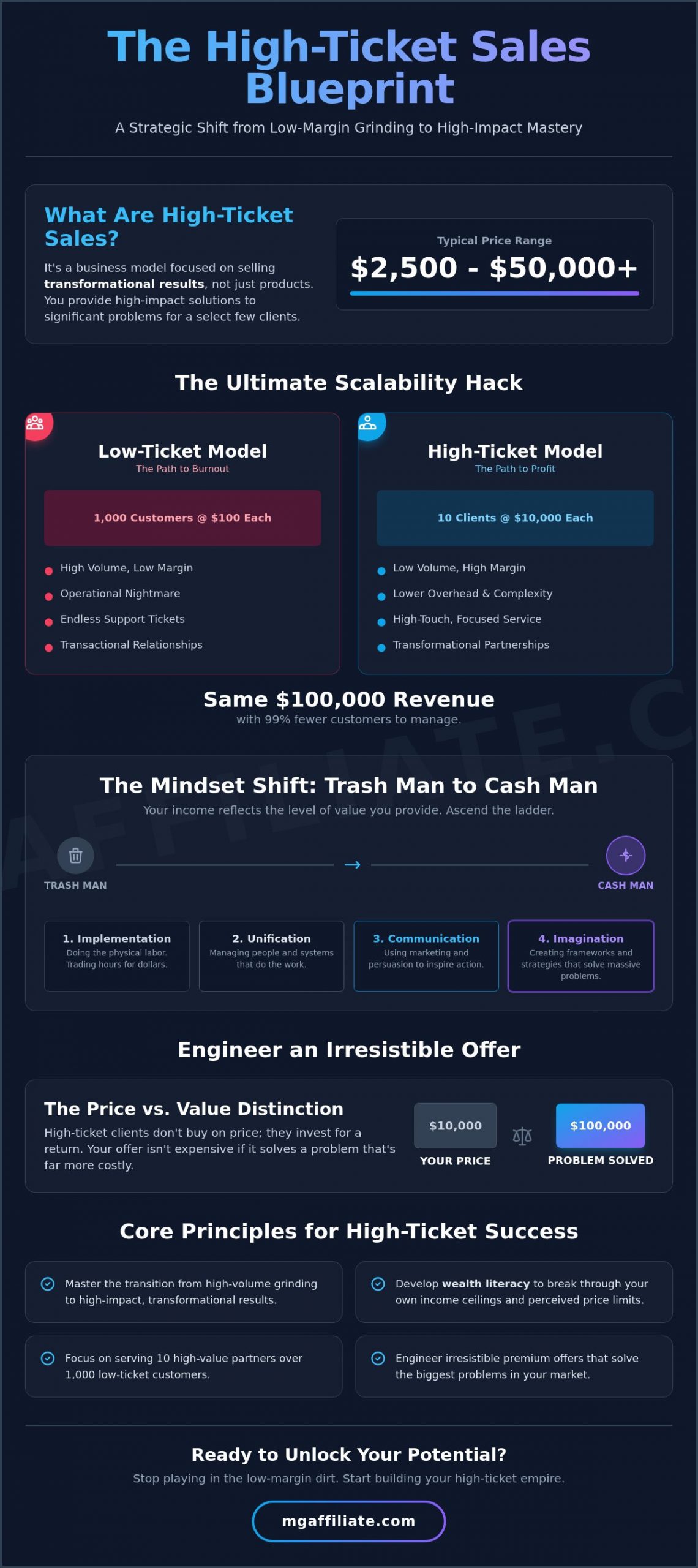
Stop thinking like a retail clerk. If you want to achieve true economic independence, you have to stop chasing pennies and start hunting for real margin. So, what’s high ticket sales? At its core, it is the strategic move from selling commodities to selling transformations. While generic marketplaces might label anything over $1,000 as high ticket, true premium models in the 2026 economy typically involve transactions starting at $2,500 and scaling well beyond $50,000. This isn’t just about charging more. It’s a business philosophy built on depth of impact rather than breadth of reach. You aren’t trying to sell to the masses; you’re looking for the few who need a total solution and have the resources to invest in it.
Low-ticket sales are inherently transactional. You sell a product, the customer uses it, and the relationship usually ends at the checkout counter. High-ticket sales are transformational. You aren’t just selling a digital course or a piece of software; you’re selling a bridge from where your client is to where they desperately want to be. This model is the lifeblood of elite coaching, high-level consulting, enterprise software, and bespoke luxury services. To succeed here, you must master a more sophisticated sales process that prioritizes relationship building and deep diagnostic discovery over generic high-pressure tactics. What’s high ticket sales if not the ultimate test of your ability to lead a prospect toward their own success?
The Price vs. Value Distinction
Price is what a customer pays, but value is what they actually receive. Most entrepreneurs fail because they focus on the sticker price, yet high-ticket buyers only focus on the return on investment. If you can solve a $100,000 problem, a $10,000 fee isn’t expensive; it’s a massive bargain. High-ticket offers solve “Big Problems” that keep people awake at night. High-ticket sales is the exchange of high-level solutions for high-level compensation.
Why High Ticket is the Ultimate Scalability Hack
Stop doing the “math of the poor.” Chasing 1,000 customers to make $100,000 is an operational nightmare that leads straight to burnout. Think about the overhead, the endless support tickets, and the constant refund requests. Now, compare that to closing just 10 sales at $10,000 each. You reach the same revenue goal with 1% of the customer volume. This allows you to lower your overhead while significantly increasing your profit margins. More importantly, it gives you the capacity to focus on client success through higher-touch service. When you have fewer clients who pay you what you’re worth, you can actually afford to ensure they get the results you promised.
The High-Ticket Mindset: Shifting from Trash Man to Cash Man
You’re hitting a ceiling because you’re projecting your own financial limitations onto your clients. Stop it. If you believe $10,000 is “a lot of money,” you’ll never be able to sell a $50,000 solution with a straight face. Mastering what’s high ticket sales requires a total internal overhaul. You need to develop wealth literacy. This is the core philosophy found in the From Trash Man to Cash Man Book. It’s the transition from being a “trash man” who works for scraps to a “cash man” who commands premium fees by solving premium problems. Your income is not a reflection of your hard work; it’s a reflection of the level of value you bring to the marketplace.
To scale, you must understand the Four Levels of Value:
- Implementation: You do the physical labor. This is where most people stay stuck, trading hours for the lowest possible pay.
- Unification: You manage the people and systems doing the work. You’ve moved from the “doing” to the “managing.”
- Communication: You use your voice, marketing, and persuasion to move people to action. This is where high-ticket sales truly begins.
- Imagination: You create the proprietary frameworks and high-level strategies that solve massive problems. This is the highest level of compensation.
Overcoming the ‘Imposter’ in Premium Sales
Why would someone pay you that much? If you’re asking this, you’re still trapped in a poverty-based narrative. You’re thinking about “selling” when you should be “offering.” Stop trying to convince people to give you money. Instead, act like a specialist. High-ticket sales is a diagnostic consultation. A surgeon doesn’t “sell” you on a life-saving procedure; they diagnose the issue and offer the solution. When you shift your perspective to being the person with the “key” to their success, the price becomes secondary to the result. If you’re ready to stop playing small, start making BOSS Moves in your business today.
Selling Transformation, Not Features
High-ticket clients don’t buy your time. They actually want as little of your time as possible. They are buying outcomes. They are buying speed, certainty, and ease. While the low-ticket “trash man” mindset focuses on listing boring features and deliverables, the “cash man” focuses on the Imagination level of value. Paint a vivid picture of their future state. Show them the world where their current pain is gone and their goals are realized. When the value of that future transformation far outweighs the investment, the sale is already made. You aren’t selling a service; you’re selling a bridge to a better life.
High-Ticket vs. Low-Ticket Sales: A Strategic Comparison
Is it actually easier to sell a $50 ebook than a $5,000 transformation? Most people think so, but they’re usually the ones struggling to pay their bills. In 2026, the digital marketplace is louder and more expensive than ever. If you’re playing the low-ticket game, you’re competing for pennies while your advertising costs eat your entire margin. When you truly grasp what’s high ticket sales, you realize it’s the only model that allows for a healthy customer acquisition cost (CAC). You can afford to spend $1,000 to acquire a client when that client is worth $10,000. If you’re selling a $100 product, you’re out of business before you even start.
Think about the operational burden. Managing 1,000 low-ticket buyers means 1,000 potential customer support tickets, 1,000 refund requests, and 1,000 people who might not even open your product. Compare that to 10 high-ticket partners. These individuals have “skin in the game.” Because they’ve made a significant investment, they’re more committed to the work and more likely to get the result. High-ticket models are also far more resilient during economic shifts. While the middle-market disappears during a crunch, the premium market continues to invest in solutions that provide speed and certainty.
Marketing Complexity: Volume vs. Precision
Low-ticket success requires massive traffic and incredibly complex automated funnels just to break even. You need to be a master of the algorithm. High-ticket success requires authority and relationship building. You don’t need a million followers; you need the right fifty people to see you as the expert who can solve their specific problem. To master these scaling strategies, you should study the frameworks in BOSS Moves by Myron Golden. Precision beats volume every single time.
The ROI of Your Time
Your time is the only non-renewable resource you have. Why would you spend forty hours a week chasing 200 people for a $50 sale? That is the fast track to entrepreneurial burnout. When you close one $25,000 deal, your “hourly equivalent” skyrockets. This isn’t just about greed; it’s about freedom. Working with fewer, more committed clients allows you to actually deliver the high-touch service they deserve. You get your life back, and they get a better result. That’s the ultimate win-win of the premium model.
How to Create an Irresistible High-Ticket Offer
Most entrepreneurs fail at premium pricing because they try to sell “more stuff” instead of “better results.” They stack bonuses like they’re clearing out a bargain bin. This is the opposite of what’s high ticket sales. High-ticket buyers aren’t looking for more work; they’re looking for the shortest path to a specific, high-value outcome. To command a premium fee, you must identify a “Big Problem” that your market is already bleeding from. If you solve a minor inconvenience, you get paid minor fees. If you solve a catastrophic bottleneck, you get paid a fortune. Are you solving a $100 problem or a $100,000 problem? Your answer determines your bank account balance.
Structuring your offer around a proprietary framework is the key to removing yourself from the commodity trap. When you use a system like the Make More Offers Challenge, you aren’t just another service provider. You’re the owner of a specific methodology that guarantees a result. You must also remove the buyer’s risk. Premium clients are often more afraid of wasting time than losing money. Use outcome-based milestones or specific, high-value guarantees to lower their guard. Your goal is to make the offer so aligned with their needs that saying “no” feels like a personal disservice to their own goals.
The Core Offer Components
Every irresistible offer needs three pillars. First, a singular Main Result. Don’t promise ten things; promise one massive transformation. Second, a Delivery Mechanism that prioritizes speed and ease. How can you get them the result with the least amount of friction? Finally, you need Scarcity and Urgency. High-ticket sales require a reason to act now. Whether it’s limited capacity in your network or a specific deadline for a project, give them a logical reason why waiting is the most expensive mistake they can make.
Positioning Yourself as the Authority
High-ticket buyers pay for “who” you are as much as “what” you do. They are looking for a leader, not a vendor. You build this authority through a “Value-First” content ecosystem that demonstrates your expertise before the sales call even begins. Use social proof and success stories to show that your proprietary framework actually works. When you have a history of moving people from the “trash man” struggle to the “cash man” reality, the close becomes a formality. Ready to stop guessing and start scaling? Join the Make More Offers Challenge and master the art of the premium offer today.
Mastering the High-Ticket Close: Your Path to Profit
Closing a premium deal isn’t about using sneaky psychological triggers or memorizing a manipulative script. It’s about leadership. When you ask what’s high ticket sales in a closing context, it’s the art of the consultative close. This means you aren’t a salesperson; you’re a gatekeeper. You only offer your solution if you are 100% certain it will solve the client’s problem. If there isn’t a fit, you don’t make the offer. This level of integrity builds massive trust and separates the “cash man” from the desperate “trash man” who will take anyone’s money just to pay the rent.
The secret to a successful close lies in identifying “The Gap.” This is the distance between where your prospect is currently suffering and where they want to be. Your job is to lead them through a diagnostic discovery that makes the pain of staying the same greater than the pain of the investment. Once the gap is clear, stop talking. Silence is one of the most powerful tools in high-level negotiations. Most people talk themselves out of a sale because they’re uncomfortable with the quiet. Let the prospect process the value of the transformation. Active listening allows you to hear what they aren’t saying, which is where the real decision happens.
Mastering this process requires a dedicated environment where you can fail safely and improve quickly. The Make More Offers Challenge serves as the ultimate laboratory for mastering these high-stakes skills. You’ll learn to navigate complex human emotions and financial logic without losing your authority. It’s where you stop guessing and start knowing exactly how to lead a prospect to the “yes” they need to change their life.
Handling High-Level Objections
You will hear objections, but you must distinguish between a stall and a real obstacle. When someone says “I need to think about it,” they’re usually just afraid of making a decision. When they say “I don’t have the money,” they’re actually saying they don’t see the value yet. Return to the value of the result. Remind them of the cost of inaction. If you truly believe your proprietary framework can change their life, you have a moral obligation to sell it to them. Closing with conviction is the highest form of service.
Taking the Next Step in 2026
Theory isn’t enough. You can read every book on wealth literacy, but until you get live coaching and feedback, your “offer muscle” will remain weak. The 5-Day MMOC is designed to push you past your comfort zone and force you to think like a high-performance entrepreneur. You’ll get the real-time feedback necessary to polish your presentation and your mindset. Don’t let another year pass by feeling capped by an hourly rate. Join the Make More Offers Challenge and start crafting your high-ticket win today.
Unlock Your Premium Potential Today
The journey from a “trash man” to a “cash man” isn’t just about changing your prices; it’s about changing your person. You’ve discovered how to identify high-value problems and structure offers that make you the only logical choice for your ideal clients. By applying the Four Levels of Value, you can finally move away from the exhaustion of implementation and start commanding the compensation your imagination deserves. Now that you understand what’s high ticket sales, the only thing standing between you and your next level is the decision to take action.
Don’t settle for theory when you can leverage the same proven frameworks that have transformed thousands of businesses. Inspired by Myron Golden’s 30+ years of business mastery, these strategies are designed to help you build an offer muscle that never fails. It’s time to stop grinding for low margins and start building true wealth through premium results. Success is a latent potential you already possess, and it’s time to use the right key to access it. Ready to scale? Join the Make More Offers Challenge now!
Your professional evolution is waiting. Step into your authority, lead with conviction, and claim the autonomy you’ve been working for. You have the tools; now go build your empire.
Frequently Asked Questions
What is considered a high-ticket price point in 2026?
In the 2026 economy, a high-ticket price point typically starts at $2,500 and can easily scale to $50,000 or more for specialized transformations. While some industries label $1,000 items as premium, true high-ticket mastery focuses on solving “Big Problems” that justify a significant investment. This pricing reflects the deep value, speed, and certainty you provide to a client who is ready to move from their current pain to a desired future state.
Do I need a large following to start selling high-ticket offers?
No, you do not need a massive audience to succeed in this model. High-ticket sales is a game of precision rather than volume. You only need a small group of highly qualified leads who recognize your authority and need your specific solution. It’s far more efficient to find ten partners ready to invest $10,000 than it is to chase 10,000 people to buy a $10 commodity. Focus on authority positioning over vanity metrics.
What is the difference between high-ticket sales and high-ticket digital marketing?
High-ticket sales is the consultative process of leading a prospect to a decision, while high-ticket digital marketing is the strategy used to attract and nurture those prospects. Marketing builds the bridge by establishing your authority and demonstrating value before the conversation even begins. The sales process is where the actual diagnostic consultation happens and the commitment is made. Both are essential pillars of a successful premium business model.
Is high-ticket sales a legitimate career or just a trend?
High-ticket sales is a highly legitimate and long-standing professional career path that has become even more vital in 2026. As automation replaces low-level transactional tasks, the marketplace increasingly rewards individuals who can lead complex negotiations and provide high-level strategy. This isn’t a temporary trend; it’s the evolution of value exchange. High-performance closers and consultants are the architects of the modern wealth economy and remain in high demand.
How do I find high-ticket clients without spending a fortune on ads?
You find premium clients by building a “Value-First” content ecosystem that proves your expertise. Use social proof, success stories, and proprietary frameworks to attract the right people organically. When you position yourself as the specialist who holds the “key” to a specific transformation, high-value clients will seek you out. This authority-based approach reduces your reliance on expensive advertising and creates a more sustainable, high-margin lead flow for your business.
What are the best high-ticket sales examples for beginners?
Excellent examples for those just starting include high-level business coaching, specialized consulting, and premium service packages like fractional leadership. These models allow you to leverage your existing professional competency to solve a major bottleneck for a client. When people ask what’s high ticket sales for a newcomer, it usually involves any service where the client’s return on investment is significantly higher than your fee. Focus on outcomes rather than hours.
Can I sell high-ticket products if I’m an introvert?
Yes, introverts often become the most successful high-ticket closers because they are natural listeners. Premium sales require deep diagnostic discovery and active listening rather than high-pressure talking. By asking the right questions and being comfortable with silence, introverts build the deep rapport and trust necessary for high-value transactions. You don’t need to be the loudest person in the room; you just need to be the most authoritative and helpful.
What is the #1 mistake people make when trying to close high-ticket deals?
The biggest mistake is talking too much and failing to identify “The Gap.” Many entrepreneurs try to “sell” features instead of diagnosing the prospect’s pain and offering a clear transformation. When you stop trying to convince and start trying to help, the sales process becomes much smoother. Understanding what’s high ticket sales means realizing that the person who asks the best questions and listens the most intently is the one who leads the client to a “yes.”
Leave a Reply