

Scarcity isn’t about tricking your customers into a panic. It’s about respecting their time by telling them the truth. Have you ever felt like a fraud for using a countdown timer? You aren’t alone. Many high-performance entrepreneurs worry that pressure tactics will damage their brand reputation, especially with the FTC intensifying its focus on “dark patterns” and issuing massive judgments, such as the $795.8 million penalty in May 2026. You want to close the sale, but you don’t want to lose your soul in the process.
We agree that the “wait and see” attitude from potential clients is the silent killer of professional growth. This guide will show you exactly how to use scarcity in marketing ethically to skyrocket your conversions while building deeper trust. You’ll master the psychological triggers that drive action without resorting to fake deadlines or deceptive claims. We’re going to dive into a clear framework for integrity-driven sales that aligns with your personal values and protects your business in this new era of regulatory scrutiny. It’s time to turn your marketing into a catalyst for life-changing results.
Key Takeaways
- Discover why “unlimited” offers often lead to zero action and how to resolve the Scarcity Paradox to drive immediate results for your business.
- Learn how to use scarcity in marketing ethically by adopting a “Marketing Stewardship” mindset that prioritizes honest communication over high-pressure tactics.
- Master the psychology of loss aversion to help your customers understand the true cost of waiting for your solution.
- Implement a five-step strategic audit to define your real capacity and identify the perfect incentive window for every offer.
- Build deeper trust with premium clients by setting firm boundaries that reflect the true exclusivity of your high-ticket services.
The Scarcity Paradox: Why High-Impact Marketing Requires Limits
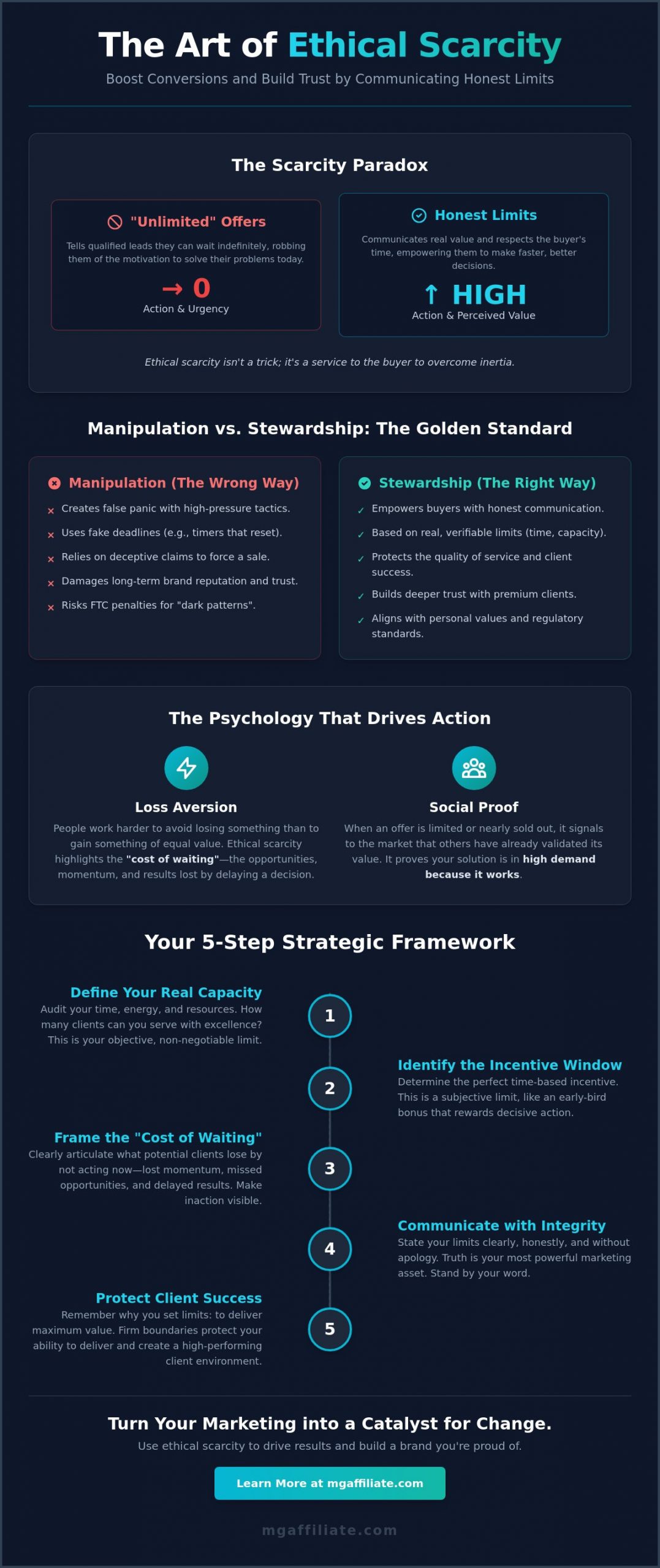
Everything valuable in this world is limited. Time, attention, and high-level expertise are finite resources. Ethical scarcity is the honest communication of these real limits to help your customers make faster, better decisions. It’s not a trick. It’s a service to the buyer. When you understand how to use scarcity in marketing ethically, you stop viewing limits as a burden and start seeing them as a tool for empowerment. You’re helping your audience overcome the inertia that keeps them stuck in mediocrity.
When you offer something as “unlimited” or “always available,” you’re inadvertently telling your qualified leads that they can wait. Guess what? They do wait. Usually forever. Unlimited availability leads to zero action. By failing to set boundaries, you rob your audience of the motivation they need to solve their problems today. Do you want to be a resource that people “get around to,” or do you want to be the catalyst for their breakthrough? The choice is yours.
High-impact marketing requires you to respect the psychological principles of scarcity. People perceive scarce items as more valuable because exclusivity often signals quality and commitment. This is the fundamental difference between manufactured panic and intentional boundaries. One is a lie designed to pressure; the other is a truth designed to protect the results you deliver. Professional growth demands that you choose the latter and stand by your word.
The Psychology of the ‘Cost of Waiting’
Delay destroys momentum. In the world of entrepreneurial growth, a week of hesitation can cost thousands in lost opportunity. You have an ethical duty to move your customers toward a firm decision. A “no” is often better than a “maybe” because it provides instant clarity for both the seller and the buyer. Learning how to use scarcity in marketing ethically means highlighting the heavy cost of staying exactly where they are. If they don’t act now, what will their business look like in six months? Probably exactly the same. Your job is to make that reality visible.
Scarcity as a Tool for Client Success
Limiting your numbers isn’t just about sales; it’s about delivery. You can’t give your best to everyone at once. By capping attendance or access, you ensure you can provide maximum value to those who actually show up. This exclusivity also creates a higher-performing peer environment. It’s why we protect the integrity of the Make More Offers Challenge. We only want committed individuals who are ready to execute. When everyone in the room has “skin in the game,” the results for every participant skyrocket. Boundaries don’t just protect your time; they protect your clients’ success.
The Psychology of Ethical Scarcity: Fixed Supply vs. False Limits
Why do humans work harder to keep a dollar they already have than they do to earn a new one? This is the power of loss aversion. It’s a fundamental psychological trigger that dictates how we value resources. When you understand how to use scarcity in marketing ethically, you tap into this innate human drive. You aren’t creating fear. You’re simply highlighting the reality that an opportunity is moving away. Scarcity also acts as a powerful form of social proof. If an offer is nearly sold out, it signals to the market that others have already validated the value. It proves that your solution is in high demand because it works.
Research into the Effect of Resource Scarcity shows that limiting access can significantly increase the perceived desirability of an offer. However, this only works if the limit is believable. We categorize ethical scarcity into two buckets: objective and subjective. Objective scarcity involves real, physical limits. Subjective scarcity involves strategic rewards for early adopters. Both are essential for driving action without compromising your brand’s soul. If you want to master these psychological nuances, studying the frameworks in BOSS Moves by Myron Golden is a logical next step for any serious entrepreneur.
Why Truth is Your Best Marketing Asset
Nothing kills a brand faster than a “limited time” timer that resets every time a user refreshes the page. This is deceptive, and in 2026, consumers are faster than ever at spotting these “dark patterns.” When you lie about availability, you lose the trust of your most valuable leads. State your limits authoritatively and stick to them. Objective Scarcity is the honest inventory of your time and resources. If you only have ten spots for a VIP experience, say there are ten. When they’re gone, they’re gone. This level of integrity builds a reputation that outlasts any single sales campaign.
Rewarding Speed Over Shaming Delay
Ethical marketing shifts the focus from shaming those who wait to rewarding those who lead. Instead of focusing solely on “what you lose,” emphasize the “bonus you earn” by taking decisive action. Fast-Action Bonuses are a brilliant way to implement this. You aren’t punishing the person who buys on day five; you’re simply providing extra value to the person who had the vision to buy on day one. This approach mirrors high-performance business optimization. It encourages the type of quick decision-making that is required for high-level success. When you understand how to use scarcity in marketing ethically, you realize that rewarding speed is actually a form of client vetting. You’re attracting the action-takers who are most likely to get results.
Manipulation vs. Stewardship: Adopting the ‘Golden’ Standard
Is your marketing designed to trick people or to serve them? This is the core question that separates a manipulator from a steward. Marketing Stewardship is the practice of managing your offer so it only reaches those who are ready to execute and achieve results. When you learn how to use scarcity in marketing ethically, you stop trying to convince everyone and start protecting the quality of your program. You’re a guardian of the transformation you provide. Your goal is to ensure your resources go to the people who will actually use them to change their lives.
Adopt the ‘Truth-in-Packaging’ rule. It’s simple. If you tell your audience there are only 10 spots left, there must be exactly 10 spots left. Breaking this rule is the fastest way to dissolve your authority. Some might ask: isn’t all scarcity just a trick to get my money? No. It’s an alignment of resources. High-level research on scarcity and ethical behavior suggests that when limits are genuine, they actually help consumers prioritize their needs. For “Stage Four” business owners who value their time above all else, clear boundaries are a sign of professional competency. They want to know they’re entering an environment that isn’t open to just anyone.
The Ethics of the Countdown
When should you use a timer? Use them for events, launches, or live challenges where a start date is a physical reality. Never use them for digital products that are always available. You must communicate the “Why” behind every deadline. For example, the Make More Offers Challenge – VIP Experience is strictly limited. Why? Because the coaching quality would suffer if the room was too crowded. By explaining the logic behind the limit, you turn a sales hurdle into a commitment to excellence. You’re showing the prospect that their future results are more important than a few extra sales today.
Handling the ‘Post-Deadline’ Request
What do you do when a buyer asks to join after the doors have closed? You say no. This is the ultimate test of your integrity. It might feel like you’re leaving money on the table; however, you’re actually investing in your future reputation. Holding your boundaries builds massive trust for your next launch. People will know that when you set a deadline, you mean it. Instead of caving, turn that missed opportunity into a waitlist. It keeps the momentum alive and ensures that those who missed out are the first in line for the next cycle of value. This is how to use scarcity in marketing ethically while maintaining total control over your brand’s narrative.
How to Implement Ethical Scarcity in 5 Strategic Steps
Theory is useless without execution. You now understand the psychology; now, you must build the system. Learning how to use scarcity in marketing ethically requires a disciplined approach to your business operations. It isn’t about making things up as you go. It’s about looking at your data and telling the truth. Follow these five steps to implement an integrity-driven sales engine that commands respect and drives revenue.
- Step 1: Audit your real capacity. How much of you is actually available? Look at your time, your team’s bandwidth, and your technology’s limits.
- Step 2: Define your ‘Incentive Window.’ When is the absolute best time for your customer to buy? Identify the period where they get the most value and reward them for meeting that window.
- Step 3: Communicate the ‘Why’ with total transparency. Don’t just set a deadline. Explain it. If a bonus expires, explain that it’s to keep the cohort size manageable.
- Step 4: Use ‘Visual Scarcity.’ Progress bars and seat counts should update in real-time. This provides objective proof that the opportunity is moving away.
- Step 5: Honor the limit. This is the hardest part. No exceptions. If you let one person in late, you’ve just told your entire market that your word is negotiable.
Defining Your Real Capacity
How many clients can you actually serve at a high level? If you take on one too many, the experience for everyone else drops. This is why we use availability within The B.E.S.T. Wealth Network as a natural scarcity anchor. We know exactly how many entrepreneurs we can mentor effectively. To calculate your ‘Opportunity Scarcity,’ divide your monthly revenue goal by your maximum client capacity to find the high-ticket value of every single open spot. When you see the dollar amount attached to an empty seat, you’ll stop treating your availability as a suggestion and start treating it as a valuable asset.
The Transparent ‘Close’ Script
How do you announce a deadline without sounding like a used car salesman? You focus on the work. Your close script should sound helpful. Try saying something like this: “We are closing the doors tonight because we start the actual work on Monday, and I need to be 100% focused on the people inside the program.” This shifts the focus from the transaction to the transformation. It shows that you value the results of your clients more than the last-minute sales of the procrastinators. This is exactly how to use scarcity in marketing ethically to build a high-performance culture before the first session even begins.
Mastering the Art of the Irresistible (and Limited) Offer
High-ticket offers and extreme scarcity are two sides of the same coin. Why? Because premium clients don’t just buy a solution; they buy access, speed, and a curated environment. If your offer is available to anyone with a credit card at any time, you aren’t selling a high-ticket transformation. You’re selling a commodity. Learning how to use scarcity in marketing ethically allows you to flip this script. You stop chasing volume and start focusing on value. This is the foundation of a “Low Volume, High Value” business model that protects your time while maximizing your impact.
Premium clients actually expect and respect boundaries. They understand that your time is a finite resource. If you claim to offer high-level mentorship but have no limits on enrollment, you’ve just signaled that your time isn’t actually that valuable. True success is about positioning your offer as the “key” to a latent potential the user already possesses. They have the engine; you have the fuel and the map. By limiting access, you ensure that only those who are truly ready to ignite that potential get in the room. This isn’t a sales tactic. It’s a quality control measure for your brand’s soul.
The MMOC Framework for Irresistible Offers
The Make More Offers Challenge is designed to teach you how to bake these principles directly into your offer design. We move you away from the “hard sell” and toward “inviting” qualified leads into a limited-time transformation. The structure of the challenge itself is a masterclass in this approach. By offering a Make More Offers Challenge – General Admission alongside a Make More Offers Challenge – VIP Experience, we use tiered scarcity to segment the audience. The VIP tier is strictly limited to ensure those seeking the highest level of proximity get the attention they require. This is the perfect example of how to use scarcity in marketing ethically to serve different needs without compromising the experience for anyone.
Your Next Move: Scaling with Integrity
Stop apologizing for your success and your boundaries. Ethical scarcity is the bridge between where your client is and where they want to be. It provides the friction necessary to spark action. Are you ready to stop losing sales to the “wait and see” crowd? It’s time to master these frameworks and build a business that aligns with your highest values. Your next move is to take what you’ve learned here and apply it with total confidence. Join us at the next challenge to refine your offer and start scaling with integrity. The door to your next level of professional evolution is open, but it won’t stay that way forever. Will you step through?
Secure Your Legacy with Integrity-Driven Sales
Are you ready to stop apologizing for your success and start commanding the respect your expertise deserves? You’ve learned that true scarcity isn’t a gimmick; it’s a commitment to excellence. By transitioning from manipulation to stewardship, you protect your brand’s soul and ensure your high-ticket offers only go to those ready to execute. Mastering how to use scarcity in marketing ethically is the final key to unlocking a business model that thrives on high value rather than high volume.
Success isn’t an accident. It’s the result of applying proven strategies like our proprietary ‘Stage Four’ business scaling methodology. Myron Golden’s frameworks have already empowered over 100,000 entrepreneurs to shift from a ‘Trash Man’ to a ‘Cash Man’ mindset. It’s time to stop letting potential clients sit on the fence. Start inviting them into a transformation that actually delivers. Ready to craft your own high-ticket, high-integrity offer? Join the next Make More Offers Challenge today!
The path to autonomy and economic independence is right in front of you. Take the lead, set your boundaries, and watch your conversions skyrocket. Your future self is waiting for you to make this move.
Answers for Integrity-Driven Entrepreneurs
Is scarcity marketing illegal or against consumer protection laws?
Scarcity marketing is legal as long as your claims are truthful and substantiated. The FTC uses a principles-based approach and a “reasonable consumer” standard to judge if a claim is deceptive. If you lie about inventory or deadlines, you risk legal action and massive fines like the judgments seen in early 2026. Honesty is your best defense against regulatory scrutiny. Never manufacture a limit that doesn’t exist.
What is the difference between urgency and scarcity in digital marketing?
Urgency is a time-based trigger; scarcity is a quantity-based trigger. Urgency says “the doors close at midnight.” Scarcity says “there are only three seats left.” Both work together to help potential clients overcome the inertia that keeps them stuck in financial limitations. Using both correctly forces a decision and prevents the “wait and see” attitude that kills business growth.
Can I use scarcity if I sell a digital product with ‘unlimited’ stock?
Digital products don’t have physical inventory, but they can have “incentive scarcity.” You can limit the number of people who receive a specific bonus or a discounted price tier. This is how to use scarcity in marketing ethically for digital assets. It rewards the action-takers who provide the most momentum for your community without requiring a physical stock count.
How do I use a countdown timer without looking like a sleazy marketer?
Use timers only when the deadline is real. If you’re running a live launch or an event like the Make More Offers Challenge, a timer is a helpful tool for the user. It becomes “sleazy” only when the timer is a lie. If the clock resets on every refresh, you’re destroying your authority and your brand’s soul. When the clock hits zero, the offer must actually end.
What should I do if I don’t sell out by my deadline?
You stick to your word and close the offer anyway. Leaving the doors open after a deadline is the fastest way to tell your market that you are a fraud. Take the data from the launch, analyze your offer, and prepare for the next cycle. Your reputation for integrity is worth more than a few late-buyer dollars. Use the missed deadline to build a waitlist for your next evolution.
How can I use scarcity for a service-based business with a small team?
Service providers have the most natural scarcity of all: time. Audit your team’s bandwidth and calculate exactly how many clients you can serve at a high level. Use this “objective scarcity” as your anchor. When you’re full, you’re full. State your real capacity clearly. This signals to the market that your services are in high demand and your time is a premium asset.
Does scarcity work for high-ticket sales as well as low-ticket products?
It is actually more effective for high-ticket sales. Premium clients don’t want a commodity; they want exclusivity. They respect boundaries and limited access because it signals that the mentor or partner they are hiring is a high-performance professional. Scarcity is the “key” that validates the premium value of the offer and ensures a high-performing peer environment.
How do I explain to my audience why I am limiting an offer?
Frame the limit as a commitment to their success. Tell the truth about your capacity. If you’re limiting a cohort to 50 people, explain that a larger group would dilute the experience and lower the coaching quality. This is how to use scarcity in marketing ethically while positioning yourself as a steward of your clients’ results. It shows you care more about the transformation than the transaction.
Leave a Reply